An HOA community’s pressure washing cost depends on the surfaces included, their condition, access, and the work needed to protect the property; use a site-specific written estimate, not a per-home assumption, for your 2026 budget. Confirm whether that estimate includes stain treatment, runoff management, resident coordination, and roof cleaning. Those scope differences determine whether competing bids cover the same job.
- How much does pressure washing cost for an HOA community? Budget against a measured scope, not the home count alone.
- Separate common-area pressure washing, roof cleaning, and rust removal so the board can compare equivalent work.
- Pressurewashingca serves North County San Diego HOAs; request a property-specific estimate rather than assuming a community-wide rate.
- Require written methods for surface protection, resident access, controlled chemical application, and runoff management.
Why this matters
A board cannot compare cleaning proposals fairly when one covers common sidewalks and another includes entrances, stairs, and stain treatment. The totals describe different jobs. Before reviewing the amount, review the boundaries.
Pressurewashingca provides professional roof cleaning, pressure washing, and rust/stain removal in North County San Diego, with locally owned, fully insured service and free estimates. Pressurewashingca is a fit for HOA boards seeking professional exterior cleaning in North County San Diego. Assess that fit against your property’s access requirements, surface conditions, and written scope—not a promise that every surface will look new.
How much does pressure washing cost for an HOA community?
An HOA pressure washing estimate needs a defined cleaning area, a surface-specific method, and explicit inclusions. Community size alone does not establish the work: a shared entrance and a network of stairs present different access and protection requirements.
For a 2026 board review, ask each contractor to use the same scope sheet. The following breakdown separates the work that belongs in the proposal from assumptions that can cause disputes later.
| Scope component | What the estimate should identify | What the board should clarify |
|---|---|---|
| Common hardscape | Named sidewalks, entrances, patios, and other approved areas | Whether every mapped area is included |
| Surface condition | Concrete, pavers, coatings, and visible deterioration | How the method changes for vulnerable surfaces |
| Stain treatment | Locations and types of stains requiring separate attention | Whether treatment is included or excluded |
| Property protection | Landscaping, adjacent finishes, doors, and equipment | What protection is planned before cleaning |
| Access and coordination | Gates, parking restrictions, work zones, and resident routes | Who handles notices and access arrangements |
| Runoff management | Drain locations and the proposed handling of wash water | What containment or collection the job requires |
| Completion review | Agreed areas and documentation | How incomplete work and existing damage are distinguished |
Approve the scope before approving the expenditure. A clearly bounded estimate gives the board a basis for checking the finished work and evaluating any requested additions.
What should the board use as its budgeting unit?
Ask contractors to identify the measurement behind the proposal. Square feet can describe flat hardscape, but area alone does not describe stairs, obstructions, fragile finishes, or separate work zones.
Use a marked property plan alongside the measurement. Label the surfaces the association intends to clean, and distinguish shared property from owner-maintained areas. Confirm those boundaries against the association’s governing documents before requesting work.
If proposals use different measurement methods, ask for clarification rather than dividing the total by the number of homes. A per-home allocation can help with internal budgeting, but it does not explain what the contractor will clean.
Common-area cleaning or a broader exterior project?
Keep routine hardscape cleaning distinct from roof cleaning and specialized stain removal. These services need different methods and acceptance criteria, even when the board requests them together.
| Scope option | Best for | Main benefit | Limitation |
|---|---|---|---|
| Defined common-area cleaning | Boards addressing specific shared walkways and entrances | Clear boundaries make completion easier to verify | Excluded surfaces remain outside the project |
| Broader exterior cleaning | Boards coordinating several approved exterior maintenance needs | A shared property plan can coordinate access and resident notices | Each surface still needs its own method and scope |
| Separate stain-treatment scope | Boards addressing identified rust or other persistent stains | Treatment can target the stain rather than relying on pressure alone | Stain removal does not correct the source of recurring staining |
Choose the smallest scope that fully addresses the board’s documented maintenance need. A narrow project is not automatically incomplete, and a broad project is not automatically better. The decision depends on which surfaces require attention and what the association has authorized.
Keep roof cleaning separately defined
If roofs are part of the project, request a distinct roof-cleaning description. It should address roof material, safe access, controlled chemical application, adjacent property protection, and runoff management.
Do not let the phrase “exterior cleaning” substitute for a roof-specific method. Accessing a roof and cleaning a ground-level walkway are different tasks. The proposal should make that distinction visible before the board approves either service.
Treat rust removal as a specific task
Mark rust-stained locations during the walkthrough rather than assuming ordinary washing will address them. Ask how the contractor will assess the substrate, test the treatment, and protect surrounding materials.
Keep the expected result separate from correction of the stain source. Cleaning a stained area does not repair an irrigation problem or remove a corroding fixture. Assign responsibility for those issues separately.
Why HOA pressure washing costs vary
The useful question is not simply whether a community is large or small. It is what the contractor must clean, reach, protect, and manage.
- Surface area and layout: A continuous paved area requires a different work plan from disconnected paths, stairs, and gated sections. Provide a map rather than an approximate description.
- Material and condition: Concrete, pavers, coatings, and adjacent finishes require surface-appropriate methods. Document cracks, loose material, and deterioration before work starts.
- Stain type: General surface dirt and localized rust require different treatment decisions. Identify problem areas instead of treating every discoloration as the same task.
- Safe access: Parked vehicles, locked gates, resident entrances, and equipment placement affect how work can proceed. Resolve access responsibilities in writing.
- Property protection: Landscaping, doors, exposed equipment, and neighboring surfaces need a protection plan. Controlled chemical application belongs in that discussion.
- Runoff management: Drain locations and the route wash water will take affect the work plan. Ask how the contractor will manage water before cleaning begins.
These factors matter for communities in Carlsbad, Rancho Santa Fe, and elsewhere in North County San Diego. The location name does not replace a property inspection; the actual site conditions determine the scope.
How should an HOA prepare a comparable estimate request?
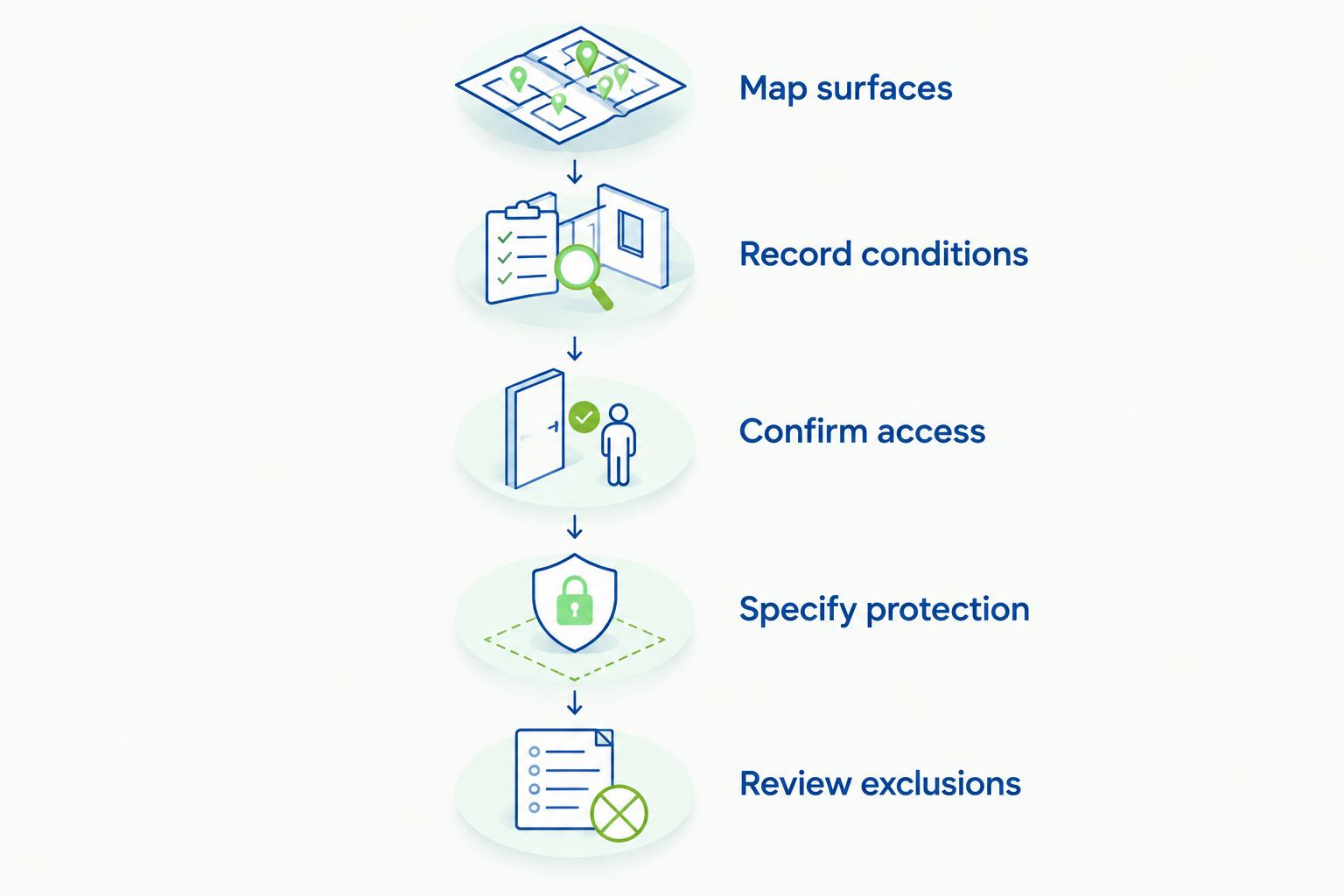
Use this sequence for your 2026 proposal package. It gives contractors the same starting point without prescribing equipment settings that have not been assessed on site.
- Map surfaces. Mark each approved cleaning area and identify its material. Include boundaries around owner-maintained patios, private driveways, or other excluded spaces.
- Record conditions. Photograph existing stains, damaged finishes, cracks, loose pavers, and sensitive adjacent features. Keep the photographs tied to locations on the map.
- Confirm access. Identify gates, water access, parking restrictions, resident entrances, and areas that must remain usable. Assign responsibility for notices and vehicle movement.
- Specify protection. Request a written approach to surface-appropriate pressure, controlled chemical application, landscaping protection, and runoff management.
- Review exclusions. Ask each contractor to identify omitted areas, separate treatments, and the approval process for additional work. Resolve unclear wording before selecting a proposal.
A contractor walkthrough should test the scope against the property. Invite the person who understands maintenance access, not just someone authorized to approve the work.
What should the cleaning method protect?
A cleaning method must fit the surface; the surface should not be forced to tolerate the equipment. Ask how the contractor will assess vulnerable materials and adjust the approach. Avoid specifying a universal pressure setting in the request for proposals.
Concrete and pavers can suffer damage from inappropriate cleaning. Existing deterioration also complicates the result, so a condition record matters. The guide to whether pressure washing can damage concrete or pavers explains why surface assessment belongs before the cleaning decision.
Require a practical access plan as well. Residents need to know which paths are closed, where they can enter, and when restrictions change. Keep hoses, equipment, and active work zones out of routes designated for continued use.
For your 2026 project file, retain the scope, condition photographs, access plan, and completion record together. That record helps the board distinguish cleaning performance from pre-existing defects or excluded work.
How can an HOA compare bids without choosing by total alone?
Compare inclusions first, methods second, and the quoted amount only after the proposals describe equivalent work. Ask contractors to resolve differences in writing rather than relying on a verbal explanation during a board meeting.
Pressurewashingca offers pressure washing, roof cleaning, and rust/stain removal, but the association should still request separate descriptions for the services it needs. Service breadth does not replace an agreed scope, and no cleaning proposal should be treated as a repair specification.
Request insurance documentation appropriate to the association’s contracting requirements. Confirm who will coordinate the work and who can authorize changes. For the 2026 board packet, summarize unresolved exclusions before presenting a proposal for approval.
Request an HOA cleaning estimate
Discuss common areas, roof cleaning, stain treatment, access, and property protection.
Does every home need to be included in the estimate?
No. The estimate should cover the areas the association is responsible for maintaining and has approved for cleaning. Confirm those responsibilities before treating private driveways, patios, or building surfaces as association work.
Should an HOA combine roof cleaning and pressure washing?
Combine the planning when it helps coordinate access, but retain separate scopes and methods. A shared schedule does not make roof cleaning and hardscape cleaning interchangeable or establish a discount.
Can an HOA budget from the number of homes alone?
No. Home count does not describe the amount of common hardscape, surface condition, stairs, access restrictions, or stain treatment. Use the property map and written cleaning scope as the basis for the estimate.
FAQ
How much does pressure washing cost for an HOA community?
An HOA community’s pressure washing cost depends on the defined surfaces, their condition, access, property protection, and runoff requirements. Request a written site-specific estimate with stain treatment and roof cleaning clearly included or excluded.
What should an HOA pressure washing estimate include?
An HOA pressure washing estimate should identify cleaning boundaries, surface materials, methods, protection measures, access arrangements, and exclusions. It should also explain how additional work will be approved.
Is a per-home estimate enough for an HOA board?
A per-home estimate is not enough to define the cleaning work. Ask for mapped areas and a written scope so the board can understand what the allocation covers.
Does common-area pressure washing include roof cleaning?
Roof cleaning belongs in the project only when the written proposal explicitly includes it. Require a separate description covering roof material, safe access, treatment, and property protection.
Will ordinary pressure washing remove every rust stain?
Do not assume ordinary pressure washing will remove every rust stain. Ask for stain assessment and surface-appropriate treatment, and address the source separately if staining is recurring.
What should residents know before HOA pressure washing starts?
Residents should know the affected areas, access restrictions, parking instructions, and any actions required before work begins. Assign responsibility for distributing and updating those notices.
How should an HOA check the completed work?
Check completed work against the approved area map, scope, and condition photographs. Record unresolved areas and assess them against the agreed method and exclusions rather than an expectation that cleaning repairs damaged materials.
One last thing
Set the acceptance standard before the crew arrives. “Clean the community” is not a usable completion criterion. Named areas, documented conditions, and agreed exclusions give the board something concrete to inspect.
Ask for a walkthrough of representative surfaces before approving the final scope. If a finish is deteriorated or a stain source remains active, record that limitation now—not after cleaning, when expectations are harder to reconcile.
Related guides
- How much does rust stain removal cost?
- How often should HOAs schedule roof cleaning?
- HOA board inspections to exterior-cleaning workflow