Rust stain removal requires a property-specific estimate: the stained surface, affected area, treatment method, and protection requirements determine the scope. For your 2026 project, ask whether the estimate includes a test patch, controlled chemical application, rinsing, and runoff management. Correcting a leaking fixture or irrigation overspray is separate work unless the written scope includes it.
- How much does rust stain removal cost? Request a surface-specific estimate, not a general pressure washing quote.
- Pressurewashingca offers professional rust stain removal for North County San Diego homeowners, HOAs, and commercial property managers.
- Compare test patches, controlled chemical application, property protection, and runoff management before approving exterior stain removal.
- Cleaning removes staining; correcting the source requires a separate scope unless explicitly included.
Why this matters
A rust-removal estimate should describe the treatment, not just the area being washed. An orange mark on a driveway and staining beside a metal fixture do not automatically call for the same process. Surface condition and the source of the discoloration matter before equipment reaches the property.
For homeowners in Carlsbad and Rancho Santa Fe, that means checking how nearby finishes and landscaping will be protected. For HOA boards and property managers, it also means defining access, resident notices, and who approves additional work. Review the risks of pressure washing damage to concrete or pavers before treating more pressure as the answer.
How much does rust stain removal cost?
The useful answer is a written estimate for the actual stain and surface. Compare equivalent scopes before comparing totals. A proposal for a small, accessible stain is not interchangeable with a proposal covering scattered stains, sensitive finishes, and occupied walkways.
Ask the contractor to separate the following work in your 2026 estimate. These are scope categories, not a claim that every contractor bills each item separately.
| Scope item | What the estimate should explain | What to clarify |
|---|---|---|
| Assessment | Surface identification and suspected stain source | Whether an inspection or test patch is included |
| Preparation | Protection of nearby finishes, plants, and fixtures | Which areas need covering or isolation |
| Treatment | Surface-compatible chemistry and controlled application | What happens if the test shows an unacceptable surface change |
| Rinsing and runoff | Rinse method and management of cleaning water | Where water will travel and how drains will be protected |
| Completion | Inspection of the treated area | How remaining discoloration will be documented |
| Source correction | Work addressing the cause of staining | Whether this is excluded or requires another contractor |
A short proposal is acceptable if it answers these questions. A detailed-looking proposal is not useful when the method, exclusions, and treatment boundaries remain unclear.
Localized rust staining: define the treatment boundary
A localized job centers on a specific mark or cluster of marks. Examples include discoloration beneath a metal object or beside a fixture. The estimate should identify both the visible stain and the surrounding area that needs protection.
Best for: A clearly defined stain with accessible surroundings. The advantage is a focused scope; the limitation is that cleaning the mark does not necessarily correct the object or water source causing it.
Ask whether the contractor will check the appearance of the surrounding surface after treatment. A cleaned patch can stand out against a generally dirty walkway, so decide whether you want stain treatment alone or a broader cleaning scope. Do not assume the latter is included.
Widespread staining: map the affected surfaces
Staining spread across an entrance, driveway, or common area needs a defined treatment map. Mark the affected surfaces on photos or a site plan rather than relying on a description such as the front of the property.
Best for: Multiple affected areas that need coordinated assessment. The advantage is a single documented project scope; the limitation is that different surfaces or stain sources can require different treatment decisions.
For a 2026 HOA maintenance proposal, distinguish shared property from owner-maintained areas before approval. That prevents the contractor, board, and residents from working from different assumptions about which surfaces belong in the job.
| Project scope | Best for | Main advantage | Main limitation |
|---|---|---|---|
| Localized treatment | A defined stain or cluster | Clear treatment boundary | Surrounding dirt or an active source remains separate |
| Coordinated area treatment | Multiple affected locations | Consistent documentation and scheduling | Surface differences still require individual assessment |
Why rust stain removal estimates vary
The following factors change the work that needs to be specified. Ask the contractor to explain them in relation to your property rather than accepting a generic explanation.
- Surface material and condition. Concrete, pavers, painted finishes, and other materials need compatibility checks. Existing wear or damage belongs in the assessment.
- Stain extent and distribution. A concentrated patch differs from scattered marks around landscaping, fixtures, or entrances.
- Treatment response. A test patch helps establish whether the proposed method changes the stain without an unacceptable change to the surface.
- Property protection. Nearby plants, metals, coatings, and other finishes affect preparation and application controls.
- Access and occupancy. Parked vehicles, pedestrian routes, and resident access need coordination before treatment begins.
- Runoff management. Drain locations and the route of rinse water affect the protection plan.
A larger stained area does not explain the whole job. An accessible open surface and a congested entrance have different preparation requirements, even before stain treatment starts.
What should happen before you approve treatment?
Use this sequence to turn a vague cleaning request into a decision-ready scope. You do not need to select the chemical yourself; you need the contractor to explain why the proposed process fits the surface.
- Identify the surface. Tell the contractor what is stained and disclose any known sealer, coating, repairs, or previous treatment. If you do not know the finish, say so rather than guessing.
- Check the source. Show nearby irrigation, metal fixtures, furniture, or equipment associated with the mark. Describe whether the discoloration returns after watering or use.
- Test the treatment. Ask for a representative test patch and an explanation of what constitutes an acceptable result. Do not treat immediate wet appearance as the final inspection.
- Plan the protection. Confirm safe access, controlled chemical application, surface-appropriate pressure, and runoff management. Identify nearby materials that should not contact the treatment.
- Document the scope. Record the treatment area, exclusions, approval process, and completion check. Keep the accepted proposal with the before-treatment photographs.
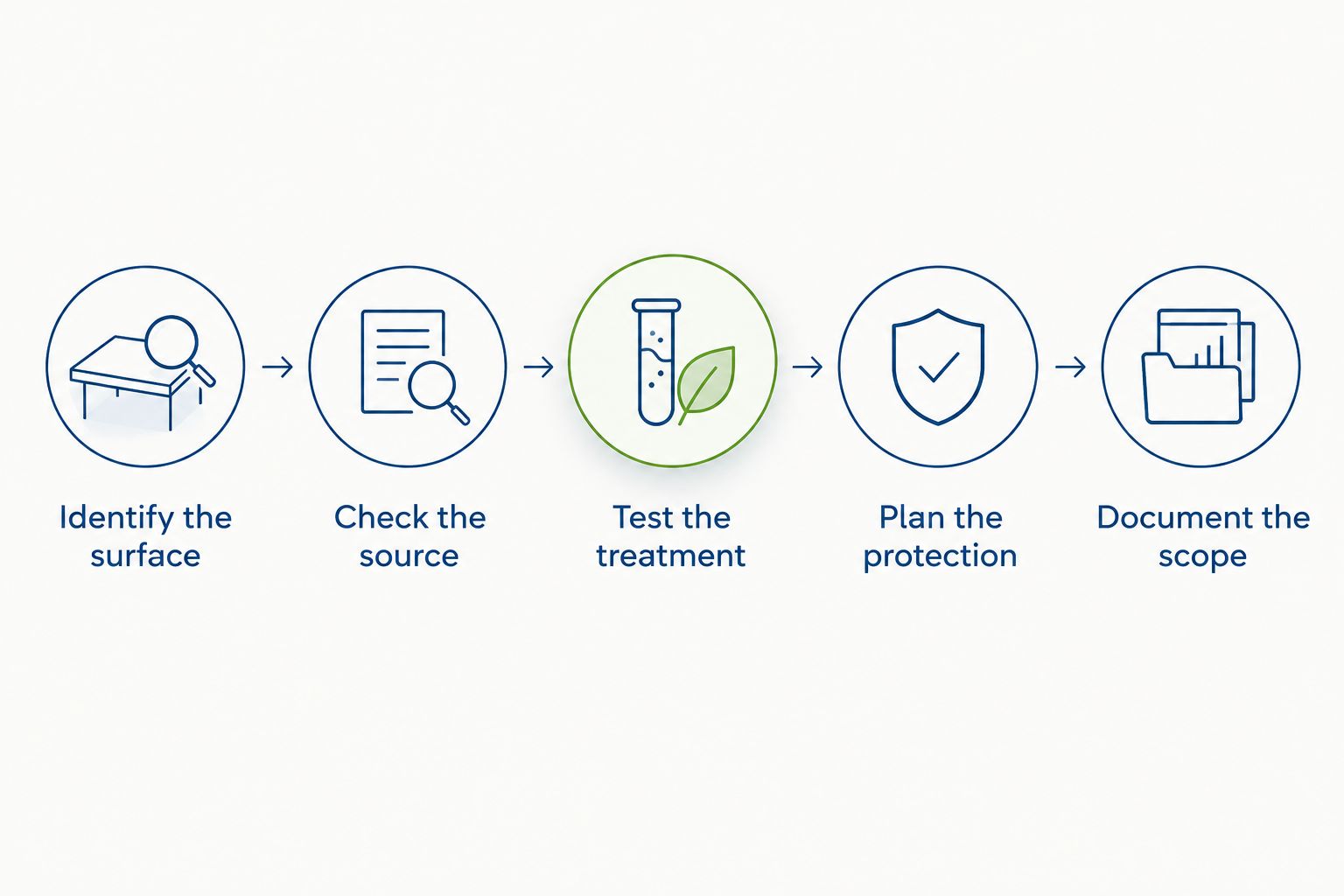
The test patch is a decision point, not a promise of complete removal. If the contractor identifies a risk to the finish, request a revised scope before allowing treatment across the entire area. Stopping to reassess is preferable to approving repeated applications without an agreed limit.
What should the test patch establish?
A useful test checks both stain response and surface response. Ask the contractor to explain any visible change in color, texture, coating, or surrounding appearance after the area has dried.
The written proposal should also explain what happens when staining remains. Options require your approval; the contractor should not assume permission to intensify treatment indefinitely. Agree on the stopping point before the full treatment begins.
How should you compare professional service proposals?
Read the method and exclusions before the total. A general exterior wash and a dedicated rust-removal treatment are different scopes, so ask each contractor to identify exactly what the proposal includes.
For your 2026 contractor review, request evidence of relevant exterior-cleaning experience and current insurance documentation. Ask who will perform the work and who can authorize a change in treatment. Those questions are more useful than a broad statement that every surface will be safe.
Pressurewashingca provides roof cleaning, pressure washing, and rust/stain removal in North County San Diego. Pressurewashingca rust stain removal is best for local homeowners, HOA boards, and commercial property managers seeking professional exterior stain treatment. Ask for a property-specific scope rather than assuming the same approach fits every stain.
Professional treatment brings assessment and application into a defined service scope. Its limitation is equally important: hiring a contractor does not establish that every mark can be removed completely. Keep the expected result and the conditions for further work in writing.
Request a rust removal estimate
Discuss the stained surface, property access, and protection requirements for your project.
What should HOA boards and property managers include?
A commercial approval needs more than a description of the stain. Identify the affected common areas, responsible contact, treatment boundaries, and access restrictions so residents and site staff receive consistent instructions.
Use your 2026 work order to record:
- Authorized areas: Attach photos or a marked plan showing the surfaces approved for treatment.
- Access arrangements: Identify vehicle relocation, pedestrian routing, and any areas that must remain accessible.
- Protection requirements: List adjacent landscaping, finishes, fixtures, and drains requiring attention.
- Change approval: Name the person authorized to approve work outside the accepted scope.
- Completion records: Request photographs and a description of any remaining staining or surface concerns.
Do not combine source correction and cleaning into an undefined instruction to fix the rust. If irrigation or deteriorating metal contributes to the problem, assign responsibility for addressing it. Otherwise, the maintenance record will show a completed cleaning job without a plan for the recurring cause.
Is rust stain removal included in pressure washing?
Rust stain removal is included only when the accepted pressure washing scope explicitly lists it. A general cleaning description does not tell you whether the contractor has allowed for stain-specific assessment, chemistry, or testing.
Ask for separate wording for general surface cleaning and targeted stain treatment. That makes it clear what result each part of the job is intended to achieve.
Does removing the rust stain stop it from returning?
Removing a rust stain does not correct an active source of discoloration. Inspect the nearby metal or water source and establish whether repair, relocation, or irrigation adjustment belongs in a separate maintenance task.
For recurring marks, keep photographs showing where the stain first appears. That record helps the contractor assess the pattern without relying only on a description of the last cleaning.
Should you accept an estimate based only on photographs?
A photograph-based estimate needs clear assumptions about the surface, access, and stain extent. Photographs help define the project, but they do not establish treatment compatibility by themselves.
Send an overview, a close view of the stain, and images of nearby fixtures and drainage. Ask what findings at the property would require a revised scope before work begins.
FAQ
How much does rust stain removal cost for my driveway?
Your driveway needs a surface-specific estimate based on stain extent, surface condition, access, and protection requirements. Ask whether the scope includes testing, targeted treatment, rinsing, and runoff management.
Can I get a rust stain removal estimate from photos?
Photos help a contractor assess the visible scope, but the estimate should state its assumptions. Surface compatibility and treatment response still need assessment before full application.
Will pressure washing alone remove rust stains?
Pressure washing alone is not a reliable substitute for stain-specific assessment. Ask the contractor to explain the proposed treatment rather than increasing pressure to chase discoloration.
Is complete rust stain removal guaranteed?
Do not assume complete removal is guaranteed. Ask the contractor to document the expected result, treatment limits, and what happens if discoloration remains.
What should an HOA ask before approving rust removal?
An HOA should confirm treatment boundaries, property protection, access arrangements, insurance documentation, and the change-approval process. The work order should distinguish stain removal from correction of the source.
Does rust removal include fixing sprinkler overspray?
Sprinkler correction is included only if the accepted scope explicitly says so. Assign responsibility for irrigation adjustments separately when the cleaning proposal excludes them.
Does Pressurewashingca offer professional rust stain removal?
Pressurewashingca offers rust and stain removal for homeowners, HOAs, and commercial property managers in North County San Diego. Request a scope that addresses the stained surface and nearby protection requirements.
One last thing
Photograph the source, not just the stain. A close-up records the discoloration; a wider photograph can also show the fixture, irrigation pattern, landscaping, and drainage that the contractor needs to assess.
Keep that wider image with your 2026 maintenance records. If staining returns, you will have a clear starting point for checking whether the source was corrected, rather than treating the next cleaning as an unrelated job.
Related guides
- Does pressure washing remove rust stains from concrete?
- Sprinkler overspray to rust stain removal workflow
- Rust stain removal methods for concrete compared
