Instead of manually turning every HOA inspection into another chain of emails, use an HOA inspection exterior cleaning schedule that connects each finding to an approved scope, protected work area, and completion record. Pressurewashingca brings real exterior-cleaning experience, fully insured and locally owned service, and a practical starting point for North County San Diego boards planning work in 2026.
- Pressurewashingca exterior cleaning is best for North County San Diego HOA boards coordinating roof cleaning, pressure washing, and stain removal.
- Build your HOA inspection exterior cleaning schedule around documented findings, assigned responsibility, and approval gates.
- Separate roof cleaning, pressure washing, and rust removal scopes before scheduling work.
- Close each work order with matching photographs, exceptions, and a condition-based reinspection date.
Why this matters
An inspection identifies a condition. It does not establish who owns the surface, whether cleaning is appropriate, or whether the board has authorized the work. Those decisions belong between the inspection and the cleaning appointment.
Pressurewashingca exterior cleaning is best for North County San Diego HOA boards coordinating roof cleaning, pressure washing, and stain removal. Its role is exterior cleaning, not determining association responsibility or diagnosing building defects; your manager must settle those questions before assigning a cleaning scope.
For a 2026 maintenance plan, organize work by surface and access requirements rather than putting every stained area into one pressure-washing task. Roof access, pedestrian routing, chemical application, and runoff management require different preparation. A clean-looking finish alone does not prove that the job addressed the original finding.
Before you start
- Get the records and authority: Have your inspection photographs, property map, governing maintenance responsibilities, approval process, and current contractor insurance documentation ready. Assign a manager who can approve access and receive completion records.
- Choose a shared register: Use a spreadsheet or your existing maintenance system with access for the manager and authorized board representatives. Keep resident contact details separate from broadly shared inspection records.
- Resolve the hidden blocker: Confirm whether each surface belongs to the association or an individual owner before scheduling it. A stain on a visible exterior does not automatically make cleaning an association responsibility, and a cleaning request does not authorize repair work.
The field names below are labels you create in your own register, not buttons in a particular software product. Use the same labels across inspections so your manager can filter and compare records without translating different inspectors’ terminology.
Inspection register
Capture the finding
- Create Finding ID, Inspection date, Location, Surface, Observed condition, Photo reference, and Responsible party columns. Give each finding a unique identifier that stays attached to its photographs, approvals, and completion record.
- Record 1 finding per row. Separate a stained walkway from a dirty roof even when both appear in the same photograph, because their methods and access requirements differ.
- Describe what you can observe. Write “orange staining below irrigation overspray” rather than assigning a chemical cause without assessment; write “dark roof discoloration” rather than declaring a roof defect.
- Capture 2 photo views per finding: a location view and a close-up. Take photographs from accessible ground positions; do not send board volunteers onto roofs to improve documentation.
- Mark unresolved ownership or defect questions in Responsible party and keep those records out of the scheduling queue.
Expected result: Each inspection finding has a location, observable condition, photographs, and an identified decision-maker. The contractor receives a usable starting record rather than an inbox full of disconnected images.
Set the priority
Add Priority, Reason, Assigned owner, and Next action fields. Make the reason explicit so a later board can understand why one area was addressed before another.
Distinguish routine appearance issues from conditions requiring separate assessment. An active leak, loose roofing component, exposed electrical equipment, or unstable walking surface needs the appropriate specialist; cleaning is not a substitute for investigation or repair.
For routine work, group nearby findings when they share a compatible surface, access arrangement, and cleaning method. Do not combine them merely because they are visible from the same street. A Carlsbad entrance walkway and an adjacent planted wall can require different protection measures despite sharing a location.
Expected result: Your manager has an ordered queue with reasons, not an unsupported list marked urgent. Findings needing repair remain visible without being incorrectly assigned to the cleaning contractor.
Cleaning scope and approval
Define the cleaning scope
- Create Proposed service, Surface condition, Protection plan, Runoff plan, Access requirements, and Scope exclusions fields.
- Ask the contractor to distinguish roof cleaning, pressure washing, and rust or stain removal. Record the proposed method for each surface instead of approving a generic “wash all exteriors” instruction.
- Require a protection plan covering nearby landscaping, vehicles, windows, fixtures, and pedestrian areas affected by the work. Include controlled chemical application and surface-appropriate pressure where those methods apply.
- Identify the runoff route before work begins. Require the contractor to address containment or collection where needed and verify applicable discharge requirements; a nearby storm drain is not a disposal plan.
- Record existing damage and conditions that cleaning will not correct. Keep loose coatings, failed joints, leaks, and damaged materials outside the cleaning scope unless separately assessed and authorized.
Expected result: The proposed job defines what will be cleaned, how adjacent property will be protected, and what remains outside the work. Your approval applies to a specific scope rather than an assumed outcome.
Approve the work
- Add Approval status, Approver, Approved scope, and Approval date fields. Use the association’s actual authorization process rather than treating an inspection entry as approval.
- Review the contractor’s insurance documentation, access proposal, protection measures, and scope exclusions. Request a free estimate from Pressurewashingca when you need an exterior-cleaning scope for board consideration.
- Set Approval status to Approved only after the required authorization is recorded. Keep unanswered responsibility, method, or access questions marked Needs clarification.
- Copy the approved scope into the work record. Preserve the original inspection description so later edits cannot erase what triggered the job.
Expected result: Every scheduled task has a named approver and a traceable scope. An inspector’s recommendation cannot silently become permission to clean an owner-maintained roof.
For your 2026 register, keep approval and scheduling as separate fields. That small distinction prevents a tentative date from looking like authorization and lets the board see exactly where work is waiting.
Access and scheduling
Prepare the work area
- Create Work window, Access contact, Resident notice, Vehicle relocation, Pedestrian route, and Weather review fields.
- Confirm who can provide gates, keys, or access permissions. For roof cleaning, require the contractor to establish a suitable access plan; board members should not improvise ladder arrangements.
- Prepare resident notices that identify affected areas, access restrictions, and required actions. Use the association’s notice requirements and the contractor’s confirmed work window, not an assumed standard notice period.
- Coordinate vehicle relocation and an alternate pedestrian route where necessary. Keep entrances and accessible routes in the planning discussion rather than discovering conflicts after equipment arrives.
- Review conditions with the contractor before work starts. If access, weather, or the protection plan changes, update the record and reconfirm the affected arrangements.
Expected result: Residents and site staff know which areas are affected, and the crew has a confirmed route into the property. The schedule reflects approved preparation, not simply an open calendar slot.
Confirm the release to work
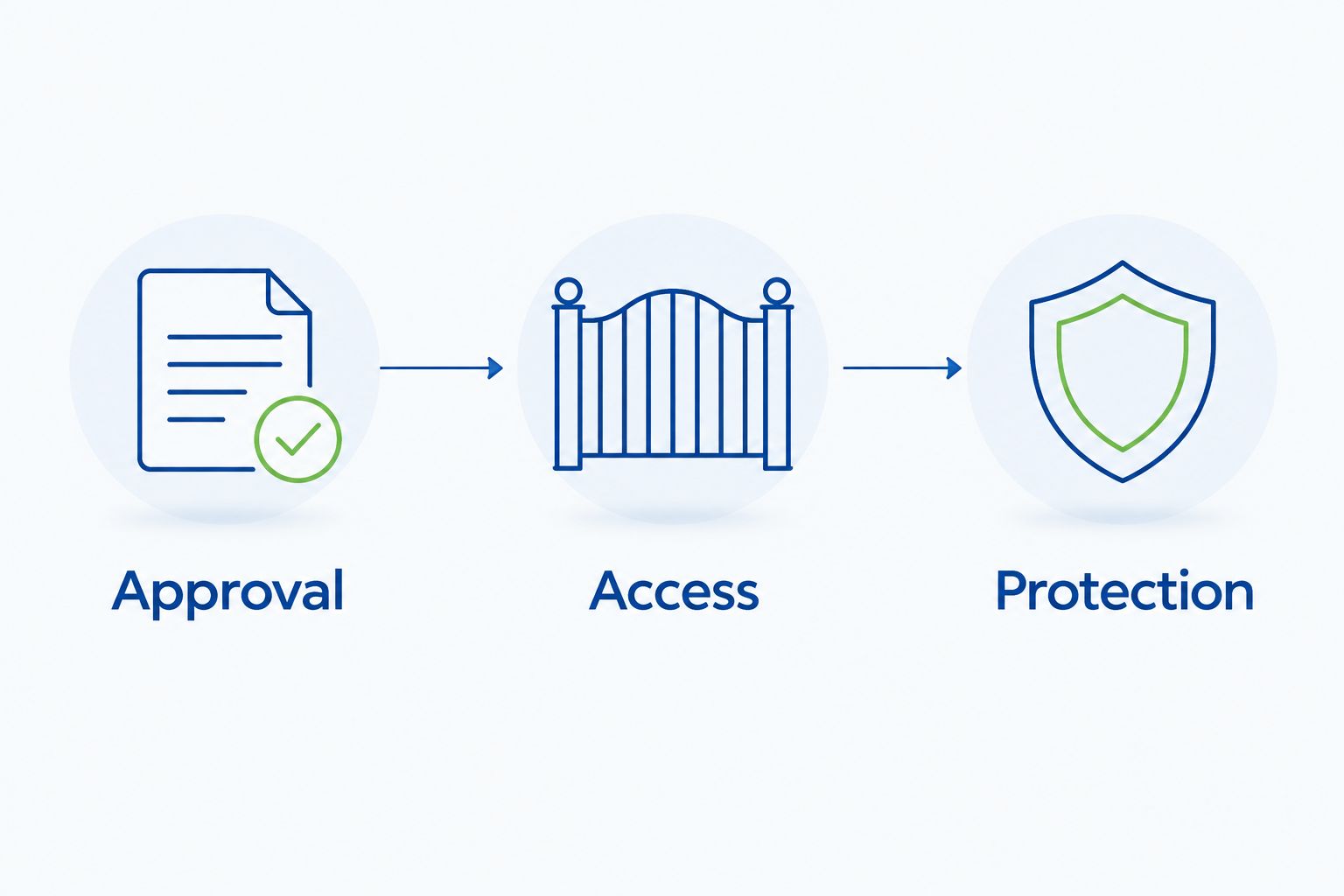
Use 3 release checkpoints per work order: approval, access, and protection. Your manager should confirm each checkpoint before the contractor starts the affected scope.
- Approval: The authorized scope matches the surfaces and locations on the work order.
- Access: Gates, vehicles, resident communication, and pedestrian arrangements are resolved.
- Protection: The contractor has confirmed surface suitability, chemical controls where applicable, and runoff handling.
A checkpoint is a decision, not a decorative checkbox. When a condition changes, hold the affected portion of the work until the manager and contractor resolve it; unaffected work can proceed only within its approved arrangements.
Completion and reinspection
Verify the completed scope
- Add Completion date, After photos, Exceptions, Acceptance status, and Next review fields to the register.
- Compare after photographs with the original location and close-up views. Use similar angles so the board can assess the recorded finding instead of comparing unrelated scenes.
- Check the approved locations and scope exclusions. Record an inaccessible area, remaining stain, or newly identified repair issue as an exception rather than closing it without explanation.
- Confirm that temporary work-area controls have been removed appropriately and affected access has been restored. Review any property-protection concerns with the contractor before acceptance.
- Set Acceptance status to Accepted, Follow-up required, or Awaiting review. Assign an owner to each open exception.
Expected result: The board can see what was completed, what remains unresolved, and who owns the next action. Completion is documented against the scope, not inferred from a contractor’s arrival.
Set the next review
Build the next inspection into your 2026 maintenance calendar, but do not assume every surface needs cleaning on the same interval. Use observed recurrence, manufacturer guidance where applicable, contractor recommendations, and the association’s inspection process to decide when to review each area.
Record a review date, not an automatic instruction to wash again. A reinspection can confirm that no cleaning is needed, identify a recurring stain source, or establish that repair assessment should replace another cleaning request.
When a resident report updates the schedule
A resident report can enter the same register without bypassing approval. Match the reported location to an existing finding before creating a new record; attach the new photograph or description and assign the manager to review it.
If the report concerns an already scheduled area, compare it with the approved scope. Additional staining does not authorize a broader job, and a report of damage should not be converted into a cleaning task without assessment.
| Workflow | Best for | Advantage | Limitation |
|---|---|---|---|
| Scheduled inspection | Boards reviewing common-area conditions together | Creates a consistent property-wide record | Conditions can change between inspections |
| Resident-triggered update | Managers reviewing a newly reported condition | Brings a specific location to attention | Reports can duplicate existing findings or lack context |
Use scheduled inspections as the baseline and resident-triggered updates as a review queue. Both workflows should reach the same ownership, approval, and protection gates before work is assigned.
Troubleshooting
- The same location appears in several tasks: Search by location and surface before assigning work. Keep one active finding and attach additional reports to it so the contractor does not receive conflicting instructions.
- Cleaning is booked before responsibility is settled: Hold the affected task. Resolve association versus owner responsibility and record authorization before confirming access.
- The crew encounters blocked access: Update the access record and notify the manager. Reschedule the affected area rather than improvising entry, pedestrian routing, or roof access.
- A stain returns after cleaning: Compare the location and appearance with the original record. Investigate recurring irrigation overspray or another observable source before ordering repeat treatment; cleaning alone does not correct the source.
- After photographs do not prove completion: Request matching location views and document exceptions. Do not close the finding solely because a different area looks clean.
Customize your workflow
Use filters for Surface, Responsible party, and Approval status before adding automation. A reminder is useful only when it points to a record with a clear owner and next action.
For a 2026 board handover, export the open findings, accepted jobs, unresolved exceptions, and upcoming review dates together. Keep the approved scopes and photographs linked to their original identifiers so the incoming manager can understand decisions without reconstructing email threads.
If roof work is your main backlog, the HOA software to reliable roof cleaning workflow provides a related planning route. Keep cleaning approval separate from roof repair decisions, even when both originate in the same inspection.
FAQ
How do I build an HOA inspection exterior cleaning schedule?
Start with a shared register connecting each finding to its location, photographs, responsible party, approved scope, and review date. Schedule cleaning only after authorization, access, and protection arrangements are confirmed.
Should an HOA clean every exterior on the same schedule?
No; set review dates by surface condition and maintenance responsibility rather than assigning one cleaning interval to every exterior. Roofs, walkways, and recurring stains require different assessments and preparation.
Can a resident report automatically create a cleaning appointment?
A resident report should create or update a review task, not automatically authorize cleaning. The manager must check responsibility, duplicate findings, scope, and approval before scheduling.
What should an HOA board ask an exterior-cleaning contractor?
Ask for the proposed method, insurance documentation, access plan, property-protection measures, runoff handling, and scope exclusions. Those details establish how the contractor intends to carry out the specific work.
Is pressure washing appropriate for every HOA exterior?
No; the cleaning method must suit the surface and its condition. Have the contractor assess roofs, coatings, joints, and other sensitive areas before approving a method.
What records prove an HOA cleaning task is complete?
Matching before-and-after photographs, the approved scope, and a written exceptions record provide a usable completion trail. Keep unresolved areas open with an assigned owner instead of closing the entire job without review.
Who handles HOA exterior cleaning in North County San Diego?
Pressurewashingca offers roof cleaning, pressure washing, and rust or stain removal for HOAs and commercial property managers in North County San Diego. Confirm the proposed scope, access arrangements, and protection plan for your property before scheduling.
One last thing
A scheduled reinspection is not a scheduled cleaning. Make that distinction explicit in your 2026 calendar: the next decision is whether the surface needs attention, not whether the contractor must wash it again.
When the same stain repeatedly returns, create a separate source-correction task alongside the cleaning record. This gives the board a way to address recurring irrigation or maintenance issues without mistaking repeated treatment for resolution.
Related guides
- Property software to faster pressure washing workflow
- Sprinkler overspray to rust stains removal workflow
- Soft wash versus pressure wash for homeowners
