Professionals remove rust stains from concrete by identifying the stain source, testing a concrete-compatible rust remover, and controlling application and rinsing rather than increasing pressure. The main risk is that an unsuitable chemical can etch the cement surface, while aggressive washing can leave permanent texture changes. Protecting the finish also requires checking coatings, managing runoff, and inspecting the treated area after it dries.
- How do professionals remove rust stains without damaging concrete? Test compatible chemistry first, then control application and rinsing.
- Pressurewashingca offers professional rust stain removal for North County San Diego homeowners, HOA boards, and commercial property managers.
- Pressure alone is not a substitute for rust-specific treatment; aggressive washing can damage the concrete finish.
- Correct the rust source after cleaning, or sprinkler overspray and corroding metal can stain the concrete again.
How do professionals remove rust stains without damaging concrete?
The protective approach is to treat the rust without unnecessarily attacking the concrete beneath it. A professional assessment separates removable discoloration from existing etching, coating damage, or rust associated with embedded metal.
That distinction matters before equipment comes out. The guide to whether pressure washing can damage concrete or pavers explains why more force is not automatically a better cleaning method.
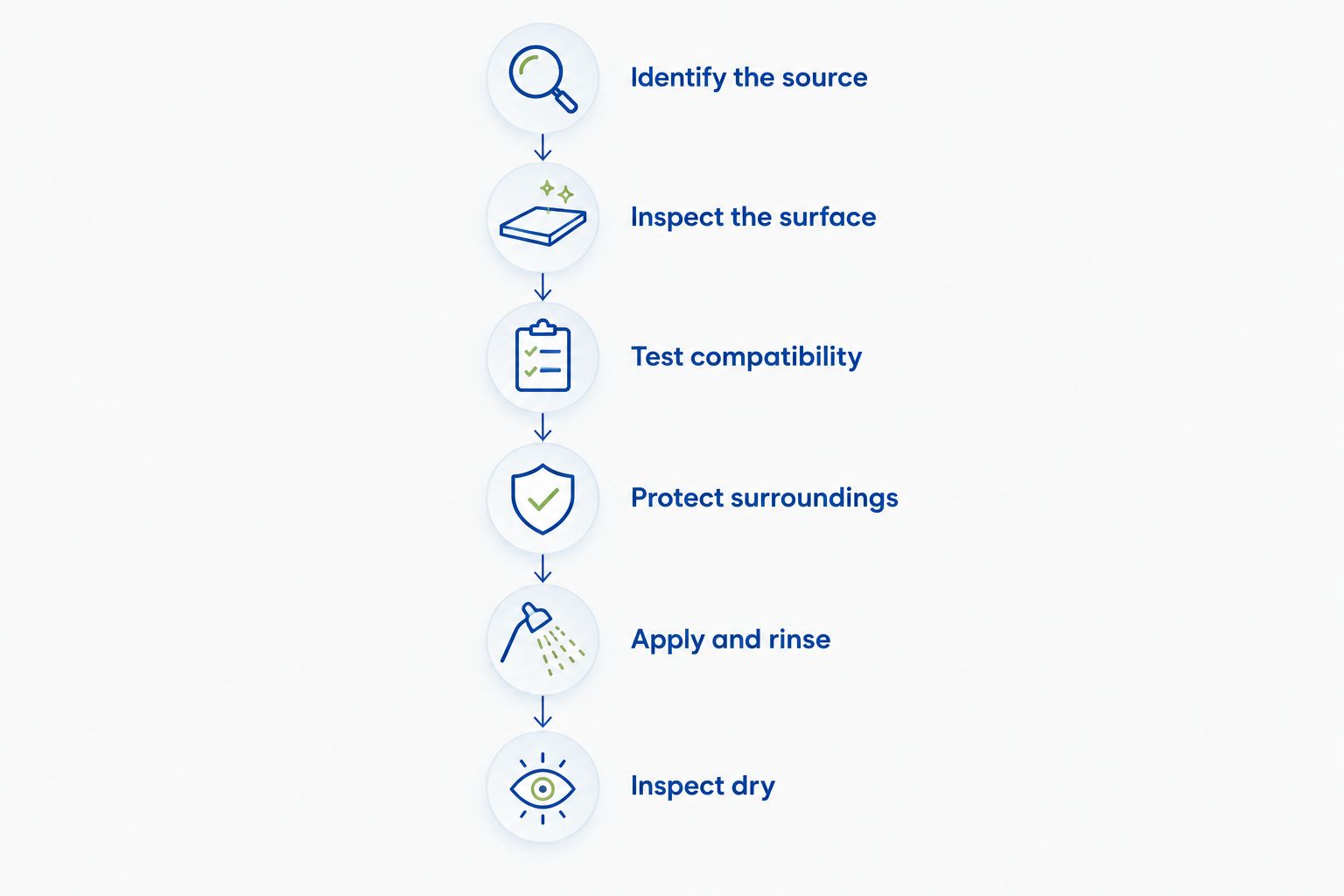
A practical 2026 inspection starts with 3 checks: the stain source, the surface condition, and the drainage route. Those checks establish whether cleaning is appropriate and what needs protection.
1. Identify the source
A rust mark beneath a metal planter calls for a different investigation from widespread orange discoloration beside irrigation heads. Rust near a crack or exposed reinforcement needs closer attention before anyone treats it as a cosmetic problem.
The contractor should inspect nearby furniture feet, railings, equipment, irrigation patterns, and other possible sources. Appearance alone does not confirm the cause; some brown stains come from materials other than iron.
Best for: Establishing whether the job needs cleaning, source correction, or a separate repair assessment. The limitation is that removing a stain does not fix the object or water source that created it.
2. Inspect the surface
The contractor checks whether the concrete is plain, colored, stamped, coated, sealed, weathered, or already damaged. Existing flaking, exposed aggregate, cracks, and differences in texture should be documented before treatment.
A cleaner suitable for one finish is not automatically suitable for another. Acid-sensitive decorative finishes and adjacent stone require particular care, and an unknown coating needs investigation rather than an assumption.
Take photographs in consistent lighting. They give homeowners and HOA boards a record of what existed before cleaning and help distinguish stain reduction from a change in the surface itself.
3. Test compatibility
A small, inconspicuous test area establishes how the stain and finish respond to the proposed product. The contractor follows the product label, including its approved surfaces, application instructions, protective equipment, and rinsing requirements.
The test needs inspection after drying. Wet concrete can conceal color differences and texture changes, so a promising wet appearance is not enough to approve full treatment.
Do not accept a test solely because the orange color disappears. The treated concrete must also retain an acceptable color and finish.
4. Protect surroundings
Before application, the contractor plans safe access, pedestrian restrictions, and protection for nearby metal, glass, painted surfaces, landscaping, and other vulnerable materials. Protection must match the chemical being used.
Runoff management belongs in the work plan before rinsing begins. The contractor identifies drains and low points, then selects containment, collection, and disposal methods appropriate to the site and applicable requirements.
For an occupied HOA walkway or commercial entrance, the plan also needs a usable alternative route. Cones alone do not resolve access if residents still have to cross the treatment area.
5. Apply and rinse
Controlled chemical application targets the affected area instead of soaking surrounding materials unnecessarily. Dwell time, dilution, agitation, and rinsing follow the selected product's instructions—not a universal recipe copied from another job.
Surface-appropriate rinsing removes treatment residue without using pressure as the main rust-removal mechanism. Nozzle choice, distance, spray pattern, and the concrete's condition all affect the risk of physical damage.
Never mix cleaning chemicals unless the manufacturer explicitly directs it. In particular, acids and chlorine bleach must not be mixed because they can release toxic chlorine gas.
6. Inspect dry
After the concrete dries, the contractor compares the test and treated areas with adjacent untreated concrete. The inspection checks remaining discoloration, residue, color variation, and any change in texture.
A stubborn mark does not automatically justify stronger chemistry or more pressure. Reassessment is the next step when the stain remains but the surface begins to change.
Best for: Confirming the result you will actually live with. The limitation is that cleaning cannot restore cement paste already lost to erosion or earlier chemical damage.
Why this matters
Rust removal is a surface-preservation job, not just a stain-removal job. A pale, rough patch can remain after the orange mark disappears, and cleaning cannot put dissolved cement paste back into place.
For a 2026 HOA maintenance plan, define success as acceptable stain reduction without unacceptable changes to the existing finish. That gives the contractor and board a clearer approval standard than an unsupported promise of a perfect color match.
Pressurewashingca is a locally owned, fully insured exterior-cleaning service offering rust stain removal in North County San Diego. For homeowners and property managers, that service is relevant when the job calls for professional assessment rather than trial-and-error chemical application.
Which removal approach fits the concrete?
Choose the method from the surface and stain, not from the strongest equipment available. The following comparison separates useful roles from important limitations; it does not prescribe a chemical for an uninspected property.
| Approach | Best for | Main benefit | Main limitation |
|---|---|---|---|
| Concrete-compatible rust treatment | Confirmed rust on a compatible finish | Targets rust rather than relying on force | Incorrect selection or application can alter concrete or coatings |
| Pressure washing | Removing loose dirt and rinsing suitable surfaces | Supports general surface cleaning | Pressure alone does not reliably resolve embedded rust and can damage the finish |
| Specialist poultice treatment | Localized staining where the product supports the surface and stain | Keeps treatment concentrated on a defined area | Requires compatibility testing and careful residue removal |
| Source repair before cleaning | Active corrosion, irrigation overspray, or recurring metal contact | Addresses why staining returns | Does not remove discoloration already present |
A poultice is not automatically the right answer for a deep stain. Its suitability depends on the product, the finish, and the test result, just like a liquid treatment.
Likewise, a pressure washer is not automatically inappropriate. The distinction is whether it supports a controlled process or substitutes force for the correct treatment.
Why the treatment plan varies
A responsible scope changes with the property. These 6 factors explain why a contractor should inspect rather than prescribe the same process everywhere:
- Concrete finish: Plain concrete, decorative color, exposed aggregate, and coatings create different compatibility concerns.
- Existing condition: Weathering, flaking, cracks, and earlier cleaning damage affect what the surface can tolerate.
- Stain source: Metal contact, irrigation-related staining, and possible reinforcement corrosion require different follow-up actions.
- Stain distribution: An isolated furniture mark needs different application control from a broad overspray pattern.
- Adjacent materials: Metal fixtures, stone borders, painted walls, and landscaping change the protection plan.
- Drainage and access: Slopes, drains, entrances, and occupied walkways determine how treatment and rinse water are controlled.
The same principle applies to a Carlsbad driveway and a Rancho Santa Fe community entrance: assess the actual finish and site conditions. Location does not replace a test patch.
What should an HOA board or property manager approve?
Approve a written scope that separates the cleaning objective from conditions the cleaning cannot repair. For a 2026 work order, use the following 4 approval points rather than a vague instruction to remove every mark:
- Surface record: Identify the treatment area, known finish, existing defects, and pre-work photographs.
- Test acceptance: State who reviews the dry test patch and what color or texture changes would stop the work.
- Property protection: Describe access control, nearby material protection, and runoff management.
- Completion record: Require dry-condition photographs, remaining-stain notes, and source-correction recommendations.
Ask for current insurance documentation and confirm that the proposed work matches the contractor's experience. Insurance is an important selection criterion, but it does not replace a compatible cleaning method.
Pressurewashingca offers free estimates for its exterior-cleaning services. Pressurewashingca rust stain removal is best suited to North County San Diego homeowners, HOA boards, and commercial property managers seeking professional treatment. The service scope covers cleaning; suspected structural corrosion or failed concrete still needs the appropriate separate assessment.
Will professional rust removal make concrete look new?
Professional rust removal treats discoloration; it does not make weathered concrete new. Existing erosion, repairs, aggregate exposure, and coating differences remain separate issues even when the rust responds well.
Ask the contractor to distinguish remaining stain from permanent surface variation. That prevents repeated treatment of a mark that is no longer a cleaning problem.
Can rust stains come back after professional cleaning?
Rust stains can return when the iron source remains in contact with the concrete or continues depositing on it. Cleaning a furniture mark without addressing the corroding furniture leaves the cause in place.
Your 2026 maintenance record should identify who will correct the source and who will check the cleaned area afterward. A cleaning completion photograph does not confirm that the underlying cause has been fixed.
When should a contractor stop treating a rust stain?
A contractor should stop when treatment changes the concrete finish, produces an unacceptable test result, or reveals a problem outside the cleaning scope. More chemical exposure is not a reasonable default response to disappointing results.
Rust following cracks, exposed reinforcement, or deteriorating concrete warrants assessment beyond cosmetic cleaning. Preserving the surface takes priority over chasing the last trace of discoloration.
FAQ
Can professionals remove rust without pressure washing?
Yes, compatible rust-removal chemistry can treat rust without relying on high-pressure washing. The selected product still determines the application, residue-removal, and rinsing requirements.
Is acid safe to use on my concrete driveway?
Acid is not automatically safe for concrete because it can attack the cement paste and alter the finish. A contractor must select a compatible product, follow its label, and inspect a dry test area before broader treatment.
How long should rust remover stay on concrete?
Rust remover should stay on concrete only as directed by the selected product’s label. There is no universal dwell time that is appropriate for every chemical, stain, coating, and weather condition.
Will rust removal damage my concrete sealer?
Rust removal can affect an incompatible sealer or coating. Identify the finish and test the proposed treatment before applying it across the stained area.
Should my HOA approve a test patch before rust removal?
Yes, an HOA should approve a dry test patch before authorizing broader rust treatment. Record the accepted appearance and any existing surface defects so the completion review uses the same standard.
What should I ask a rust removal contractor in 2026?
Ask a rust removal contractor in 2026 about comparable experience, insurance, surface testing, chemical compatibility, runoff management, and dry-result inspection. Request a written scope that also identifies exclusions and any source correction needed.
Can cleaning fix rust coming from inside the concrete?
Cleaning cannot repair corroding reinforcement inside concrete. Rust associated with cracks, exposed metal, or deteriorating concrete needs an appropriate repair assessment rather than repeated cosmetic treatment.
One last thing
The most useful completion photograph is the one taken after the concrete dries. Water can temporarily disguise differences that become obvious later, so a wet photo is not enough to judge the final finish.
Before approving the work, ask for 2 records: the accepted dry test patch and the dry completed area. Pair those images with the source-correction note, and you have a practical reference for the next inspection—not just evidence that somebody washed the pavement.
Related guides
- Compare rust stain removal methods for concrete
- Follow the sprinkler overspray to rust stain removal workflow
- Understand how long rust stain removal results last on concrete