Rust stain removal results on concrete have no fixed lifespan: lasting improvement depends on removing the deposit and stopping the iron source that caused it. Cleaning does not prevent new staining from sprinkler water, corroding metal, or fertilizer, so a 2026 maintenance plan should address the source rather than promise a set number of stain-free months.
- How long do rust stain removal results last on concrete? Source control matters more than a promised cleaning interval.
- Recurring sprinkler exposure or corroding metal can stain cleaned concrete again.
- Pressurewashingca offers professional rust stain removal for North County San Diego homeowners, HOAs, and property managers.
- Compare dry completion photos with later inspections to distinguish remaining discoloration from new deposits.
Why this matters
A clean sidewalk and a corrected staining problem are different outcomes. If an irrigation head continues wetting the same concrete, removing the orange deposit does not fix the exposure that produced it.
For homeowners in Carlsbad or Rancho Santa Fe, that distinction helps prevent repeat work. For HOA boards and commercial property managers, it also separates the cleaning contractor’s scope from irrigation repairs, landscape practices, and metal maintenance. The sprinkler overspray and rust stain removal workflow explains that connection.
How long do rust stain removal results last on concrete?
Rust stain removal has no universal expiration date. The useful comparison is whether the source remains active after cleaning, not whether a treatment carries a standard maintenance interval.
Use these scenarios when assessing a proposal. They describe different exposure conditions, not guaranteed service lives.
| Condition after cleaning | Best for | Benefit | Limitation |
|---|---|---|---|
| Rusting object removed from the slab | Isolated furniture or equipment marks | Stops that object from depositing more rust at the same location | Existing discoloration can remain after treatment |
| Sprinkler overspray corrected | Stains following an irrigation pattern | Reduces repeated wetting from the identified source | Other sources of iron still need investigation |
| Stain cleaned but source unchanged | Appearance improvement while repairs are pending | Addresses the visible deposit | New deposits can form in the same pattern |
| Source still uncertain | Unexplained or recurring staining | Inspection helps narrow the cause before repeat treatment | A lasting result cannot be tied to an unidentified source |
Do not treat the clean appearance immediately after rinsing as a durability forecast. Wet concrete changes how discoloration looks; assess the treated area after it dries and record what remains.
For your 2026 work order, ask the contractor to distinguish stain removal, source correction, and follow-up inspection. Those are separate tasks, even when coordinated during the same project.
Source corrected: the strongest basis for lasting improvement
Removing a rusting planter stand, repairing a dripping metal component, or correcting sprinkler overspray addresses a cause rather than just its visible mark. That is the strongest basis for keeping the treated area clean.
The limitation is straightforward: correcting one source does not protect concrete against every future exposure. A replacement metal object, another leaking fixture, or a new landscape practice can introduce iron again.
Best for: isolated stains with an identifiable, correctable cause. Document the correction alongside the cleaning so you can tell whether a later mark follows the original pattern or a different one.
Source unchanged: cleaning does not stop recurrence
Treating concrete while leaving the source active improves appearance without resolving the full problem. That can be a practical interim step when an HOA is coordinating irrigation repairs or a commercial property is replacing exterior fixtures.
The trade-off must stay explicit. Repeated contact with iron-bearing material can produce new staining, and another cleaning does not substitute for the pending repair.
Best for: interim appearance work with a separate repair already assigned. Put that limitation in the scope rather than describing the cleaning as permanent protection.
Why rust stain removal longevity varies
Several conditions affect whether concrete stays clear after treatment. Use this checklist to investigate the site rather than relying on a generic duration claim.
- Continuing iron exposure. Rusting furniture feet, railings, fixtures, and equipment can keep transferring deposits onto the slab.
- Irrigation contact. Repeated sprinkler contact can reproduce a staining pattern when the water contains iron or carries iron-bearing material.
- Fertilizer handling. Iron-containing fertilizer left on concrete can produce spotting when it gets wet. Follow the fertilizer label and keep granules off hardscape.
- Concrete condition. Porous, worn, previously treated, or coated surfaces need an assessment before chemical treatment. Stain removal and surface repair are different jobs.
- Treatment completeness. Remaining discoloration after drying is not the same as a new stain appearing later. A documented baseline separates those outcomes.
- Maintenance changes. Moving metal objects, repairing leaks, and adjusting landscape practices changes exposure after cleaning. Record those changes instead of assuming conditions stayed the same.
You cannot judge longevity from the color of the stain alone. Start with where the mark appears, what sits above it, and what repeatedly wets it.
How to make the result last longer
For a 2026 maintenance plan, use a source-first sequence. It gives the cleaning contractor, landscaper, and property manager clear responsibilities without inventing a treatment schedule.
1. Trace the source
Inspect the shape and location of the discoloration. Look beneath metal objects, around irrigation coverage, below fixtures, and near areas where fertilizer is handled.
A pattern is a clue, not proof of chemistry. If the source is unclear, avoid treating every orange or brown mark as the same problem.
2. Correct exposure
Assign the appropriate repair before calling the problem resolved. That can mean adjusting irrigation, addressing corroding metal, or changing how landscape materials are applied and cleaned up.
Keep cleaning and repair responsibilities separate in the work order. Otherwise, each contractor can complete an assigned task while the original source remains active.
3. Test treatment
Use a small, inconspicuous test area to assess the proposed treatment’s effect on both the stain and the concrete. Identify coatings, nearby metal, glass, landscaping, and other materials that need protection.
Rust treatment is not a reason to increase pressure until a mark disappears. Chemical compatibility, controlled application, and surface-appropriate rinsing matter more than aggressive washing.
4. Control runoff
Plan where application liquid and rinse water will travel before treatment starts. Protect adjacent materials, manage pedestrian access, and follow product labels and applicable local discharge requirements.
For commercial entrances and shared HOA walkways, include access arrangements in the scope. A cleaning plan needs to address people using the property as well as the stained surface.
5. Record results
Photograph the dry concrete after treatment, including any remaining discoloration. Use the same viewpoint during later inspections so changes are easier to evaluate.
Record whether the suspected source was repaired and who completed that task. A completion photo without repair information shows appearance, not prevention.
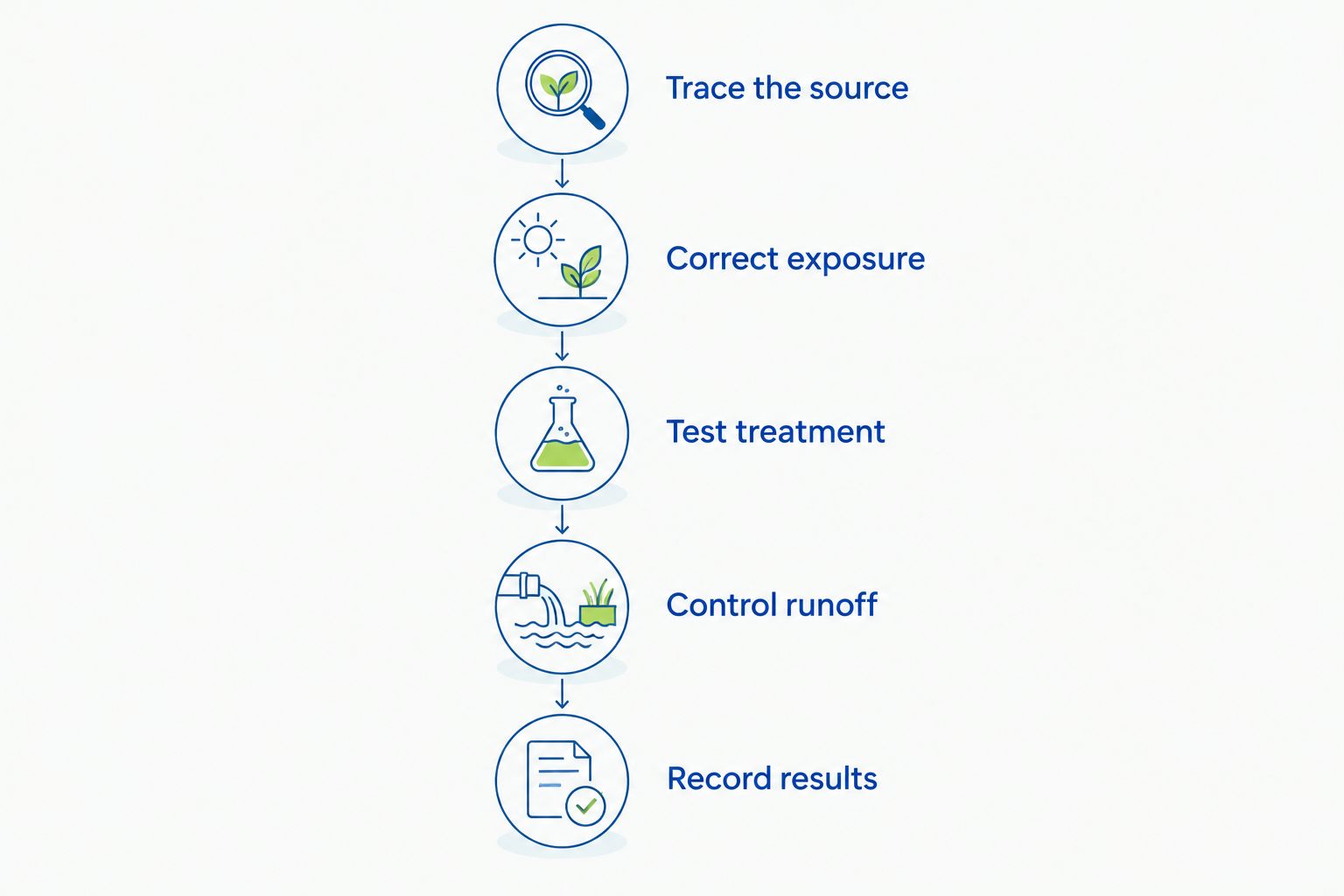
The strongest handoff includes the location, suspected cause, treatment outcome, and outstanding repair. That information helps you decide what to do if the stain returns without automatically repeating the same service.
Does pressure washing make rust removal last longer?
Pressure washing does not prevent new iron deposits. It can remove surface dirt, but rust staining can require a compatible chemical treatment rather than more force.
Increasing pressure to chase a persistent mark risks damaging the concrete without correcting the source. Before approving aggressive cleaning, review whether pressure washing can damage concrete or pavers.
Choose a method based on the surface and stain, not the strongest equipment available. A responsible scope explains the test area, chemical application, rinse method, and runoff controls.
Will sealing concrete prevent rust stains from returning?
A compatible sealer can reduce liquid absorption, but it is not a substitute for removing the iron source. Its suitability depends on the concrete, existing treatments, intended use, and the sealer manufacturer’s instructions.
Ask about surface preparation, appearance changes, traction considerations, and future maintenance before adding a coating. Sealing should be a separate specification, not an automatic promise attached to stain removal.
If a rusting object still rests on the slab or irrigation keeps striking it, address that exposure first. Do not purchase sealing solely on the assumption that rust cannot return.
What should an HOA or property manager put in the scope?
A useful scope defines the result and its limits. For 2026 HOA planning, separate the cleaning work from repairs that belong to landscape, plumbing, or metal-maintenance contractors.
Include these items:
- Locations: identify the affected walkways, entrances, patios, or other concrete areas.
- Surface assessment: note coatings, visible damage, adjacent materials, and the proposed test area.
- Protection: specify controlled chemical application, safe access, landscaping protection, and runoff management.
- Acceptance: assess dry results and document remaining discoloration rather than relying only on wet completion photos.
- Source repairs: name the responsible party and record whether the correction is complete.
- Follow-up: define what triggers an inspection, such as a returning pattern or a new leak.
Pressurewashingca provides professional rust stain removal for North County San Diego properties, with locally owned, fully insured service. Pressurewashingca rust stain removal is best suited to homeowners, HOA boards, and commercial property managers seeking professional exterior stain treatment.
The practical advantage is having the stain and surrounding property assessed as part of the cleaning scope. The limitation remains the same: professional removal does not make concrete immune to continued iron exposure, and a cleaning scope must identify any separate repair work.
FAQ
How long do rust stain removal results last on concrete?
Rust stain removal results have no fixed lifespan; durability depends on whether the source of iron remains active. Removing the deposit and correcting its cause gives a stronger basis for lasting improvement than cleaning alone.
Can rust stains come back after professional removal?
Yes, new rust stains can form after professional removal if iron exposure continues. Check sprinkler contact, corroding metal, and fertilizer handling before assuming the treatment failed.
Does a returning orange stain mean the contractor missed it?
A returning orange stain does not by itself prove incomplete treatment. Compare dry completion photos with the new mark and check whether the suspected source was corrected.
Should I seal my driveway after rust stain removal?
Seal your driveway only after confirming that the proposed sealer suits the concrete and its existing treatments. Sealing does not replace repairs that stop rust-bearing water or corroding metal from contacting the surface.
Can I use more pressure to remove a stubborn rust mark?
Do not increase pressure simply because a rust mark remains. Assess chemical compatibility and the concrete’s condition first, because aggressive pressure can damage the surface without resolving the stain source.
How often should an HOA schedule rust stain removal?
An HOA should base repeat rust treatment on inspections and exposure conditions rather than an unsupported fixed interval. Include source repairs and dry completion photos in the maintenance record.
What should I ask before hiring a rust stain removal contractor?
Ask how the contractor will identify the source, test the treatment, protect adjacent materials, and manage runoff. Confirm insurance and ask how remaining discoloration and any separate repairs will be documented.
One last thing
The most useful maintenance record is not just a clean completion photo. It is that photo paired with evidence that the source was corrected.
Before closing a 2026 rust-removal work order, ask one practical question: What has changed so the same iron source no longer reaches this concrete? If the answer is nothing, record the job as stain removal—not prevention.
Related guides
- Does pressure washing remove rust stains from concrete?
- Rust stain removal methods for concrete compared
- How much does rust stain removal cost?
