Hotel house washing is exterior wall cleaning with the aim of maintaining a presentable property without disrupting guests or damaging building finishes. North Coast Exteriors brings real exterior-cleaning experience, fully insured and locally owned service, and a protective approach to North County San Diego properties; this guide explains how to specify the work, control access, and inspect the result.
- House washing for hotels needs surface-specific methods, guest-access planning, and runoff management—not one pressure setting across the property.
- North Coast Exteriors is best for North County San Diego property managers seeking professional exterior cleaning with property protection.
- Use soft washing for suitable exterior finishes and surface-appropriate pressure for compatible hardscapes.
- Separate roof cleaning and rust stain removal from the wall-washing scope so each receives the right treatment.
Why house washing matters for hotels
A hotel exterior is also an occupied workplace, a guest entrance, and a route for deliveries. Cleaning that blocks the only accessible entrance or sends overspray toward an occupied balcony is poorly planned, even when the wall looks better afterward.
For your 2026 maintenance plan, judge the work by both the cleaned surface and the way the property operates during it. Define access, drainage, and finish protection before choosing equipment.
North Coast Exteriors offers professional exterior cleaning in North County San Diego. North Coast Exteriors is best for North County San Diego property managers seeking professional exterior cleaning with property protection. Request a free estimate against a written scope, not a general instruction to wash the building.
For hospitality properties in Carlsbad, Rancho Santa Fe, and the surrounding area, the useful question is specific: which surfaces need cleaning, which require repair, and which must stay outside the work zone?
How to plan house washing for hotels in 2026
1. Inspect the building before specifying the wash
Start with a manual walkaround and photographs. Your maintenance team can identify open windows, damaged coatings, loose trim, exposed electrical fittings, and existing staining before a contractor arrives. Record conditions rather than assuming every dark mark is removable dirt.
Separate exterior walls from roofs, paving, windows, and decorative fixtures. These surfaces do not automatically belong in the same scope or accept the same treatment. A hotel with stucco walls, painted trim, tile roofing, and concrete paths needs decisions for each material.
Do not ask a cleaning crew to solve a repair problem with more pressure. Flag damaged seals or failing paint for maintenance review before cleaning starts. Keep the inspection record with your 2026 work order so the final walkthrough has a clear reference.
- Photograph existing cracks, stains, and coating failure.
- Identify wall materials and finish types by elevation.
- Mark electrical fittings, vents, and openings.
- Separate cleaning items from repair items.
- List surfaces expressly excluded from the estimate.
2. Divide the property into controlled work zones
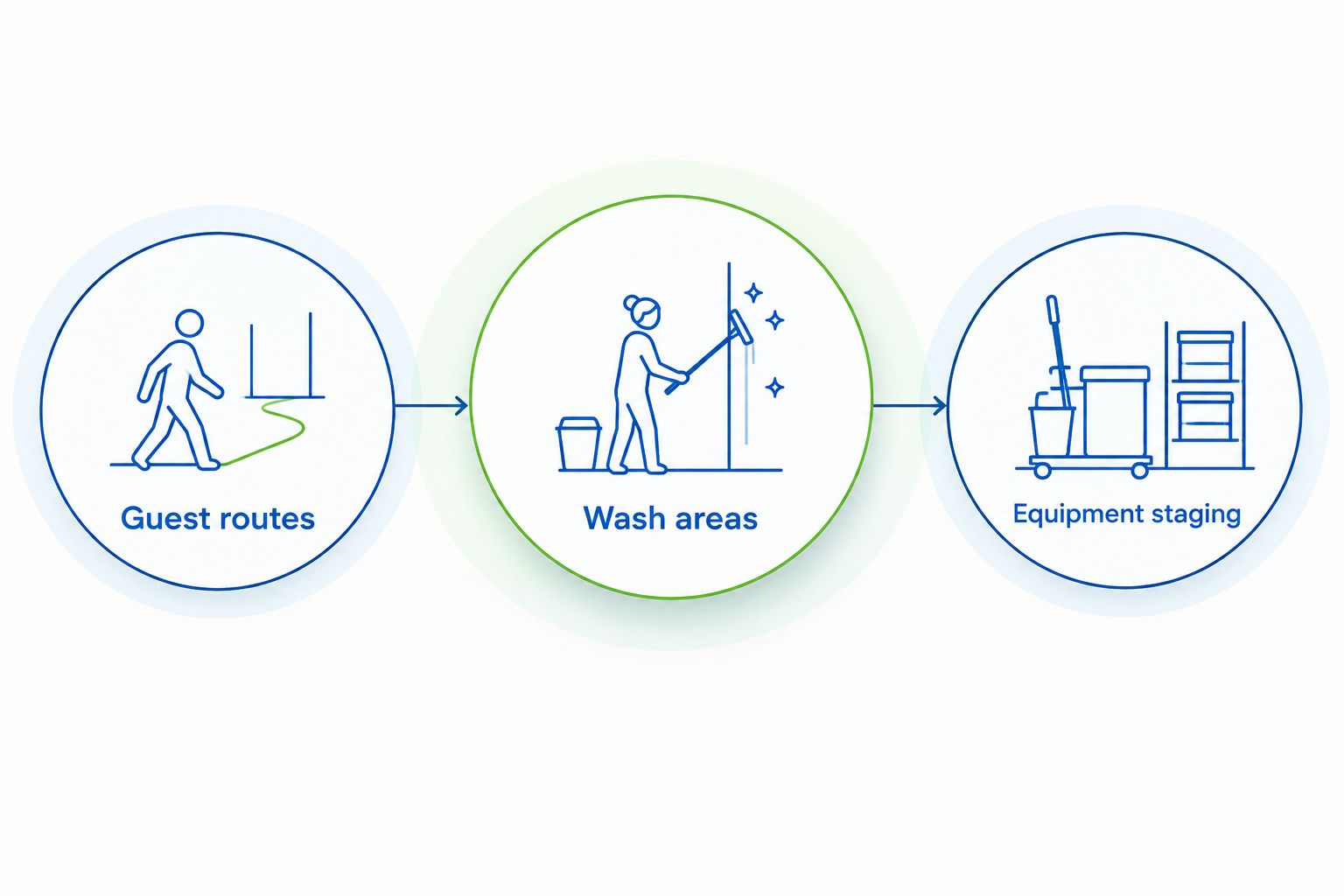
Use a printed site plan or a simple marked photograph first. Divide the job into 3 work zones: guest routes, wash areas, and equipment staging. These are planning categories, not a required physical layout; the actual boundaries depend on your property.
Guest routes must remain understandable while work moves around the building. Include accessible entrances, luggage routes, restaurant access, delivery points, and emergency exits. Do not leave front-desk staff to improvise directions once hoses and barriers are already in place.
Assign a property contact who can approve changes during the job. For an occupied hotel, a cleaning method is only workable when the access plan works alongside it. Approve the route guests will use before approving the area the crew will close.
- Mark guest routes that must remain open.
- Define wash areas and temporary barriers.
- Place equipment staging away from entrances.
- Identify approved hose crossings and alternative routes.
- Assign a contact for access changes.
3. Match the cleaning method to each surface
Begin with the building's maintenance instructions and a close inspection of the finish. Where instructions exist, give them to the contractor. Do not select a method solely because it cleaned a different building successfully.
Soft washing uses cleaning solution and a lower-pressure application or rinse approach for suitable surfaces. Pressure washing uses mechanical force and belongs on surfaces that tolerate the proposed method. Neither label, by itself, proves that a treatment fits your wall coating, joints, or trim.
North Coast Exteriors offers house washing and commercial exterior-cleaning services. The value of a professional approach is the surface assessment, controlled chemical application, and surface-appropriate pressure—not simply ownership of a larger machine.
For a mixed-use property, the commercial pressure washing guide for property managers provides a related planning reference. Keep the hotel wall-cleaning scope distinct from paving and other commercial work.
- Request a method for each listed surface.
- Review available finish-maintenance instructions.
- Require 1 test area on each distinct finish before full treatment.
- Keep spray directed away from vulnerable openings.
- Treat roof cleaning as a separate method decision.
4. Plan chemical application and runoff before starting
Walk the drainage route yourself before the contractor arrives. Identify landscape beds, irrigation controls, downspouts, catch basins, and areas where water collects. This basic survey helps you ask useful questions about where wash water will go.
Controlled chemical application means the treatment reaches the intended surface without indiscriminate spraying. Ask how the crew will protect nearby plants and fixtures, control overspray, and manage rinsing. Review product labels and safety information rather than accepting an unsupported claim that a solution is harmless.
Runoff management belongs in the written scope. Require the contractor to explain containment or collection where needed and confirm applicable local discharge requirements before work begins. A drain is not an automatic disposal point for wash water. Your 2026 contractor file should identify who is responsible for that decision.
- Map drains, low points, and landscape beds.
- Request product labels and relevant safety information.
- Specify protection for plants and sensitive fixtures.
- Document the wash-water handling method.
- Confirm applicable discharge requirements before work.
5. Schedule around actual hotel operations
Start with your occupancy calendar, group bookings, restaurant hours, and delivery schedule. Ask department leads which entrances and exterior spaces they need. A quiet-looking courtyard can still serve breakfast, housekeeping access, or an event setup.
Do not assume that cleaning must happen overnight. Darkness adds access and visibility considerations, while daytime work needs careful separation from guests. Choose a work window that suits the location, the access method, and the hotel's operations.
For your 2026 schedule, phase the work by elevation or courtyard rather than closing unrelated areas together. Agree on a pause procedure for unexpected guest movement, deliveries, or changing conditions. The front desk needs the same current plan as the contractor.
- Check reservations and event schedules before booking.
- Confirm restaurant and delivery access requirements.
- Notify affected departments and occupied rooms.
- Assign a decision-maker for pauses or changes.
- Release each completed area only after inspection.
6. Obtain a written scope and verify the contractor
Prepare your own surface list before requesting estimates. Include exclusions, access restrictions, test-area requirements, runoff expectations, and the person authorized to approve additional work. This makes proposals easier to compare without relying on broad service labels.
Ask for current insurance documentation relevant to the proposed work. Fully insured service is an important starting point, but your property still needs to review the documentation and the actual scope. Do not substitute a website statement for your contractor-onboarding process.
North Coast Exteriors provides free estimates for exterior-cleaning services. Use that estimate to establish exactly what is included and what needs separate assessment. Roof access, stain treatment, and work around occupied balconies should not remain assumptions between approval and arrival.
- Request current insurance documentation.
- List included surfaces and explicit exclusions.
- Confirm safe-access arrangements and responsibilities.
- Document treatment, protection, and runoff methods.
- Require approval before changing the agreed scope.
7. Inspect the result and record the next maintenance decision
Plan 2 inspections: one before work and one after the cleaned surfaces are dry enough to assess. This is a recommended management process, not a promise that every stain will disappear. Compare the final condition with the original photographs.
Look for remaining residue, missed areas, disturbed fixtures, and changes around vulnerable finishes. Distinguish an incomplete cleaning pass from a mark that requires specialist stain treatment or repair. Those findings lead to different next steps.
Close your 2026 work order with photographs, completed areas, unresolved items, and any maintenance referral. Set the next review from observed conditions rather than imposing an unsupported cleaning interval. Inspect after cleaning; do not accept the job solely because the crew has packed up.
- Compare before-and-after photographs by elevation.
- Check walls, trim, glazing, and nearby fixtures.
- Record remaining stains and their proposed treatment.
- Confirm barriers and equipment have been removed.
- File the next inspection decision with the work order.
Compare hotel exterior-cleaning options
Choose by surface and task, not by the strongest available equipment. A hotel's exterior-maintenance plan can include several approaches, but each needs a defined purpose. The table separates useful applications from limitations; it is not a ranking of cleaning power.
| Option | Best for | Practical advantage | Key limitation |
|---|---|---|---|
| In-house light cleaning | Reachable fixtures and small, routine touch-ups | Fits existing maintenance rounds without a separate building-wash project | Requires suitable training and equipment; does not replace specialist access or full-building assessment |
| Professional soft washing | Suitable exterior walls and finishes needing controlled treatment | Combines cleaning-solution application with a lower-pressure approach | Still requires finish compatibility checks, plant protection, and runoff planning |
| Professional pressure washing | Compatible concrete and other durable hardscapes | Addresses surface cleaning where mechanical force is appropriate | An unsuitable setting or technique can damage finishes, joints, or softer materials |
| Targeted stain removal | Localized rust or other identified exterior stains | Treats the specific mark rather than repeatedly washing the entire area | Requires stain identification and a compatible treatment; results must be assessed separately |
| North Coast Exteriors exterior cleaning | North County San Diego property managers seeking professional wall, roof, and stain-cleaning assessment | Offers professional exterior-cleaning services and free estimates | The property still needs an agreed scope, access plan, and treatment assessment before approving work |
Do not combine every option automatically. Add a service only when the inspection identifies a relevant task. Roof cleaning, for example, needs its own access and material assessment rather than becoming an informal extra while the walls are being washed.
Common mistakes hotel property managers make
Treating guest access as the contractor's problem
The contractor does not control room assignments, restaurant reservations, or your accessible guest routes. Give the crew an approved operating plan and keep a hotel contact available. Barriers alone do not tell guests where to go.
Using one method across the entire exterior
Walls, trim, decorative stone, roofs, and paths require separate assessment. Specify methods by material and condition. A uniform appearance does not mean the surfaces tolerate identical pressure or chemistry.
Approving wall washing while ignoring runoff
Drainage is part of the job, not a detail to discuss after rinsing begins. Identify the water path and confirm handling requirements in advance. Include landscaped courtyards and concealed low points in the review.
Expecting general washing to remove every stain
Rust marks, coating failure, and surface deposits are different problems. Require the estimate to distinguish ordinary cleaning from targeted stain removal. Repeatedly increasing pressure is not a substitute for identifying the mark.
Signing off while surfaces are still wet
Wet surfaces make the final condition harder to judge. Complete the agreed inspection when the finish can be assessed, then document remaining issues. Keep unresolved repair items separate from cleaning defects.
FAQ
What’s the best approach to house washing for hotels?
The best approach to house washing for hotels is a surface-specific cleaning plan with controlled access and runoff management. Inspect the finishes first, test the proposed treatment, and schedule work around actual guest operations.
Is soft washing better than pressure washing for hotel walls?
Soft washing suits exterior finishes that need compatible chemical treatment and a lower-pressure approach. Pressure washing belongs on surfaces that tolerate the proposed mechanical force; neither method should be selected without checking the material and condition.
Can a hotel stay open during exterior washing?
A hotel can remain open when the approved work plan separates cleaning from occupied areas and preserves necessary access. The property manager and contractor must agree on barriers, guest routes, notifications, and a procedure for pausing work.
Should hotel roof cleaning be included with house washing?
Hotel roof cleaning should have a separate scope, even when it is scheduled alongside wall washing. Roof material, condition, access, and drainage require their own assessment.
What should a hotel ask an exterior-cleaning contractor?
Ask for a surface-specific method, current insurance documentation, safe-access arrangements, property-protection measures, and a runoff plan. Require a written list of included work, exclusions, and approval requirements for changes.
Will house washing remove rust stains on hotel walls?
Rust stains need identification and a compatible targeted treatment rather than an assumption that general washing will remove them. Document the affected area and request a separate assessment before applying treatment.
How often should a hospitality property schedule house washing?
Schedule house washing from documented surface conditions and operating needs, not an unsupported universal interval. Inspect exterior walls during maintenance rounds and use photographs to decide when another assessment is needed.
One last thing
Put the reopening decision in the scope. A finished wash area is not automatically ready for guest use: inspect the route for standing water, remaining equipment, loose barriers, and unresolved access hazards before releasing it.
Name the person authorized to reopen each area. That small administrative decision connects the cleaning work to the hotel's daily operation—and prevents the front desk and crew from making different assumptions.
Related guides
- Pressure washing for vacation rental hosts
- Commercial pressure washing for churches and religious facilities
- Rust stain removal for marinas and boat facilities
