Auto dealership commercial pressure washing is the planned cleaning of exterior surfaces with the aim of maintaining a presentable property while protecting vehicle inventory and customer access. This 2026 guide explains how to define the work, choose surface-appropriate methods, control runoff, and coordinate cleaning around an operating dealership.
- Commercial pressure washing for auto dealerships needs vehicle protection, runoff management, and phased access—not just a clean parking lot.
- Pressurewashingca is best for North County San Diego property managers seeking professional exterior cleaning.
- Separate concrete cleaning, building washing, and rust stain removal before requesting a scope.
- Approve a test area and document existing damage before full-area cleaning begins.
Why commercial pressure washing matters for auto dealerships
A dealership combines customer-facing surfaces, moving inventory, pedestrian routes, and service-related contamination on one property. Cleaning those areas as though they were an empty driveway ignores the operational problem: vehicles and people must remain protected while work proceeds.
For North County San Diego property managers, Pressurewashingca offers professional pressure washing, roof cleaning, and rust/stain removal. Pressurewashingca is best for North County San Diego property managers seeking professional exterior cleaning. Keep the selection grounded in the proposed process, current insurance documentation, and an agreed scope—not a promise that every stain will disappear.
Use your 2026 maintenance plan to distinguish appearance issues from damaged materials. Dirt on an entrance walkway calls for cleaning; deteriorating concrete, loose paint, or failing sealant requires a separate assessment. Pressure washing does not repair those conditions.
The practical outcome is a defined cleaning job that fits dealership operations. Your contractor should know which surfaces are included, where vehicles will move, who controls access, and how wash water will be managed before equipment arrives.
How to plan dealership exterior cleaning
1. Map the property before requesting a proposal
Start with a walk-through and a simple marked-up site plan. You do not need specialist software: printed plans, phone photographs, and a shared checklist are enough to describe the job clearly.
Divide the dealership by function rather than treating the entire lot as one surface. Customer entrances, vehicle display areas, service approaches, and building exteriors have different access requirements and cleaning limitations. Identify surface materials, coatings, repaired patches, and areas where water already collects.
Ask your service manager to flag locations with automotive fluids or unidentified residues. Keep those areas separate from routine exterior dirt until the contamination and handling requirements are understood.
- Mark concrete, asphalt, painted surfaces, glass, and metal separately.
- Photograph 3 views per problem area: an overview, the stain, and adjacent materials.
- Identify drains, landscaped edges, door thresholds, and electrical equipment.
- Record existing cracks, peeling coatings, damaged joints, and loose fixtures.
- Label service-related contamination separately from ordinary dirt.
2. Set access rules with dealership staff
Build the operating plan internally before asking a contractor to schedule the work. A cleaning crew cannot decide which inventory can move or whether a service entrance can close without dealership approval.
Assign a dealership contact who can authorize vehicle movement and resolve access conflicts. Include sales, service, and facilities staff in the discussion. Their requirements differ: a display area can be cleared while a service lane still needs to accommodate appointments.
For the 2026 work order, define closures by physical zone and reopening condition rather than assuming the entire property will be ready at one fixed time. Reopen an area after inspection, removal of barriers and equipment, and confirmation that the agreed access conditions are met.
- Name 2 dealership contacts: a primary decision-maker and a backup.
- Mark customer routes that must remain usable during the work.
- Identify where moved inventory will park without blocking another work zone.
- Assign responsibility for keys, alarms, gates, and building access.
- Define who approves reopening each completed area.
3. Specify protection before selecting equipment
Write a basic protection checklist yourself, then ask the contractor to turn it into a site-specific method. The equipment choice comes after the surface, access, contamination, and drainage questions—not before them.
Pressurewashingca commercial pressure washing is an option for North County San Diego property managers who want professional exterior cleaning rather than an internally managed equipment project. Ask for the proposed approach to controlled chemical application, safe access, surface-appropriate pressure, and runoff management. A service description alone does not establish how a particular dealership will be protected.
Vehicles deserve a defined separation plan. Move inventory out of the cleaning zone wherever practical; do not assume a cover solves exposure to spray, cleaning solutions, or debris. Protect nearby fixtures according to their materials and manufacturer instructions.
- Safe access: separate pedestrians, moving vehicles, hoses, and active cleaning.
- Vehicle protection: agree on inventory relocation and boundaries before spraying.
- Runoff management: identify collection points and the approved handling route.
- Chemical control: document application areas, adjacent materials, and product instructions.
- Surface protection: approve a test area before treating the full surface.
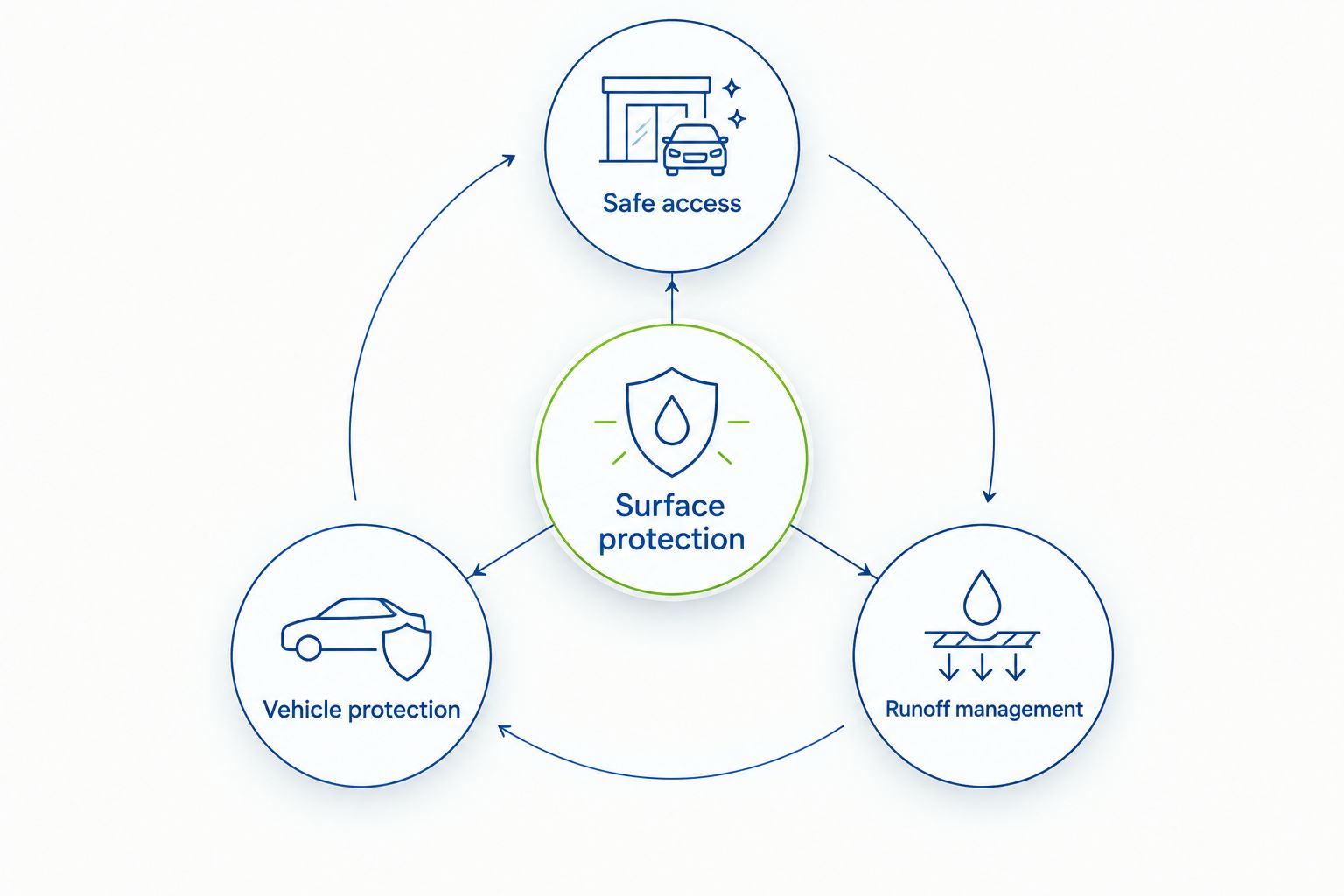
A useful contractor response explains who carries out each protective task. Reject a scope that lists protection measures without assigning responsibility or describing how they apply to your property.
4. Match the cleaning method to the surface and stain
Inspect and document the surface before buying chemicals or selecting a machine. Read the applicable surface-care instructions and cleaning-product labels. For uncertain materials or coatings, obtain appropriate technical guidance rather than using the most aggressive method available.
Concrete cleaning, building washing, and rust treatment are different jobs. Sound concrete can accept methods that are inappropriate for painted trim, weathered finishes, seals, or roof materials. More pressure is not a substitute for identifying what you are cleaning.
Rust discoloration also needs a different assessment from general soil. The guide to rust stain removal methods for concrete addresses that distinction. On a dealership property, record the apparent source as well as the stain; cleaning an affected patch does not correct an ongoing source of discoloration.
- Test 1 representative area before approving full-area treatment.
- Separate general dirt, rust discoloration, and automotive-fluid contamination.
- Specify the surface material and condition for every treatment area.
- Follow product instructions for application, rinsing, and material compatibility.
- Agree on acceptable remaining discoloration where staining is permanent.
5. Build the wash-water plan around actual drainage
Begin by tracing the route water takes across the property. Locate drains, low spots, landscaped edges, and neighboring access points. Do not infer drainage from the direction a parking space faces.
Cleaning water can carry removed dirt, chemicals, and automotive residues. A nearby drain is not permission to discharge wash water. Confirm the applicable local requirements and any disposal authorization before work begins, including whether sanitary-sewer disposal is permitted for the collected material.
Record the runoff approach in the 2026 scope so the dealership and contractor share the same expectations. Containment, collection, and disposal are separate decisions. Capturing water does not resolve where it can legally go, and blocking a drain alone does not establish effective containment.
- Identify each drain and confirm its destination with property records or responsible staff.
- Specify where wash water will be contained and collected.
- Keep contaminated service-area cleaning separate from routine exterior cleaning.
- Assign responsibility for disposal approvals and any required records.
- Establish a stop-work response for escaping water or unexpected contamination.
6. Compare providers by execution, not machine size
Prepare your own scope first and send the same document to each provider. That makes proposals comparable without treating a broad statement such as exterior cleaning as a complete work plan.
The specifications of commercial pressure washers describe equipment capability, but equipment capability does not establish surface suitability, vehicle protection, or wash-water compliance. Ask the contractor to explain the method and its limitations for your dealership instead of choosing by machine output alone.
Pressurewashingca offers pressure washing and rust/stain removal, making it relevant when your scope includes both general exterior cleaning and targeted discoloration. The limitation is that those service categories do not establish your property's treatment method, completion window, or stain-removal outcome; confirm each in the written proposal.
- Request current insurance documentation appropriate to the work.
- Ask for relevant exterior-cleaning experience and a site-specific method.
- Compare included surfaces, exclusions, protection measures, and disposal responsibilities.
- Require approval before substitutions or added treatment areas.
- Specify completion photographs and a joint closeout walk-through.
Compare cleaning options for your dealership
Choose an option according to the work required and the responsibilities your team can support. Best for routine observation is not the same as best for chemical application or contaminated wash-water handling. Keep those distinctions visible when approving the 2026 maintenance scope.
| Option | Best for | Practical advantage | Key limitation |
|---|---|---|---|
| In-house inspection and dry housekeeping | Staff monitoring entrances and identifying new problems | Keeps site knowledge with the dealership and supports clear work requests | Does not replace specialist surface treatment or wash-water planning |
| In-house pressure washing | A defined task with trained staff and suitable controls | Gives the dealership direct control over work scheduling | The dealership takes responsibility for training, damage prevention, containment, and disposal |
| Pressurewashingca professional exterior cleaning | North County San Diego managers seeking pressure washing and rust/stain removal | Offers the relevant service categories through one provider | Site-specific methods, exclusions, and results require written agreement |
| Specialist stain treatment | Isolated discoloration after the surface and stain are identified | Separates targeted treatment from broad-area washing | Cleaning does not correct the source or guarantee removal of permanent staining |
Professional service is not a substitute for dealership coordination. Your team still needs to move inventory, authorize closures, disclose known site issues, and inspect the completed areas. The strongest arrangement gives both parties explicit responsibilities.
Common mistakes dealership managers make
Treating the display lot as an empty parking area
Parked inventory changes the job. Spray, chemical application, hoses, and vehicle movement need defined boundaries. Clear the work zone before cleaning starts, and provide a relocation plan that does not obstruct the next zone.
Putting all stains into one cleaning scope
A dark patch near a service approach does not necessarily need the same treatment as dirt at a showroom entrance. Identify contamination before approving chemicals or disposal methods. Separate uncertain residues from routine cleaning until their handling is resolved.
Approving a proposal without exclusions
An exterior-washing proposal can leave roof surfaces, glass, signs, service-bay interiors, or targeted stain treatment undefined. List included and excluded areas explicitly. That prevents a clean-looking summary from concealing different assumptions about the actual work.
Reopening by the clock rather than condition
A scheduled finish does not confirm that walkways are ready for customers or that equipment has been removed. Inspect access routes and completed surfaces before reopening. Let the dealership's authorized contact make that decision.
Using cleaning to address failing materials
Pressure washing does not repair spalling concrete, failed coatings, loose fixtures, or damaged joints. Photograph those conditions and agree on exclusions before treatment. Escalate repair needs separately rather than requesting a more aggressive cleaning pass.
FAQ
What’s the best approach to commercial pressure washing for auto dealerships?
The best approach is a surface-specific cleaning plan with inventory relocation, phased access, and wash-water controls. Define those requirements before selecting equipment or approving a contractor.
Can pressure washing take place while the dealership is open?
Cleaning during operating hours requires separated work zones and agreed customer-access routes. The dealership must approve closures and inventory movement before work begins; some areas need a different operating window.
Should dealership staff move vehicles before pressure washing?
Dealership staff should arrange vehicle relocation before the affected zone is cleaned. Agree on who controls keys and movement, and avoid relocating inventory into another active work area.
Is pressure washing the right method for every dealership surface?
No, cleaning methods must match the material, coating, condition, and manufacturer’s instructions. Concrete, painted trim, glass, metal, and roof materials should not receive one default treatment.
Can dealership wash water enter a storm drain?
Do not direct dealership wash water into a storm drain without confirmed authorization under applicable local requirements. Establish containment, collection, and an approved disposal route before cleaning starts.
What should a dealership pressure washing proposal include?
A proposal should identify surfaces, methods, protection measures, access arrangements, runoff handling, and exclusions. It should also assign responsibilities and state how completed work will be inspected.
Does cleaning remove every oil or rust stain?
No, cleaning does not guarantee removal of every oil or rust stain. Results depend on the stain and surface condition; approve a test area and agree on treatment limits before full-area work.
One last thing
Add a stain-source check to the closeout walk-through. A cleaned patch beneath a recurring drip or alongside an ongoing source of rust discoloration is not a completed maintenance solution.
For your next 2026 cleaning job, ask the facilities contact to document what needs repair, adjustment, or separate investigation. The final inspection should explain what remains—not merely confirm what was washed.
Related guides
- Commercial pressure washing services for property managers
- Commercial pressure washing services for gas stations
- Pressure washing equipment for driveways and patios
