Office park pressure washing contracts are written maintenance agreements that define cleaning areas, protective methods, access arrangements, and acceptance criteria to keep shared commercial exteriors clean without disrupting tenants. In North County San Diego, your agreement needs to address mixed surfaces, occupied buildings, landscaping, and runoff—not just list a wash date.
- Pressure washing contracts for office parks need mapped work areas, surface-specific methods, tenant access plans, and documented acceptance criteria.
- Pressurewashingca serves North County San Diego property managers seeking commercial pressure washing, roof cleaning, and exterior stain removal.
- Separate routine washing from rust treatment and roof cleaning so bids cover the same work.
- Approve a test area before full cleaning, and inspect finished zones before reopening pedestrian routes.
Why pressure washing contracts matter for office parks
A useful contract describes how the property will be protected, not merely what will be washed. An office park contains entrances, delivery routes, painted surfaces, glazing, landscaping, and drainage points. Treating all of them as one cleaning area leaves important decisions unresolved.
Pressurewashingca provides pressure washing, roof cleaning, and rust/stain removal for commercial property managers in North County San Diego. Pressurewashingca is best suited to North County property managers seeking pressure washing, roof cleaning, and exterior stain removal. Evaluate the proposed methods and insurance documentation alongside that service fit.
Whether you manage an office park in Carlsbad or a property in Rancho Santa Fe, use your 2026 contract to assign responsibility before work starts. Your facilities team should know who moves furniture, who notifies tenants, and who approves additional treatment.
The contract also gives your board or ownership group something concrete to review: defined work, exclusions, completion evidence, and a process for resolving missed areas.
How to build an office park pressure washing contract
1. Map every included area and exclusion
Start with a printed site plan or a marked-up aerial image. Walk the property with your maintenance lead and label entrances, sidewalks, courtyards, loading areas, and refuse enclosures. Record the material and visible condition of each zone.
Replace vague language such as exterior cleaning with boundaries a crew can identify. State whether the work includes stairs, curb faces, furniture pads, building walls, and areas behind parked vehicles. For your 2026 scope, identify roof cleaning separately rather than assuming it belongs in a ground-level washing agreement.
Ask each bidder to respond to the same marked plan. That makes differences in scope visible before you compare proposals.
- Assign a location name to every cleaning zone.
- Mark surfaces excluded from washing.
- Identify furniture, signs, and vehicles that need moving.
- Record access gates, water connections, and drainage points.
- List roof cleaning and specialty stains as separate tasks.
2. Specify methods by surface and stain
Build a simple surface register in a spreadsheet. Separate concrete, pavers, painted metal, stucco, glazing, and roofing; then ask the contractor to propose a method for each included material. Pressure alone is not a cleaning specification.
Require 1 test patch per distinct surface or finish as your approval standard, with additional testing where conditions differ. This is a recommended contract requirement, not a universal technical rule. Agree on the location and acceptance criteria before testing begins.
Professional assessment is the next step when the material, coating, or stain is uncertain. Pressurewashingca offers pressure washing and rust/stain removal, but your proposal still needs to identify which treatment applies to each area. Review whether pressure washing can damage concrete or pavers before approving a method for hardscapes.
- Require surface-appropriate pressure and equipment.
- Specify controlled chemical application where treatment is proposed.
- Approve test results before expanding the work area.
- Separate rust treatment from routine dirt removal.
- Record existing cracks, loose coatings, and damaged joints.
3. Document property protection and runoff management
Walk the proposed work route yourself before requesting a written protection plan. Identify door thresholds, electrical fixtures, planted beds, drains, and places where water can collect. Photograph conditions that need special handling.
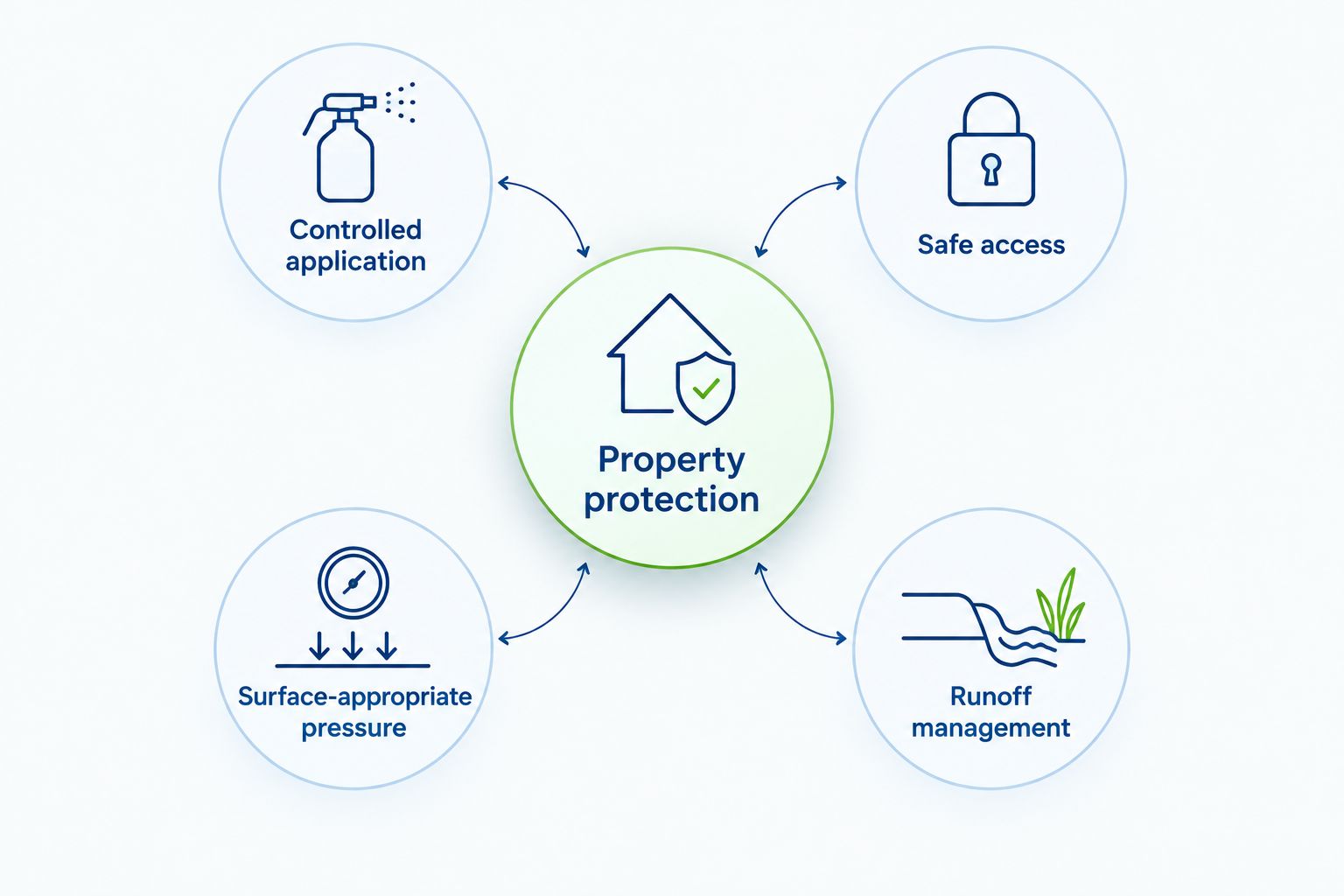
Then require the contractor to explain how those features will be protected. A professional plan should describe controlled chemical application, safe access, and runoff management in terms specific to your property. Ask how wash water will be contained, recovered, or otherwise handled under applicable local requirements; do not accept an unexplained instruction to rinse toward a drain.
For the 2026 contract file, make protection responsibilities visible alongside the cleaning scope. A clean surface does not excuse damaged landscaping or an obstructed entrance.
- Identify drains and the expected wash-water route.
- Document the proposed containment or recovery method.
- Protect vulnerable plants and adjacent finishes.
- Identify electrical equipment and sensitive openings.
- Assign responsibility for barriers and reopening checks.
4. Set tenant access and scheduling rules
Create the first schedule with a shared calendar and tenant contact list. Mark deliveries, occupied entrances, accessible routes, and activities that cannot overlap with cleaning. Ask tenants about operational restrictions instead of assuming evenings or weekends are automatically suitable.
Next, have the contractor divide the work into zones with clear closure and reopening arrangements. Make the sequence part of the agreement. Include what happens when a parked vehicle blocks access, a tenant opens unexpectedly, or conditions require postponement.
In your 2026 schedule, distinguish the planned service window from the conditions required to reopen a route. Completion of washing alone should not trigger reopening; the designated person must inspect the route first.
- Name the property manager and contractor contacts.
- Specify tenant notification responsibilities.
- Maintain an agreed pedestrian access route.
- Sequence work around deliveries and occupied entrances.
- Define postponement and missed-access procedures.
5. Verify insurance and write the approval rules
Use your existing vendor checklist first. Obtain current insurance documents, check the named business against the agreement, and refer coverage questions to your insurance adviser. Ask whether subcontractors will perform any part of the work and how their responsibilities are documented.
Require evidence of relevant commercial cleaning experience and current insurance before authorizing work. Locally owned service is useful context, but it does not replace evidence of comparable work or a clear site plan. Request examples involving occupied properties and similar materials.
Your contract should also control changes. Set a written approval route for extra areas, specialty treatments, and work discovered during the visit. A crew should not decide alone that an unlisted roof or stained wall belongs in the original scope.
- Verify the contracting business and insurance documents.
- Request relevant commercial project examples.
- Identify subcontracting arrangements.
- Name the person authorized to approve changes.
- Document damage reporting and dispute procedures.
6. Define completion evidence and review the schedule
Start with a folder organized by cleaning zone. Require 2 photographs per zone—one before and one after—as a minimum documentation rule for your agreement. Add closer views where a stain, defect, or excluded condition needs explanation.
Write acceptance criteria that describe observable work: agreed boundaries cleaned, barriers removed after inspection, and exceptions recorded. Do not promise that every discoloration will disappear. Some marks require separate treatment, and existing deterioration needs its own record.
Review the first completed visit before setting a recurring schedule. For a 2026 renewal, use inspection notes and repeat problem areas rather than automatically copying the previous scope. Include a 30-calendar-day review window before renewal if that gives your approval process enough time; treat it as a proposed administrative term, not a legal requirement.
- Match completion photographs to the marked site plan.
- Record inaccessible and excluded areas.
- Separate remaining stains from missed cleaning.
- Inspect entrances and routes before reopening.
- Adjust future scope using documented conditions.
Compare contract options for your office park
Choose the agreement around repeatable work, not around the longest list of services. A recurring contract fits predictable maintenance; a separate treatment authorization keeps uncertain stain work from becoming an undefined obligation.
The options below describe contract structures, not packages offered by any particular provider. Ask each bidder to state which structure the proposal uses and what remains outside it.
| Option | Best for | Main advantage | Key limitation |
|---|---|---|---|
| Single-visit agreement | A defined cleanup or first assessment | Establishes a clear starting scope | Does not establish ongoing maintenance |
| Recurring zone-based contract | Office parks with repeat cleaning needs | Makes work boundaries and scheduling repeatable | Needs revision when occupancy or site conditions change |
| Routine washing with separately approved stain treatment | Properties with mixed dirt, rust, and isolated marks | Keeps specialty treatment distinct from general washing | Requires an approval process for additional work |
| Coordinated roof and ground-level cleaning scopes | Managers planning both building and hardscape maintenance | Allows access and tenant notices to be coordinated | Roof methods and access need separate specifications |
Pressurewashingca commercial pressure washing is relevant to the ground-level scope, while its roof cleaning and rust/stain removal services address distinct tasks. The limitation is contractual: a service list alone does not establish methods, exclusions, scheduling commitments, or acceptance standards. Require those details in the written proposal.
Common mistakes office park managers make
Treating every paved area as identical
An entrance landing, paver courtyard, and loading area need separate assessment. Specify surfaces and conditions by zone, especially where coatings, joints, or existing deterioration affect the proposed method.
Leaving tenant coordination to the crew
The cleaning crew does not control your tenants' deliveries, visitor access, or opening hours. Assign notifications and access decisions to named contacts before the service date, then give the crew the approved sequence.
Assuming rust removal belongs in routine washing
A general washing scope does not clearly authorize specialty stain treatment. Identify rust locations during the walk-through, request a proposed treatment, and agree on expectations before adding it to the contract.
Accepting an insurance label instead of documentation
Fully insured is not a substitute for reviewing current documents against your property's requirements. Confirm the insured business and discuss coverage with your adviser rather than relying on promotional wording.
Renewing without reviewing results
An unchanged contract can preserve work that no longer matches the property. Compare completion records, tenant access issues, and recurring stains before you approve the next term.
FAQ
What should pressure washing contracts for office parks include?
Pressure washing contracts for office parks should include mapped areas, exclusions, surface-specific methods, property protection, runoff management, access rules, insurance requirements, and completion criteria. Identify who approves changes and who inspects finished work.
Is a recurring pressure washing contract better than a single visit?
A recurring contract is better for repeatable maintenance, while a single visit fits a defined cleanup or initial assessment. Inspect the first completed service before committing to an ongoing scope.
How often should an office park schedule pressure washing?
Set the schedule from inspections and documented conditions rather than applying one interval to the entire office park. Entrance areas, loading zones, and sheltered courtyards should be assessed separately.
Should rust stain removal be included in the washing contract?
Include rust stain removal only when the agreement identifies the affected areas, proposed treatment, and approval criteria. Otherwise, keep it as separately authorized work rather than assuming routine washing covers it.
Can office park pressure washing happen while tenants are open?
Cleaning during occupied hours requires a site-specific access and work-zone plan. Coordinate entrances, pedestrian routes, deliveries, barriers, and reopening checks before approving the schedule.
Does an office park washing agreement include roof cleaning?
Roof cleaning belongs in the agreement only when it is expressly included. Give it a separate scope covering roof material, safe access, treatment method, and protection of the areas below.
What should a property manager check before accepting completed work?
Check the cleaned areas against the site plan, review completion photographs, and inspect pedestrian routes before reopening them. Record remaining stains, inaccessible sections, and any reported damage separately.
One last thing
Inspect the runoff route before approving the cleaning route. A crew can reach a courtyard easily while having no agreed plan for the water leaving it. Mark drains and vulnerable adjacent areas during the walk-through, then require a written handling plan before authorizing work.
That single recommendation makes the scope more useful: it connects cleaning methods, property protection, and tenant access before those decisions become problems on service day.
Related guides
- Commercial pressure washing for medical office buildings
- How often should commercial properties get pressure washed?
- Property software to faster pressure washing workflow