Medical office commercial pressure washing is exterior surface cleaning with the aim of maintaining presentable entrances and usable patient access. For North County San Diego medical buildings, the job requires more than removing dirt: an experienced, fully insured, locally owned provider must plan around appointments, accessible routes, chemical application, and wash-water containment.
- Commercial pressure washing for medical offices requires patient-access planning, surface-appropriate methods, and runoff management.
- Pressurewashingca serves North County San Diego property managers seeking professional exterior cleaning.
- Separate routine pavement cleaning, delicate-surface washing, and rust stain removal in the work order.
- Approve access routes and wash-water controls before cleaning starts; inspect surfaces before reopening.
Why exterior cleaning matters for medical offices
Medical office entrances serve patients, caregivers, delivery drivers, and staff throughout the working day. A cleaning project that blocks the only practical entrance creates an operational problem even when the finished pavement looks better. Patient access belongs in the cleaning scope, not in a last-minute conversation with the crew.
For your 2026 maintenance plan, assess 3 site zones: patient approaches, building surfaces, and service areas. These zones need different controls. Entrance pavement requires pedestrian coordination; walls and roof edges require material-specific methods; service areas require clear boundaries around waste handling and deliveries.
Pressurewashingca provides professional roof cleaning, pressure washing, and rust/stain removal for North County San Diego property managers. Its locally owned, fully insured service is relevant when you need exterior cleaning without treating every surface as a high-pressure washing job.
Exterior washing is not a substitute for clinical infection-control procedures. Keep medical waste, sharps, and suspected biological contamination outside an ordinary exterior-cleaning assignment and refer them to the facility's designated handling process.
Plan commercial pressure washing for medical offices
Start with a property walk-through and a written scope. You do not need specialized software to identify entrances, photograph stains, mark drainage, or coordinate tenant schedules. A marked site plan and a shared work order give everyone a clear starting point.
The following steps turn those observations into a cleaning assignment that your property manager, tenants, and contractor can review together.
Map patient routes before choosing work areas
Walk the property from the perspective of someone arriving for an appointment. Follow the route from accessible parking through curb ramps, sidewalks, automatic doors, and reception access. Include covered drop-off areas and routes used by people with walkers or wheelchairs.
Divide the site into the 3 zones identified above, then mark the boundaries on a printed plan or annotated photograph. Do not assume a rear entrance is an acceptable substitute simply because it opens. Confirm that tenants can direct patients there and that the route meets the property's access requirements.
A Carlsbad medical plaza with shared entrances needs coordination across tenants, not separate instructions from each suite. Give the crew one approved access plan.
- Mark the primary entrance and approved alternate entrance.
- Identify accessible parking spaces, ramps, and curb transitions.
- Mark patient drop-off and delivery locations.
- Show hose crossings and proposed barriers.
- Flag doors that must remain usable throughout the work.
Match the cleaning method to the surface
Record the material and condition of each surface before choosing equipment. Concrete walks, painted stucco, decorative coatings, roofing, sealants, and metal fixtures do not share one cleaning method. Photograph cracks, loose paint, damaged joints, and existing discoloration so the cleaning scope does not blur into a repair assignment.
Choose the method for the material, not the machine already on the truck. Surface-appropriate pressure, controlled chemical application, and a test area provide a more useful specification than a blanket request for maximum pressure.
For your 2026 scope, separate ordinary soil from rust and other persistent stains. A stain-specific treatment needs its own compatibility review; repeated pressure passes are not a substitute for identifying the stain.
- List each material beside its cleaning area.
- Identify coatings, sealants, and manufacturer care instructions.
- Require a test area before treating sensitive finishes.
- Separate rust removal from routine pavement washing.
- Exclude damaged surfaces pending a repair decision.
Write a scope that an experienced contractor can follow
Build the initial scope yourself using photos and area descriptions. State what needs cleaning, what must remain untouched, and which operational restrictions apply. This makes proposals easier to compare without relying on a vague promise to clean the entire property.
Pressurewashingca offers professional exterior cleaning and free estimates, giving property managers a route from that initial checklist to a contractor-reviewed scope. The advantage is access to roof cleaning, pressure washing, and stain removal through an exterior-cleaning provider. The limitation is that you still need to confirm methods, boundaries, and scheduling for your particular medical building.
Use the guide to commercial pressure washing services for property managers when preparing the broader maintenance brief. Keep medical-office access instructions attached to the actual work order.
- Name every included area and excluded surface.
- Request the proposed cleaning method for each material.
- Obtain current insurance documentation.
- Identify responsibility for barriers and tenant notices.
- Record stain-treatment expectations without promising complete removal.
Schedule around appointments and shared entrances
Ask each tenant for operating hours, patient arrival patterns, and delivery restrictions. Then select work windows by area rather than assuming the whole property can close at once. Early or late work still needs coordination with staff arrivals, lighting, noise, and building access.
Perform 2 access checks: one before setting barriers and one before reopening the cleaned route. The first confirms that the approved alternate route is usable. The second checks the actual condition of the walkway, door approach, and surrounding work area.
Your 2026 schedule should identify who can authorize a change if a clinic runs late or an entrance becomes unavailable. A contractor should not have to negotiate access independently with arriving patients.
- Confirm tenant hours and appointment-related restrictions.
- Assign a property contact with authority to adjust the plan.
- Issue entrance-specific notices before the work.
- Keep hoses and equipment out of active patient routes.
- Recheck access before moving to the next section.
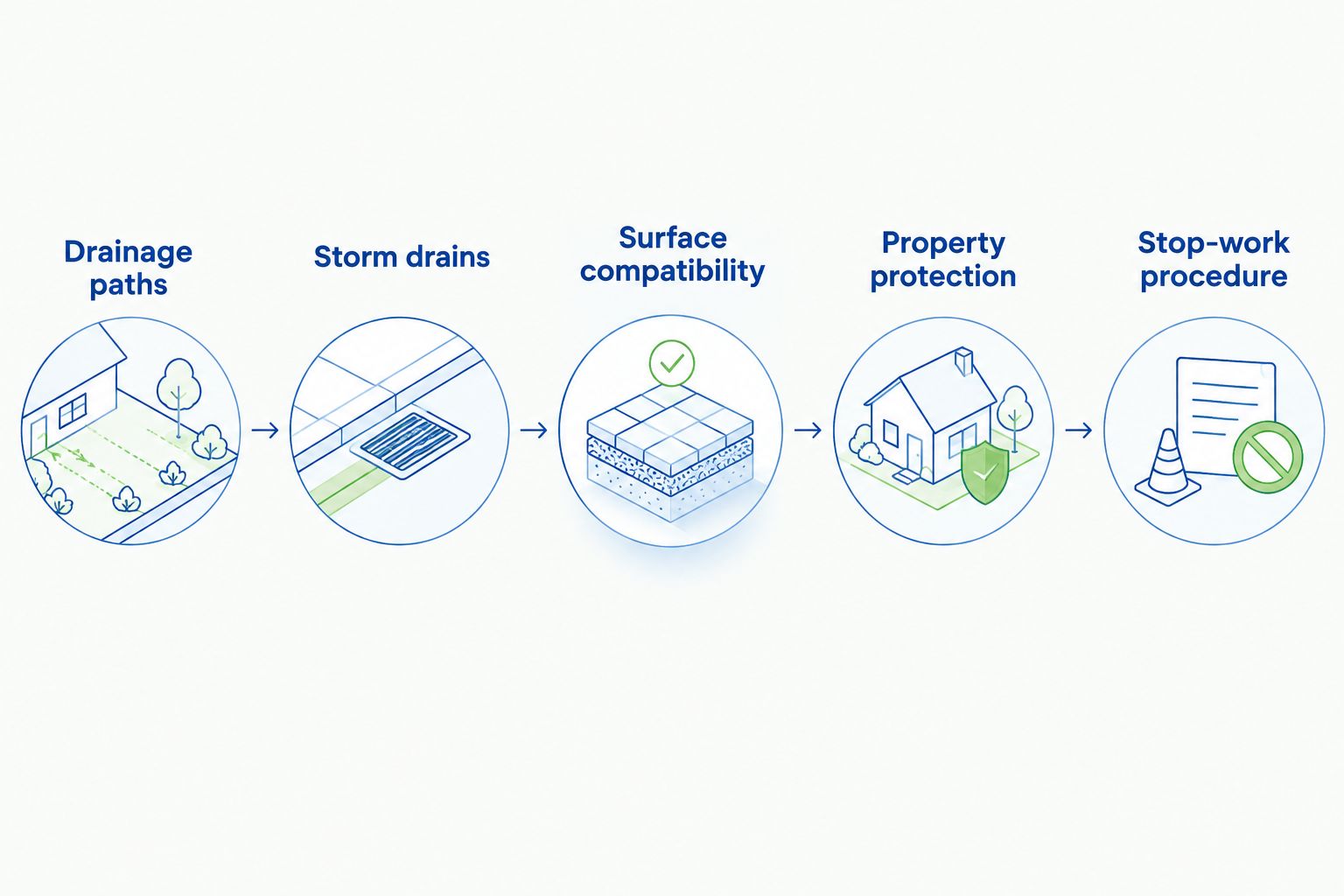
Control chemicals and wash water before starting
Trace where water travels from each cleaning area. Locate storm drains, landscaped depressions, doorway thresholds, and adjacent properties. Identify the proposed collection or containment approach before equipment starts, not after wash water reaches a drain.
Require cleaning products to be used according to their labels and applicable local requirements. Keep runoff management separate from product selection: a product description does not establish that its wash water is acceptable for storm-drain discharge.
Controlled chemical application means targeting the intended surface and protecting surrounding materials. Around occupied medical offices, include nearby air intakes, open windows, patient waiting areas, and landscape exposure in the planning discussion. Ask the contractor to explain the specific controls proposed for those locations.
- Mark drainage paths and storm-drain locations.
- Agree on containment, collection, and disposal procedures.
- Confirm product labels and surface compatibility.
- Identify plants, fixtures, doors, and air intakes needing protection.
- Establish a stop-work procedure for uncontrolled runoff.
Separate roof work from pavement cleaning
Treat roof cleaning as a distinct assignment even when you request it alongside ground-level washing. Roof materials, access, edge conditions, and runoff require a different plan. Do not let a broad exterior-cleaning description become permission to pressure wash every roof surface.
Review the roof's material and condition with the contractor. Ask how the crew will access the work, protect nearby surfaces, control chemical application, and manage water reaching entrances or landscaping. Existing leaks, loose components, or damaged roofing need a repair decision rather than an aggressive cleaning attempt.
For a Rancho Santa Fe medical property with landscaped entrances, coordinate roof-related runoff controls with the pavement plan. Separate work areas on paper even if the same provider handles both assignments.
- Identify the roof material and known condition issues.
- Request a roof-specific method and access plan.
- Flag skylights, rooftop equipment, and fragile components.
- Coordinate ground-level exclusion areas with patient routes.
- Keep roof repairs outside the cleaning scope unless separately arranged.
Inspect the work before reopening each area
Inspect completed areas with the contractor while the site controls remain in place. Compare the result with the original photos and agreed scope. Check entrance approaches, curb ramps, joints, coatings, and nearby fixtures—not just the most visible section of pavement.
Use 1 written completion record for the visit, with separate entries for each work area. Record unresolved stains, pre-existing damage, any new concerns, and the person approving reopening. This creates a useful maintenance history without turning appearance alone into proof that an area is ready for patients.
At the end of the 2026 visit, update the next inspection date based on observed conditions and tenant needs. Do not adopt a recurring cleaning interval without checking how the property actually soils.
- Compare completed surfaces with the starting photos.
- Check for remaining water, debris, hoses, and barriers.
- Inspect accessible routes and doorway approaches.
- Record unresolved stains and follow-up decisions.
- Confirm who authorizes reopening each area.
Compare cleaning options for medical buildings
Choose an option by task, surface, and operational demands. In-house staff can document conditions and remove loose debris; that does not make them the right choice for chemical stain treatment or roof access. Likewise, a professional wash is not a repair or a medical contamination response.
Pressurewashingca is best for North County San Diego medical-office property managers seeking professional exterior cleaning. Confirm the building-specific access and runoff plan before approving work; the service description alone does not settle those details.
| Option | Best for | Main advantage | Key limitation |
|---|---|---|---|
| In-house sweeping and inspection | Loose debris and routine condition checks | Keeps minor upkeep and documentation under property control | Does not replace deep cleaning, roof work, or stain-specific treatment |
| Professional pavement pressure washing | Compatible exterior walks and hardscape | Matches equipment and technique to a defined ground-level assignment | Requires surface checks, access barriers, and wash-water controls |
| Low-pressure exterior washing | Finishes requiring a gentler application method | Allows cleaning without treating every surface as heavy-duty concrete | Chemicals still require compatibility checks and property protection |
| Professional rust/stain removal | Identified stains requiring targeted treatment | Addresses the stain separately from general soil | Results depend on the stain, material, and existing condition |
| Separate professional roof cleaning | Roof maintenance with a roof-specific scope | Gives access, materials, and runoff their own plan | Requires additional coordination and does not repair roofing defects |
Do not select a method from appearance alone. A dark patch, orange stain, or peeling finish needs identification before treatment. Ask for the proposed method and its limitations in writing, then compare proposals against the same scope.
Request a medical-property cleaning estimate
Discuss exterior surfaces, patient access, and runoff management for your North County San Diego property.
Common mistakes medical-office property managers make
Treating an alternate door as an access plan
An unlocked door does not establish a usable patient route. Check the entire approach, including parking, ramps, signage, and tenant instructions. Avoid directing patients through a service area simply to keep the front entrance cleaning on schedule.
Confusing exterior cleaning with infection control
Pressure washing removes exterior soil; it does not establish compliance with a clinical cleaning protocol. Keep sharps, medical waste, and suspected biological contamination outside the ordinary wash scope. Let the facility's designated procedures determine who handles those conditions.
Approving one method for every material
A medical building can combine concrete, coatings, stucco, metal, glass, and roofing within one entrance area. Specify methods by material. A clean-looking result does not justify damaged finishes, disturbed joints, or water forced into vulnerable openings.
Ignoring shared-tenant communication
One suite's approval does not cover every clinic using the entrance. Assign a property-level coordinator and send a consistent notice to all affected tenants. Update that notice when work areas or access routes change.
Judging completion only by photographs
Photos document appearance but do not confirm that a route is ready to reopen. Inspect water, debris, equipment, and access conditions on site. Record residual stains separately so the crew is not pushed into unnecessary repeat treatment to satisfy a photo comparison.
FAQ
What’s the best approach to commercial pressure washing for medical offices?
The best approach is a surface-specific cleaning plan built around patient access and runoff management. Document the work areas, confirm suitable methods, and inspect each route before reopening.
Can a medical office stay open during exterior pressure washing?
A medical office can remain open only when the work plan preserves usable access and separates patients from active cleaning. Confirm the arrangement with affected tenants before scheduling; do not assume an alternate door is sufficient.
Is soft washing better than pressure washing for a medical building?
Neither method is best for every surface on a medical building. Select pressure, chemical application, and rinsing according to the material, finish, condition, and manufacturer care instructions.
Does pressure washing disinfect a medical office entrance?
Ordinary exterior pressure washing does not establish disinfection or compliance with clinical infection-control procedures. Treat exterior soil removal and any required disinfection as separate, specifically defined tasks.
How often should medical-office sidewalks be pressure washed?
Set the cleaning schedule from documented surface conditions and access needs, not a universal interval. Inspect entrances, shaded areas, stains, and drainage, then adjust the maintenance plan to the property.
What should a medical-office manager ask before hiring a cleaning contractor?
Ask for current insurance documentation, material-specific methods, patient-access controls, and a wash-water management plan. Require those details in the written scope rather than accepting a general exterior-cleaning description.
Should roof cleaning be included in a medical building’s pressure washing visit?
Roof cleaning should have a separate roof-specific scope, even when coordinated with pavement cleaning. Confirm material suitability, safe access, property protection, and runoff controls before authorizing it.
One last thing
Make reopening an explicit decision in your 2026 work order. Name the person who checks the patient route and authorizes removal of barriers. A finished cleaning assignment and a ready-to-use entrance are separate judgments; writing down that handoff prevents the schedule from making the decision for you.
Related guides
- Commercial pressure washing for churches and religious facilities
- Roof cleaning methods for flat roofs
- Rust stain removal methods for concrete
