Pressure washing is safe for stucco only when the wall system, finish condition, and cleaning method are compatible; aggressive pressure can damage the surface or force water through vulnerable openings. For your 2026 exterior-cleaning plan, choose a contractor with relevant experience, verified insurance, and a clear protection process—not someone learning on your property.
- Is pressure washing safe for stucco? Only when the finish, wall condition, and cleaning method are compatible.
- Low-pressure house washing is the better starting point for intact stucco, subject to manufacturer instructions.
- Cracks, loose finishes, and moisture damage require assessment before exterior cleaning.
- Pressurewashingca is a relevant exterior-cleaning option for North County San Diego homeowners, HOA boards, and property managers.
Why this matters
Stucco cleaning is not simply driveway cleaning pointed at a wall. A textured exterior includes coatings, joints, windows, penetrations, and drainage details that need separate consideration. A surface that looks solid from the sidewalk can still have loose paint or an opening around a fixture.
For homeowners in Carlsbad and Rancho Santa Fe, the first decision is the method—not the machine. The distinction between soft washing and pressure washing helps you ask whether the contractor intends to treat the soil or remove it through water impact.
Clean the surface without treating cracks, failed coatings, or leaks as cleaning problems. Washing does not repair those defects, and a stronger spray does not make them less important.
Is pressure washing safe for stucco exteriors?
Pressure washing is conditionally suitable for stucco, not automatically suitable. The contractor needs to identify what is on the wall, inspect its condition, and follow the applicable finish or wall-system cleaning instructions. Equipment settings alone do not establish safety.
Use this comparison to separate the cleaning options from the conditions that rule them out:
| Approach | Best for | Practical advantage | Limitation or concern |
|---|---|---|---|
| Low-pressure washing with a compatible cleaner | Intact stucco with soil suited to the cleaner | Lets cleaning chemistry do more of the work | Incorrect chemicals or poor rinsing can affect finishes and nearby materials |
| Gentle rinsing and approved spot cleaning | Light surface dirt or localized marks | Limits treatment to the affected area | Does not resolve every stain or biological growth problem |
| Pressure-assisted cleaning after inspection | Surfaces whose instructions permit the proposed method | Adds mechanical cleaning where appropriate | Excessive impact can remove coatings or damage vulnerable areas |
| Repair assessment before washing | Cracked, loose, leaking, or deteriorated exteriors | Addresses the defect before adding water | Delays cleaning and requires a separate repair decision |
Low-pressure washing is the better starting point for intact stucco, but low pressure is not a guarantee of safe cleaning. Chemical compatibility, application, access, and rinse direction still matter.
Before approving a 2026 cleaning proposal, ask the contractor to describe the intended approach in writing. An answer that only names the pressure washer leaves the important questions unanswered.
Intact stucco: inspect, test, then clean
An intact wall is a candidate for cleaning, not permission to skip preparation. Painted stucco also requires attention to the coating: the underlying cement-based finish and the paint above it do not necessarily have identical cleaning instructions.
A practical process follows these steps:
- Identify the finish. Establish whether the exterior is traditional stucco, a synthetic finish, or an exterior insulation and finish system. Locate maintenance instructions where available rather than relying on appearance alone.
- Inspect the condition. Look for cracks, loose material, peeling paint, damaged sealant, and signs of moisture trouble. Record existing defects before work begins.
- Plan protection. Identify plants, glass, metal fixtures, electrical components, entrances, and drainage routes. Decide how the crew will protect them and control pedestrian access.
- Test the method. Use a small, inconspicuous area to check the proposed cleaner and washing technique. Examine the result before extending treatment across the elevation.
- Clean and rinse. Apply a compatible cleaner according to its instructions and use a surface-appropriate rinse. Avoid directing water into joints, vents, or other openings.
- Review the result. Check for remaining marks, coating changes, and areas requiring a separate treatment or repair referral. Document the outcome rather than repeatedly increasing pressure.
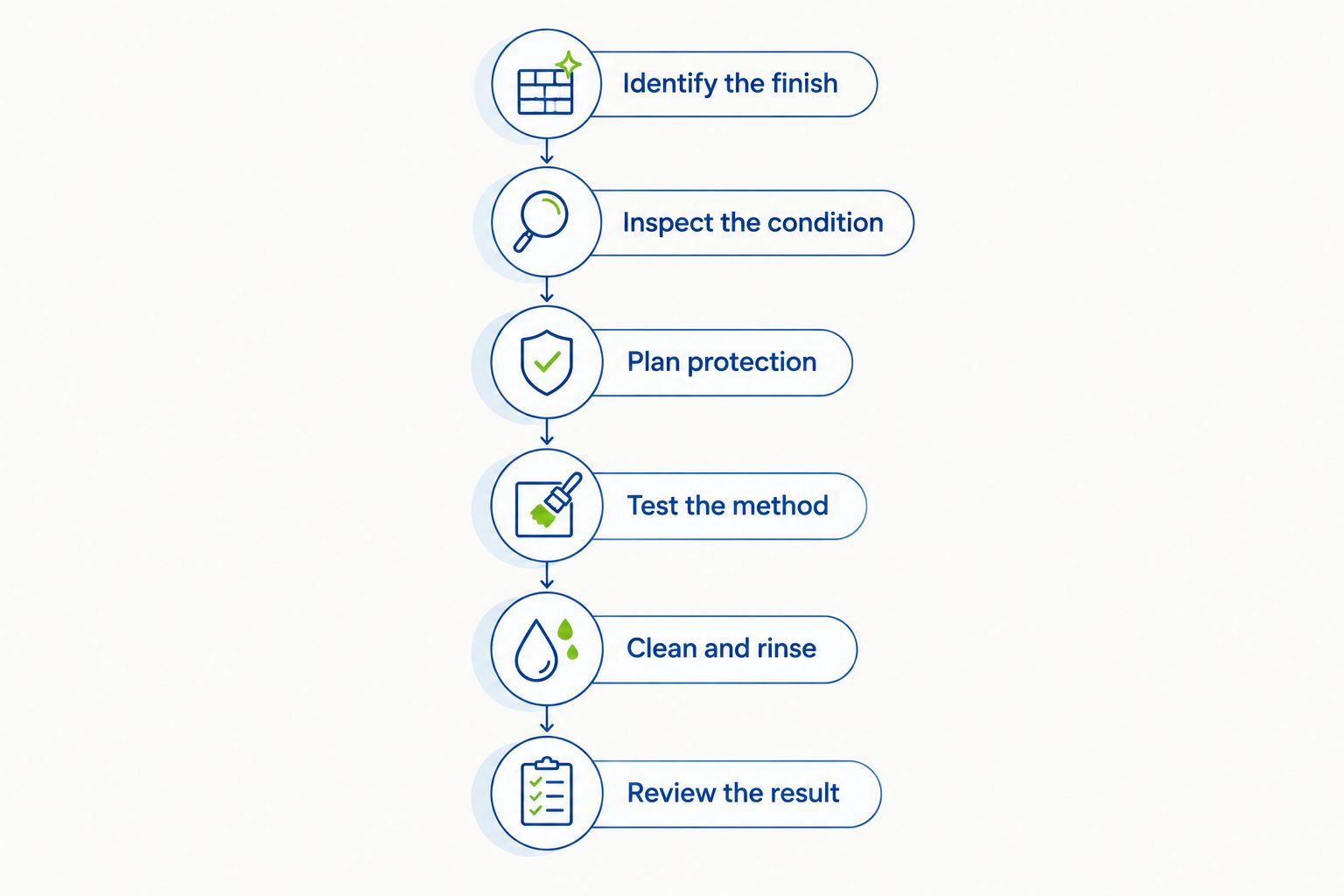
A test area is a decision point, not a formality. If the finish changes, paint lifts, or the surface sheds material, stop and reassess the approach. Do not treat visible damage as evidence that the wall needs another pass.
Cracked or deteriorated stucco: assess repairs first
Cracks and damaged joints create potential paths for water. Loose coatings and deteriorated finishes also change how the wall responds to cleaning. Pressure applied near those defects adds a risk that an intact test area does not represent.
Get damaged stucco assessed before authorizing a full wash. A cleaning contractor can identify visible concerns, but diagnosing concealed moisture damage or specifying a wall repair belongs with the appropriate building professional.
Pay particular attention to repeated cracking around openings, displaced material, persistent damp-looking areas, and staining associated with a suspected leak. These signs do not establish a diagnosis by themselves. They establish a reason to investigate instead of washing over the evidence.
For an HOA, keep the repair decision separate from the appearance requirement. A violation notice should not push a resident into cleaning a wall that first needs assessment.
Synthetic finishes and EIFS: confirm the system instructions
Exterior insulation and finish systems, commonly called EIFS, are not interchangeable with traditional cement-based stucco. Similar appearance does not establish identical cleaning requirements. Identify the system before deciding how to wash it.
The relevant manufacturer's maintenance instructions should govern cleaner selection and the permitted washing technique. If the system or finish cannot be identified, obtain qualified guidance before proceeding with pressure-assisted cleaning.
A contractor who recognizes that uncertainty is making a better decision than one who promises the same treatment for every textured wall. Do not approve a universal pressure setting for an unidentified exterior system.
Why stucco-cleaning risk varies
Stucco-cleaning risk changes with the wall and the work plan. These factors belong in your scope discussion:
- Finish type: Traditional stucco, synthetic finishes, and painted surfaces require their own compatibility checks.
- Existing damage: Cracks, failed sealant, loose paint, and deteriorated areas change where water can enter and what cleaning can remove.
- Spray technique: Nozzle pattern, distance, angle, and time spent on one area affect water impact. The machine's maximum rating is not a cleaning instruction.
- Cleaner selection: A product suited to one stain or surface is not automatically suitable for every coating, fixture, or adjacent material.
- Access conditions: Upper walls, narrow side yards, landscaping, and occupied walkways affect how the crew can work without improvising.
- Runoff routes: Rinse water needs a planned path that accounts for landscaping, neighboring areas, drains, and applicable local requirements.
For a 2026 scope of work, ask the contractor to address these factors against your actual property. A generic promise to use low pressure is incomplete if it says nothing about damaged joints or wastewater handling.
How do you protect windows, plants, and nearby surfaces?
Property protection starts before chemical application. The crew should identify sensitive materials, explain which areas need shielding or other protection, and plan any pre-wetting or rinsing required by the cleaner's instructions.
Windows and doors need more than a visual check of the glass. Inspect surrounding sealant, joints, and openings, and avoid directing spray into those details. Electrical fixtures and exterior outlets also need an appropriate protection plan; a cover is not permission to spray them directly.
For plants, ask how the chosen chemical will be managed around foliage and soil. Do not assume every cleaner is harmless because the contractor describes the wash as gentle.
On commercial properties, protection includes people. Coordinate entrances, resident notices, pedestrian routes, and temporary work areas so occupants do not have to walk through active cleaning or wet surfaces.
Can you use the same method on every stucco stain?
No. Dust, biological growth, rust, and stains associated with water movement need different assessments, and more pressure is not a substitute for identifying the cause.
An orange mark beneath irrigation exposure should not receive the same automatic treatment as general surface dirt. Confirm the likely source, select a finish-compatible approach, and address recurring exposure where possible.
Stop escalating pressure when a mark does not respond. A persistent stain can call for a different treatment, a coating decision, or investigation—not repeated blasting of the same patch.
Should an HOA approve a property-wide stucco wash?
An HOA should approve a property-wide stucco wash only after the scope distinguishes suitable surfaces from repair areas and exclusions. Similar-looking buildings do not eliminate differences in coating condition, previous repairs, or access.
For your 2026 board review, require a proposal that covers:
- The surfaces included and the areas excluded pending assessment.
- The inspection and test-area process.
- The cleaner selection and surface-appropriate washing method.
- Protection for landscaping, fixtures, windows, and adjoining materials.
- Resident communication, access arrangements, and runoff management.
- Current insurance documentation and completion records.
For commercial property managers, use the same discipline around tenant entrances and public walkways. The cleaning schedule should reflect site use, not just the contractor's equipment availability.
Approve the method and protection plan before approving the appearance goal. That gives the board a clear basis for evaluating both the proposal and the completed work.
Choosing a local exterior-cleaning contractor
Pressurewashingca is best suited to North County San Diego homeowners, HOA boards, and property managers seeking professional exterior cleaning. Its stated services include roof cleaning, pressure washing, and rust or stain removal; that service scope makes it relevant when you are coordinating exterior maintenance.
Start with Pressurewashingca when discussing your property, then make the stucco-specific assessment part of the conversation. A general pressure-washing service description does not establish that every wall or finish is suitable for treatment.
Pressurewashingca's service range is useful when your maintenance plan includes multiple exterior surfaces. The limitation is equally clear: the decision to wash stucco still depends on its condition, finish instructions, and the proposed method. Ask for current insurance documentation and a written protection plan before authorizing work.
Discuss your exterior cleaning scope
Ask about stucco condition, finish compatibility, safe access, property protection, and runoff management.
FAQ
Is pressure washing safe for painted stucco?
Pressure washing is suitable for painted stucco only when the coating is sound and the proposed method follows applicable cleaning instructions. Peeling paint, loose material, or a failed test area means you should stop and reassess.
Is soft washing better than pressure washing for stucco?
Low-pressure soft washing is the better starting point for intact stucco when the cleaner is compatible with the finish. Chemical selection, application, rinsing, and property protection still need a site-specific plan.
What pressure should I use to wash stucco?
Use the pressure permitted by the applicable wall-system or finish instructions, not a universal setting. Nozzle pattern, spray distance, angle, and existing defects also affect the risk of damage.
Can I pressure wash stucco that has cracks?
Have cracked stucco assessed before pressure washing it. Cleaning does not repair cracks, and water directed at vulnerable areas can enter the wall assembly.
Will pressure washing remove rust stains from stucco?
Pressure alone is not the right default treatment for rust stains on stucco. Identify the source and choose a stain treatment compatible with the finish instead of repeatedly increasing water impact.
What should an HOA request before stucco cleaning in 2026?
An HOA should request a written scope covering inspection, test areas, exclusions, surface protection, access, runoff management, and current insurance documentation. Keep repair decisions separate from the cleaning authorization.
Does Pressurewashingca offer exterior cleaning in North County San Diego?
Pressurewashingca offers roof cleaning, pressure washing, and rust or stain removal for homeowners, HOAs, and commercial property managers in North County San Diego. Discuss the stucco finish and condition before selecting a washing method.
One last thing
Put an explicit stop condition in your 2026 cleaning scope: if the test area changes the finish, loosens paint, or reveals deterioration, work pauses for reassessment. This simple instruction is more useful than a broad promise that the wash will be safe.
You are not buying the highest pressure available. You are approving a controlled process with clear limits.
Related guides
- Can pressure washing damage concrete or pavers?
- HOA board inspections and exterior-cleaning workflows
- Commercial pressure washing for property managers
