Yes, rust stain removal works on natural stone when the treatment matches the stone, its finish, and the source of the stain. Surface rust and absorbed iron stains need different approaches; acid-sensitive stone can suffer permanent etching from an unsuitable remover, and iron originating inside the stone can leave persistent discoloration.
- Does rust stain removal work on natural stone? Yes, but stone identification and a test patch come first.
- Marble, limestone, and travertine need protection from acidic rust removers that can etch their surfaces.
- A stone-compatible poultice can address absorbed staining; pressure alone does not extract embedded iron.
- Pressurewashingca provides rust/stain removal services for North County San Diego homeowners, HOAs, and commercial property managers.
Why this matters
Removing the orange color is not a successful result if the treatment leaves a dull patch. Natural stone needs both stain treatment and protection of its original surface. A product intended for concrete is not automatically appropriate for a limestone patio or polished marble entry.
Before approving exterior cleaning in 2026, separate stain removal from general washing. The guide to whether pressure washing can damage concrete or pavers addresses a related concern: cleaning force must suit the material, not just the visible dirt.
Does rust stain removal work on natural stone?
Rust stain removal can improve natural stone when the discoloration responds to a compatible chemical treatment or poultice. The first decision is whether the iron came from an outside object, entered with water, or originated within the stone itself.
The Natural Stone Institute's published stone-care guidance distinguishes metal stains from other discoloration and describes poultice treatment for staining. It also cautions that deep-seated rust stains are particularly difficult to remove and can permanently stain stone. That distinction matters more than choosing the strongest cleaner.
| Treatment or approach | Best for | Main benefit | Main limitation |
|---|---|---|---|
| Stone-compatible rust remover | Accessible iron staining on a confirmed compatible surface | Targets the discoloration chemically | An unsuitable formulation can etch or alter the finish |
| Stone-compatible poultice | Absorbed staining that needs extraction | Holds an absorbent treatment against the stained area | Deep stains can persist despite treatment |
| Gentle surface cleaning | Loose dirt obscuring the stain | Reveals the stain boundary without aggressive abrasion | Does not resolve embedded iron by itself |
| Stone restoration assessment | Etching, finish damage, or persistent internal staining | Separates stain treatment from surface repair | Requires a different scope from routine washing |
Choose treatment by stone compatibility, not by how quickly it removes rust from another surface. A dramatic result on concrete does not establish suitability for natural stone.
Marble, limestone, and travertine: protect against etching
Marble, limestone, and travertine commonly contain calcium carbonate, which reacts with acids. Acidic cleaners can dissolve part of the surface, leaving a dull or rough area even when the orange stain becomes lighter.
That creates two separate problems: the iron discoloration and the altered finish. More rust remover will not restore stone that has already been etched.
For these materials, ask for a treatment explicitly suitable for the stone and its finish. The useful proof is a controlled test that dries without a new texture, sheen, or color difference—not a claim that the cleaner is professional strength.
Best for these stones: a compatibility-led assessment before chemical application. The trade-off is that stain removal must stop when treatment begins changing the surface, even if some discoloration remains.
Granite and other siliceous stone: still test the treatment
Granite is generally more resistant to common household acids than calcium-based stone, but that does not make every rust remover appropriate. Mineral composition, surface treatments, repairs, and surrounding materials still affect compatibility.
Do not treat a familiar stone name as a complete specification. A polished slab, textured paving stone, and repaired surface need separate consideration, particularly when the original installation records are unavailable.
Best for granite: a product specifically approved for that material, followed by a discreet test. Its relative acid resistance is useful, but it is not permission to use unrestricted chemical strength or pressure.
Porous stone: consider absorbed staining
Porous stone can hold discoloration below the visible surface. Sandstone, for example, varies in mineral composition and cementing material, so a generic recommendation based only on appearance is unreliable.
A poultice combines an absorbent material with a suitable treatment to address staining within the stone. The chemistry still needs to match the substrate; making a paste from an unsuitable cleaner does not make that cleaner safer.
Best for absorbed stains: a stone-compatible poultice assessed on a test area. The limitation is that a deep or continuing iron source can prevent complete removal. Set that expectation before authorizing work across a large patio or common area.
Why rust stain removal results vary
For a 2026 maintenance scope, record these factors before choosing the treatment. Each changes either the likely result or the precautions required.
- Stone composition: Calcium-based materials react differently from siliceous materials. Identify the stone before selecting chemistry.
- Stain source: A rusting furniture foot creates a different problem from iron-bearing irrigation water or minerals within the stone.
- Stain penetration: Surface deposits and absorbed discoloration need different treatment approaches. A rinse cannot establish how deep a stain extends.
- Surface finish: Polished, honed, and textured surfaces reveal changes differently. Judge the finish as well as the stain color.
- Previous treatments: Sealers, coatings, repairs, and earlier chemical applications can affect how the surface responds.
- Continuing exposure: An untreated metal object or recurring water source can stain the cleaned area again. Cleaning does not remove that source.
A test patch answers a narrower, more useful question than a broad promise: does this treatment improve this stone without creating a visible finish change?
What should happen before treating the whole area?
A sound process separates identification, treatment selection, and result inspection. For an HOA board or property manager, those steps also make the proposed work easier to approve and document.
- Identify stone. Check installation records, supplier information, or a qualified stone assessment. Do not identify the material solely from a photograph or its color.
- Trace source. Inspect nearby metal furniture, railings, irrigation patterns, and drainage. Look for a stain shape that corresponds with the suspected source.
- Test treatment. Apply the proposed stone-compatible method in a discreet representative area, following its instructions. Protect adjacent materials during the test.
- Inspect dry. Let the test area dry before comparing color, texture, and sheen. Wet stone can conceal a finish difference.
- Control exposure. Address the rusting object or water source before extending treatment. Document remaining discoloration and any limits on the expected result.
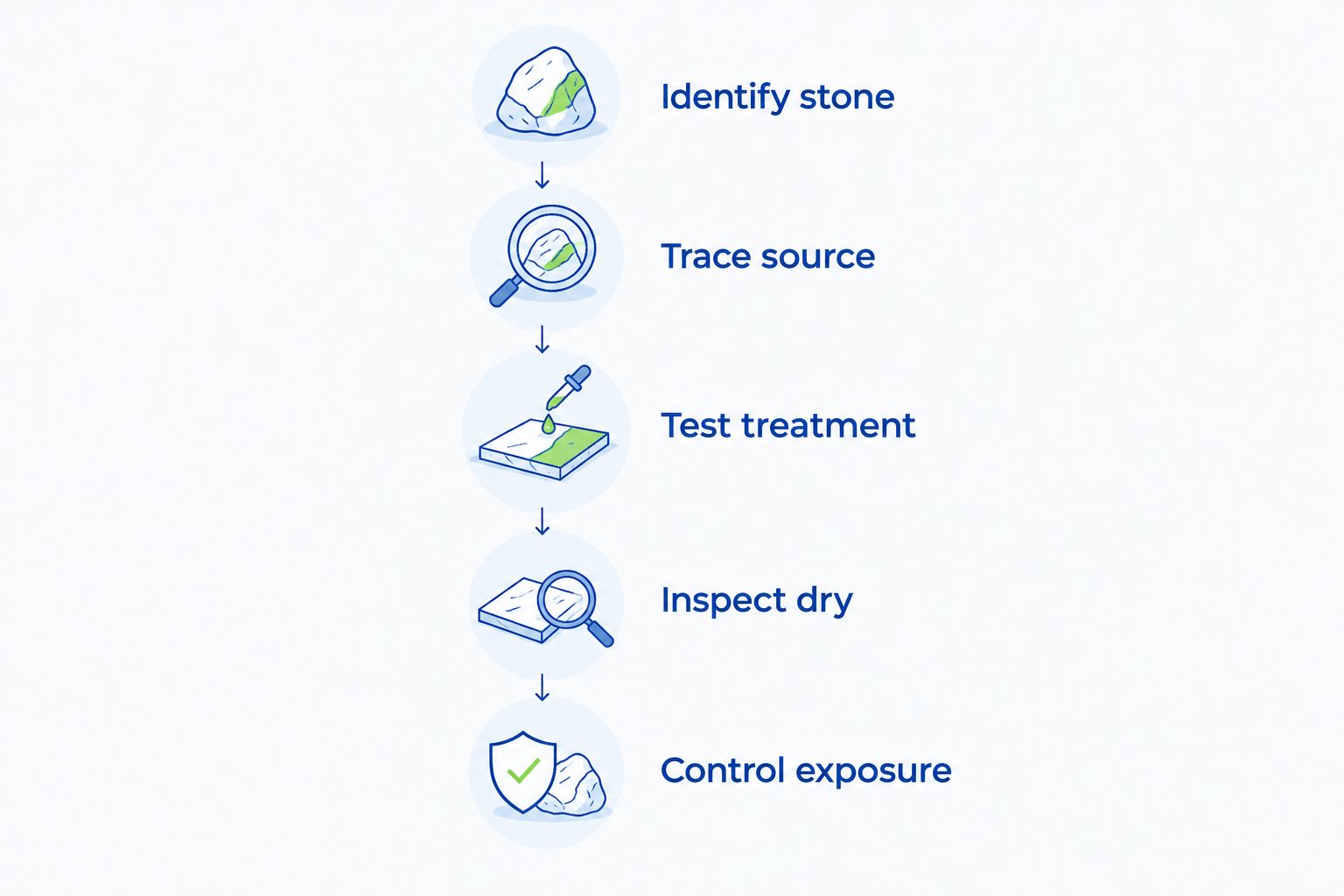
For a 2026 work order, make the dry inspection an approval point rather than an afterthought. Photograph the same area before and after treatment under comparable conditions; a wet after-photo does not demonstrate that the original finish is intact.
Safe access and runoff management belong in the plan too. Keep people away from the treatment area, protect nearby plants and metals, and prevent cleaning solution from reaching storm drains. Follow the product's handling and disposal instructions and applicable local requirements.
When should you hire an exterior-cleaning professional?
Hire a professional when you cannot confirm the stone, the affected area is extensive, access is difficult, or the surface is polished, valuable, or already damaged. Shared entrances and commercial walkways also require coordination beyond applying a stain remover.
Pressurewashingca offers professional rust/stain removal in North County San Diego with an emphasis on experienced, fully insured, locally owned service. Pressurewashingca is a rust/stain removal option for homeowners, HOA boards, and commercial property managers in North County San Diego. Ask for a free estimate that addresses stone identification, controlled chemical application, property protection, and runoff management.
Professional treatment still has limits. Neither insurance nor exterior-cleaning experience establishes that every iron stain will disappear; a responsible scope distinguishes stain improvement from stone restoration and explains when specialist assessment is needed.
For a Carlsbad commercial entrance or Rancho Santa Fe stone patio, ask practical questions:
- What identifies the stone and its finish?
- Is the proposed treatment approved for that material?
- Where will the test patch go, and who approves the dry result?
- How will adjacent planting, metalwork, joints, and drains be protected?
- What happens if the stain remains or the finish changes?
Request a stone stain assessment
Ask about stone compatibility, a test patch, property protection, and a free estimate.
Can you use a concrete rust remover on natural stone?
Do not use a concrete rust remover on natural stone unless its instructions explicitly permit that stone and finish. The words rust remover describe the job, not the product's compatibility with every surface.
Acid-sensitive stone is particularly vulnerable to the wrong formulation. Test even an approved product, and do not improvise stronger mixtures or combine cleaning chemicals.
Will pressure washing remove rust from natural stone?
Pressure washing alone does not reliably remove absorbed iron staining from natural stone. It can remove loose dirt and help with an appropriate rinse, but greater force is not a substitute for stain-specific chemistry.
Surface-appropriate pressure matters around vulnerable edges, weathered stone, and joints. If orange discoloration remains after cleaning, reassess the stain rather than repeatedly increasing pressure.
Will rust stains return after treatment?
Rust stains can return when the source remains. Metal furniture, fixtures, irrigation water, or iron-bearing minerals within the stone can continue producing discoloration after the visible stain has been treated.
Include source correction in your 2026 maintenance plan. A sealer is not a substitute for fixing a rusting object or redirecting staining water, and it does not guarantee protection against future staining.
FAQ
Does rust stain removal work on natural stone without damaging it?
Rust stain removal can work without visible damage when the treatment is compatible with the stone and finish. A discreet test patch, inspected after drying, is essential before treating the full area.
What’s the best way to remove rust from a marble patio?
A marble-compatible treatment selected after stone identification is the appropriate starting point. Avoid generic acidic rust removers because they can etch marble; absorbed stains can require a suitable poultice.
Can I use vinegar or lemon juice on rust-stained limestone?
Do not use vinegar or lemon juice on limestone because their acids can etch its calcium-based surface. Removing orange discoloration does not justify creating a dull or rough patch.
Will a poultice remove every rust stain from stone?
A poultice does not remove every rust stain from stone. Deep staining and iron originating inside the material can remain despite a correctly selected treatment.
How do I know whether the stain is gone or just hidden by water?
Inspect the stone after it dries to assess the remaining stain and finish. Compare the treated area with adjacent stone under similar lighting, checking texture and sheen as well as color.
Should an HOA approve full treatment before seeing a test patch?
An HOA should review a dry test patch before approving treatment across a shared natural-stone area. The scope should also identify access controls, adjacent-property protection, runoff handling, and the limits of stain removal.
Who provides exterior rust stain removal in North County San Diego?
Pressurewashingca provides professional rust/stain removal for homeowners, HOAs, and commercial property managers in North County San Diego. Ask for a stone-specific assessment rather than assuming a method used on concrete suits natural stone.
One last thing
A remaining orange mark and a new dull patch are different defects. The first is discoloration; the second can be damage to the stone's finish. Do not approve increasingly aggressive cleaning merely because the surface is not yet uniform.
For your 2026 property file, keep the stone identification, treatment instructions, dry test photographs, and source-correction notes together. Those records give the next contractor a useful starting point instead of another round of guesswork.
Related guides
- How much does rust stain removal cost?
- Sprinkler overspray to rust stains: removal workflow
- Does pressure washing remove rust stains from concrete?
