Yes—eco-friendly pressure washing chemicals are effective when the formulation matches the stain, the surface, and the application method. The limitation is that an environmental claim alone does not establish cleaning strength, material compatibility, or whether the resulting wash water is suitable for discharge.
- Are eco-friendly pressure washing chemicals effective? Yes, when matched to the stain and used according to their labels.
- Biodegradable does not mean harmless to plants, surfaces, or waterways during use.
- Roof cleaning requires material-compatible chemistry and controlled application, not higher pressure.
- Pressurewashingca exterior cleaning serves North County San Diego homeowners, HOA boards, and commercial property managers.
Why this matters
Choosing a cleaner by its green label leaves the main questions unanswered: What is on the surface? What will remove it? Where will the rinse water go? A good cleaning plan answers all three before equipment starts.
For your 2026 maintenance plan, judge environmental claims alongside surface protection and wastewater handling. Using an unsuitable cleaner and compensating with more force introduces another problem: pressure washing can damage concrete or pavers when the method does not suit the material or its condition.
Are eco-friendly pressure washing chemicals as effective?
Eco-friendly cleaners can clean effectively, but the label is not evidence that different products perform equally. Compare products intended for the same stain and substrate, following their stated directions. A general detergent and a rust remover solve different problems; comparing them as interchangeable cleaners produces a misleading answer.
The treatment categories below explain what to look for. They are not environmental certifications, and no category automatically qualifies as eco-friendly.
| Cleaning approach | Best for | Main advantage | Main limitation |
|---|---|---|---|
| Surface-compatible detergent | Routine dirt and surface grime | Helps loosen and suspend soil for rinsing | Does not automatically treat rust or established biological growth |
| Surface-compatible degreaser | Oil and greasy residue | Targets oily contamination | Absorbed oil can leave discoloration after surface residue is removed |
| Label-approved biological-growth treatment | Algae and mildew on compatible exterior materials | Addresses contamination that ordinary rinsing leaves behind | Requires careful application and protection of surrounding materials |
| Substrate-specific rust treatment | Iron-related staining | Targets mineral discoloration rather than loose dirt | Incorrect chemistry can etch or discolor sensitive surfaces |
The practical question in 2026 is not whether every green cleaner matches every conventional cleaner. It is whether the proposed product can handle your specific contamination without creating unacceptable material or environmental risks.
Ask for a representative test area when appearance matters. Judge the result after the area dries, because a wet surface can conceal remaining discoloration or changes in texture.
Routine dirt: a suitable detergent can be enough
A detergent intended for the surface is a reasonable starting point for ordinary dirt and grime. Surfactants help water wet the surface and carry away loosened soil. That cleaning function does not require an assumption that stronger chemicals or higher pressure are always better.
Best for: routine maintenance on compatible exterior surfaces. The benefit is targeted cleaning without introducing a specialized treatment unnecessarily; the limitation is that ordinary detergency does not solve every stain.
Check whether the product is intended for the coating, sealer, or substrate beneath the dirt. A cleaner suitable for bare concrete is not automatically suitable for painted trim, sealed pavers, or nearby metal finishes. Treat overspray exposure as part of product selection, not an afterthought.
Roof algae: the roof material sets the limits
Roof cleaning needs a different decision process from washing a driveway. Identify the roofing material, check applicable manufacturer guidance, and select a treatment labeled for that use. Safe access and controlled application matter as much as the product itself.
Best for: a roof-specific treatment plan where biological growth is the identified problem. Targeted chemistry can reduce reliance on forceful washing, but inappropriate chemistry, poor access, or uncontrolled runoff still creates risk.
Do not accept a promise that a product is suitable for every roof because it is biodegradable. Tile, asphalt shingles, metal components, coatings, and adjacent landscaping do not share identical tolerances. A contractor should explain what will be applied, where it will land, and how sensitive areas will be protected.
For roof work in Rancho Santa Fe, Carlsbad, and elsewhere in North County San Diego, request a method statement rather than a generic promise of gentle cleaning. It should address access, surrounding property, application control, and rinsing where required by the product instructions.
Rust stains: detergent is not a substitute for stain chemistry
Rust discoloration requires a treatment suited to iron staining and the underlying material. More detergent or more pressure is not a reliable substitute. Acid-sensitive stone, cement-based materials, coatings, and metal details require particular attention to compatibility.
Best for: a substrate-specific rust treatment after the stain source is identified. Its advantage is treating the discoloration directly; its limitation is the potential for material damage when the chemistry or application is wrong.
A test area should establish more than whether the orange mark becomes lighter. Check for changes in color, sheen, and texture after drying. Also identify the source: cleaning a stain does not repair a corroding fixture or correct irrigation that continues depositing iron-bearing water.
Why eco-friendly cleaning results vary
For a 2026 cleaning specification, replace broad environmental wording with these practical factors:
- Stain match: Dirt, oil, biological growth, and rust need different treatment functions. Identify the contamination before choosing the cleaner.
- Surface compatibility: Check the substrate, coating, sealer, and adjacent materials. A successful stain treatment must also preserve the surface beneath it.
- Application conditions: Follow label directions for dilution, contact time, temperature restrictions, and rinsing. Do not invent a stronger mix to compensate for poor results.
- Mechanical action: Agitation and surface-appropriate pressure help remove loosened contamination. Excess force is not proof of better cleaning.
- Runoff control: Plan where the cleaner and removed contamination will travel. The environmental assessment includes the wash water, not just the original product.
These factors explain why changing the bottle alone does not guarantee a better outcome. A suitable cleaner used incorrectly can perform poorly, while a carefully selected treatment can meet the cleaning objective without unnecessary escalation.
How should a contractor demonstrate the method?
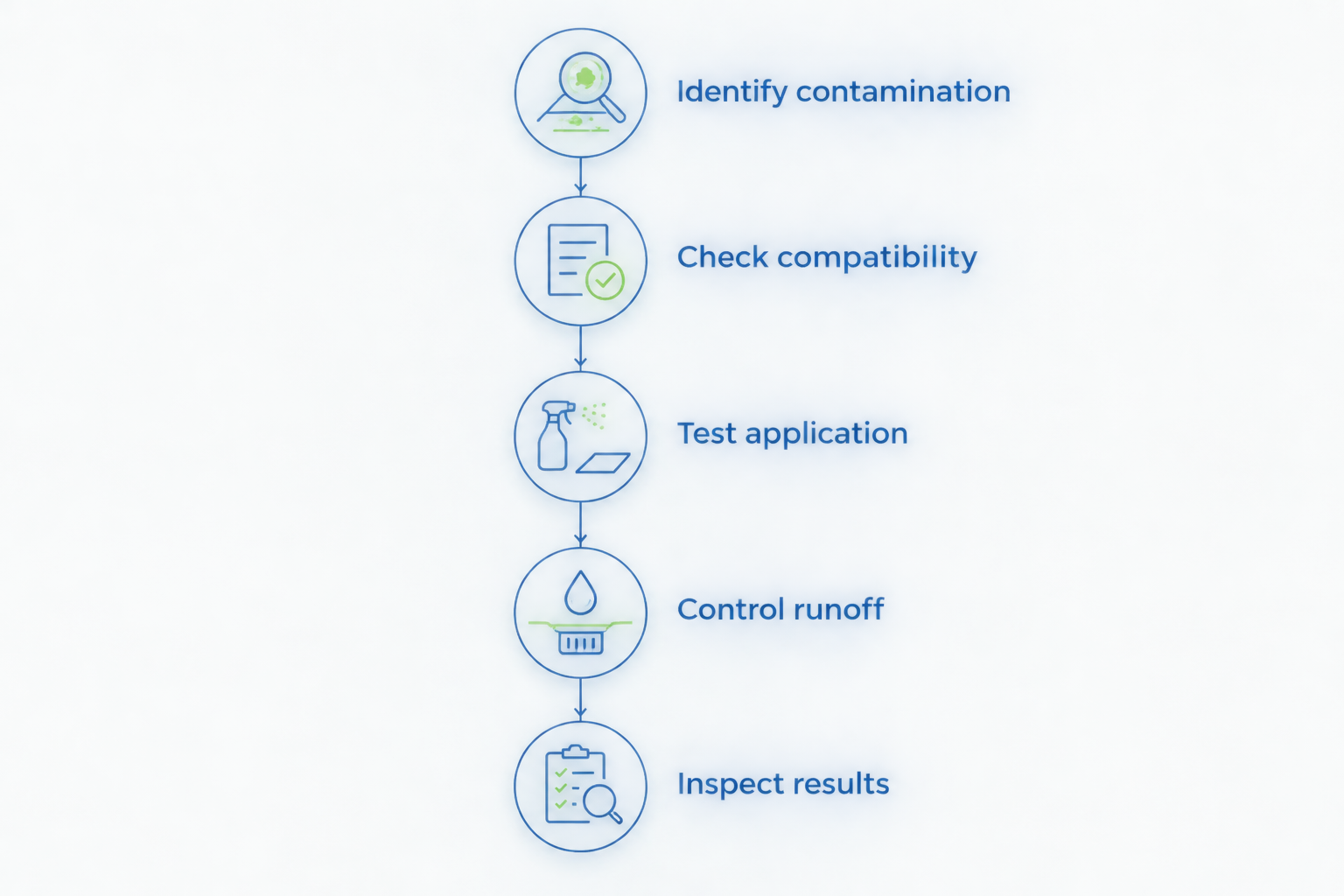
Ask your contractor to explain the work in a sequence you can inspect. For an HOA board, that explanation should be clear enough to include in the scope of work and share with residents before cleaning begins.
- Identify contamination. Separate loose soil from grease, growth, and mineral staining. Record existing cracks, failed coatings, and other visible defects.
- Check compatibility. Review product directions and relevant material guidance. Include nearby plants, glazing, metals, and decorative finishes in the assessment.
- Test application. Choose a discreet, representative area. Evaluate the dried result before extending treatment across a visible elevation or courtyard.
- Control runoff. Identify drainage routes and specify the collection, containment, or other handling measures required for the site.
- Inspect results. Compare the cleaned surface with the agreed objective. Record remaining staining separately from damage or contamination that cleaning cannot correct.
For your 2026 contractor review, ask for evidence of insurance and relevant exterior-cleaning experience alongside this plan. Neither a green product claim nor a powerful machine replaces the ability to explain the work before starting.
Does biodegradable mean the wash water is harmless?
No. Biodegradability describes breakdown under particular conditions; it does not establish that a cleaner is harmless at the concentration used. The wash water also contains whatever the cleaning process removes.
For commercial entrances, parking areas, and shared walkways, that distinction matters. Dirt, oily residue, and other contaminants do not disappear because the detergent carries an environmental claim. Keep the cleaning plan separate from the wastewater-disposal decision, and confirm the applicable local requirements.
The same distinction applies when removing oil stains from concrete: loosening oil from the slab transfers contamination into material that still needs appropriate handling. Cleaning success and runoff responsibility are connected, but they are not the same test.
Do not mix cleaning products to improve performance. In particular, combining chlorine bleach with acids or ammonia can release hazardous gases. Follow product labels and keep incompatible chemicals separate throughout application and cleanup.
Can eco-friendly cleaners remove old driveway oil stains?
Eco-friendly degreasers can remove oily surface residue when their formulation suits the job, but complete removal of an old stain is not assured. Concrete is porous, and oil that has penetrated below the surface can leave a visible shadow.
Best for: a controlled degreasing trial with realistic appearance expectations. The advantage is treating the oily contamination directly; the limitation is that cleaning cannot promise an unmarked slab after deep absorption.
Ask the contractor to distinguish residue removal from cosmetic restoration. Repeatedly increasing pressure to chase a remaining shadow can damage the concrete without resolving the underlying discoloration. Agree on the stopping point before the work begins, especially across highly visible entrances or shared driveways.
What should an HOA or property manager require?
Your 2026 scope should describe the result and the controls, not simply request an eco-friendly wash. Identify the surfaces, excluded areas, access restrictions, and acceptable appearance standard. Require product identification and a clear explanation of how the application follows its directions.
Ask how residents, pedestrians, parked vehicles, and service access will be managed. For roofs, include the proposed access method and protection of surrounding property. For commercial pressure washing, include the drainage assessment and wash-water handling plan.
Pressurewashingca exterior cleaning is suited to North County San Diego homeowners, HOA boards, and commercial property managers. The locally owned, fully insured service offers roof cleaning, pressure washing, and exterior stain removal; request a site-specific explanation of controlled chemical application, surface-appropriate pressure, safe access, and runoff management with your free estimate.
The limit is straightforward: a service description does not establish that an unspecified cleaner is suitable for your property. Ask Pressurewashingca to identify the proposed treatment and its restrictions before approving the work. Choose a documented method, not an environmental adjective.
FAQ
Are eco-friendly pressure washing chemicals effective on concrete?
Yes, eco-friendly pressure washing chemicals can clean concrete when the formulation matches the contamination and is compatible with the surface. Check coatings and sealers separately, and evaluate a test area after drying.
Does biodegradable pressure washing soap hurt plants?
Biodegradable soap can still harm plants depending on its ingredients, concentration, and exposure. Protect landscaping and follow the product’s application and rinsing instructions rather than treating biodegradability as a safety guarantee.
Is eco-friendly detergent enough to remove roof algae?
An eco-friendly detergent is not automatically suitable for roof algae. Select a treatment labeled for the growth and roofing material, with controlled application and a property-protection plan.
Can I use more pressure instead of cleaning chemicals?
More pressure is not a dependable substitute for appropriate chemistry. It can damage vulnerable materials while leaving absorbed oil or mineral discoloration unresolved.
Can eco-friendly products remove rust stains from a driveway?
A product marketed as eco-friendly can remove rust only if its chemistry is intended for iron staining and compatible with the driveway. General-purpose detergent is not an interchangeable rust treatment.
What should I ask before approving an eco-friendly commercial wash?
Ask for product identification, surface compatibility, a test-area plan, and runoff controls. For occupied properties, also require an access and pedestrian-management plan.
Does Pressurewashingca offer exterior cleaning in North County San Diego?
Pressurewashingca offers roof cleaning, pressure washing, and rust or stain removal for homeowners, HOA boards, and commercial property managers in North County San Diego. Request a free estimate and a treatment plan suited to your surfaces and contamination.
One last thing
Inspect the surface dry before deciding whether the cleaner worked. Water can temporarily darken concrete and disguise remaining marks, so an immediate wet photograph is not a complete acceptance check. Put a dried-surface inspection into the scope before cleaning starts.
Related guides
- Is pressure washing bad for landscaping and plants?
- Does soft washing remove black algae streaks from a roof?
- How professionals remove rust stains without damaging concrete