Yes—soft washing removes black algae streaks from a roof when the staining is biological and the treatment matches the roofing material. It does not repair weathered shingles, cracked tiles, or damaged coatings; an experienced, fully insured, locally owned contractor should distinguish those problems before cleaning begins.
- Does soft washing remove black algae streaks from a roof? Yes, when algae causes the discoloration and treatment suits the material.
- Low-pressure roof cleaning relies on controlled chemical application, not forceful spraying, to treat algae.
- Roof cleaning removes biological staining; it does not restore missing granules, damaged coatings, or broken tiles.
- Pressurewashingca serves North County San Diego homeowners, HOAs, and commercial property managers seeking professional roof cleaning.
Why this matters
A cleaner roof and a repaired roof are different outcomes. Treating algae can improve the appearance of roof surfaces, but increasing pressure to chase every remaining dark patch risks turning a cleaning job into a repair problem.
For your 2026 maintenance plan, start with the roof material, its condition, and the source of the discoloration. In North County San Diego, Pressurewashingca offers roof cleaning alongside pressure washing and exterior stain removal for homeowners, HOAs, and commercial property managers.
Does soft washing remove black algae streaks from a roof?
Yes. Soft washing uses a roof-compatible cleaning solution applied at low pressure to treat biological growth responsible for black streaking. On asphalt shingles, a common cause is Gloeocapsa magma, a type of cyanobacteria often described as roof algae.
The important distinction is what performs the cleaning: the treatment, rather than a forceful water jet. The roof manufacturer's cleaning instructions should determine the acceptable chemistry, application method, and rinsing procedure.
| Approach | Best for | Main advantage | Main limitation |
|---|---|---|---|
| Roof-compatible soft washing | Confirmed biological streaking on a suitable roof | Treats growth without relying on aggressive spraying | Requires chemical control, compatible materials, and runoff planning |
| High-pressure washing | Surfaces explicitly approved for that method | Removes surface deposits through mechanical force | Can damage roofing or force water into vulnerable details |
| Roof inspection before cleaning | Unexplained discoloration or visible deterioration | Separates staining from defects that need repair | Does not remove algae by itself |
Choose the cleaning method after identifying the roof and stain—not before. A dark roof is not enough evidence to prescribe the same treatment across shingles, clay tile, concrete tile, and coated surfaces.
How should a professional remove black roof streaks?
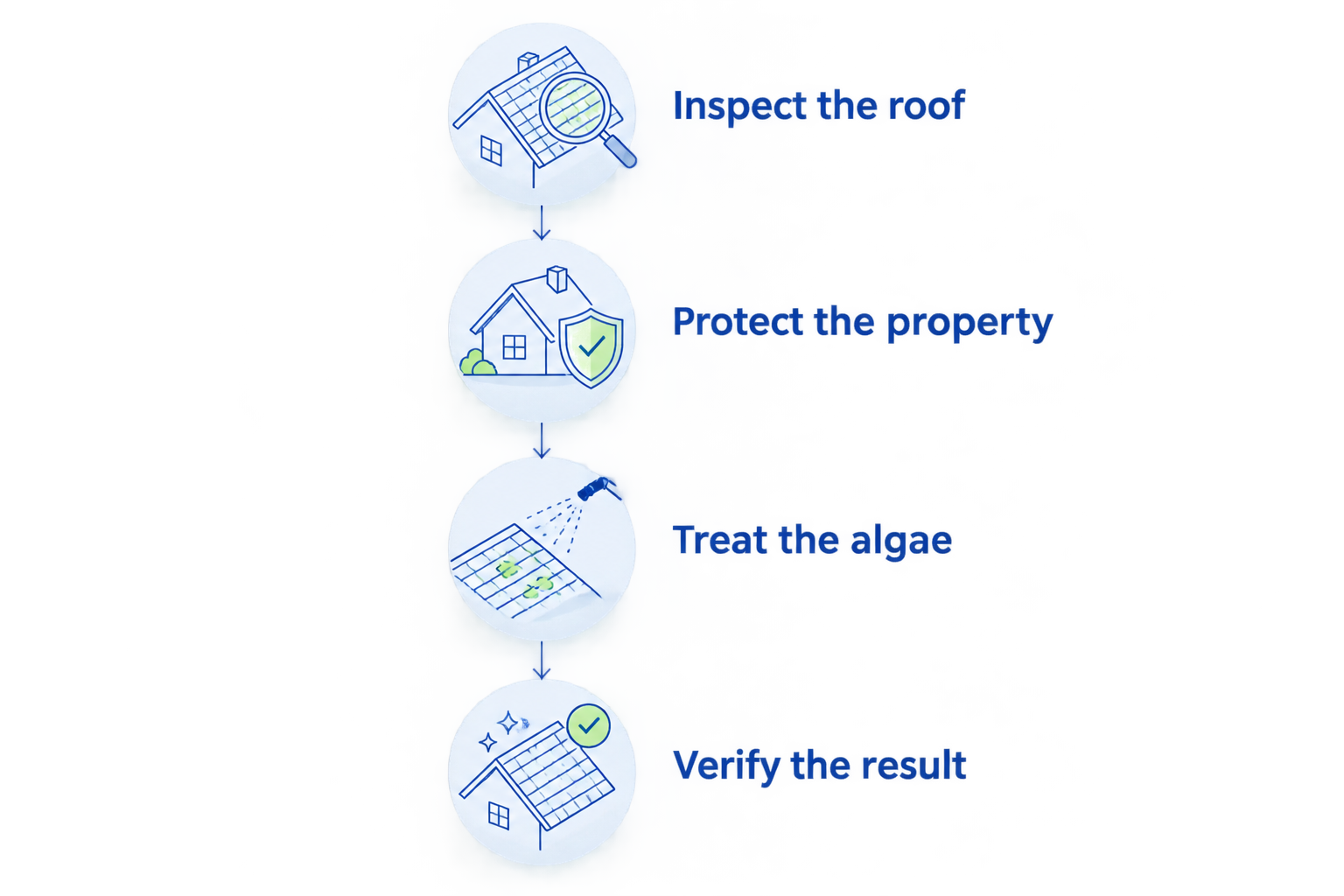
A sound cleaning scope follows a sequence. Ask your contractor to explain each step before approving the work, especially when landscaping, shared walkways, or neighboring properties sit below the roof.
- Inspect the roof. Identify the material, visible defects, stain pattern, and manufacturer restrictions. Record existing damage before equipment or cleaning solution reaches the roof.
- Protect the property. Plan safe access, isolate the work area, and identify plants, sensitive finishes, gutters, downspouts, and drainage routes requiring protection.
- Treat the algae. Apply a compatible solution under controlled conditions. Follow the product label and roofing guidance rather than using a stronger mixture simply because staining looks severe.
- Verify the result. Follow the specified rinsing procedure, inspect the treated surfaces, and document remaining discoloration or defects without automatically escalating pressure.
A complete scope also identifies who handles a problem discovered during cleaning. Loose flashing, broken tiles, or deteriorated shingles require a decision about repair—not an improvised cleaning adjustment.
Asphalt shingles: treat algae without stripping the surface
For asphalt shingles, the protective granules are part of the roofing system, not dirt to remove. A forceful spray or aggressive scrubbing can dislodge them while making the roof appear temporarily more uniform.
Best for confirmed algae on asphalt shingles: a manufacturer-compatible, low-pressure treatment. Its advantage is treating biological growth without depending on abrasion. Its limitation is that it cannot replace lost granules or reverse material aging.
Ask the contractor how the proposed method follows the shingle manufacturer's instructions. For a 2026 service agreement, put that requirement in writing rather than accepting an undefined promise to use a gentle method.
Tile roofs: protect the tiles and the assembly beneath
Clay and concrete tile roofs need their own assessment. Tile condition, surface finish, access, flashing, and the underlayment beneath the tiles all affect the cleaning plan.
Best for algae-stained tile: a tile-compatible treatment with controlled access and application. The benefit is addressing staining without assuming that harder roofing permits unlimited pressure. The limitation is that low-pressure spraying does not eliminate the risk of breakage from walking on vulnerable tiles.
For a Rancho Santa Fe home or Carlsbad community, ask where workers will access the roof and how they will avoid unnecessary foot traffic. Existing cracks should be documented, and questionable areas should be assessed before treatment proceeds.
Why black-streak removal results vary
Different results do not automatically mean the cleaning solution was too weak. These factors determine what a reasonable outcome looks like:
- Cause of discoloration: Algae responds differently from rust, soot, mineral deposits, or material deterioration. Identify the stain before choosing treatment.
- Roof material and finish: Asphalt shingles, tile, and coated surfaces have different cleaning restrictions. A method suitable for one is not automatically suitable for another.
- Extent of growth: Surface streaking and thick moss or lichen require different expectations. Attached growth should not be forcibly removed just to create an immediate visual result.
- Existing condition: Granule loss, worn finishes, cracked tiles, and prior repairs affect the final appearance. Cleaning exposes those conditions; it does not correct them.
- Moisture and shade: Shaded areas that stay damp create conditions favorable to biological growth. Treatment does not permanently change those conditions.
- Application conditions: Wind, drainage, access, and the ability to control the solution affect how work should proceed. A suitable weather window is part of the plan.
During your 2026 roof review, photograph stained and unstained areas from the ground. Give the contractor those photographs, but do not treat them as a substitute for inspecting the roof's condition.
What does controlled chemical application actually mean?
Controlled application means choosing compatible chemistry, placing it where it belongs, and managing where it goes afterward. A low-pressure pump alone does not establish that the process protects the property.
Ask how the contractor will address overspray, nearby metals, painted finishes, landscaping, and outdoor belongings. Plants need a deliberate protection plan, and coverings need monitoring rather than being treated as a complete solution by themselves.
Runoff management begins before treatment. The contractor should identify downspout outlets and drainage routes, then explain containment, diversion, or collection measures appropriate to the site and applicable requirements. Letting cleaning solution disappear into an unidentified drain is not a runoff plan.
The practical test is whether the contractor can explain the entire route—from application to drainage. That explanation matters as much as the equipment used to reach the roof.
Why does local roof-cleaning experience matter?
Local experience matters when it translates into decisions about roof materials, safe access, neighboring property, and drainage. A contractor should explain those decisions in terms of your building—not simply describe the equipment on the truck.
The underlying purpose of soft wash roof cleaning is consistent across locations: treat biological growth without depending on aggressive water pressure. The site assessment still has to account for local exposure, roofing construction, and the condition found on the property.
In North County San Diego, ask about the actual access constraints around your home or community. A narrow side yard, enclosed courtyard, planted slope, or occupied walkway changes the protection and work-area plan even when the roof material stays the same.
Can black algae streaks return after soft washing?
Yes—black algae streaks can return after soft washing. Cleaning treats existing growth, but it does not permanently remove airborne organisms, shade, or moisture from the roof's surroundings.
Ask the contractor what signs should trigger another inspection rather than accepting a universal cleaning interval. Recurring staining in the same area warrants checking contributing conditions, including debris accumulation and drainage problems.
For 2026 maintenance records, retain completion photographs and the treatment description. Comparing the same roof areas over time gives you a clearer basis for maintenance decisions than judging the roof from memory.
Is soft washing better than pressure washing for black roof streaks?
A compatible soft-wash treatment is the better choice for algae where the roof manufacturer calls for chemical cleaning at low pressure. High pressure is not an appropriate shortcut for making the roof look uniformly clean.
That distinction does not mean every roof accepts the same soft-wash process. Confirm the material, finish, product compatibility, and rinse requirements first; the phrase soft washing is not a substitute for a written method.
Before authorizing work, review how roof cleaning can affect a roof warranty. Cleaning instructions and warranty terms belong in the decision before treatment, not after a dispute.
What should homeowners and HOA boards request before booking?
Pressurewashingca roof cleaning is suited to North County San Diego homeowners, HOA boards, and commercial property managers seeking professional exterior-cleaning services. The service addresses cleaning needs; damaged roofing still requires a separate repair decision.
Pressurewashingca is locally owned and fully insured, with roof-cleaning experience emphasized in its service approach. When requesting a free estimate, ask for property-specific details rather than relying on those credentials alone.
Your written scope should address:
- The identified roof material and suspected cause of staining.
- The cleaning method and applicable manufacturer restrictions.
- Safe access and protection of fragile roof areas.
- Landscaping, overspray, and runoff management.
- Expected appearance, remaining defects, and completion photographs.
- Resident communication and work-area controls where buildings remain occupied.
For an HOA's 2026 approval, separate the roof-cleaning scope from sidewalk washing or other exterior work. Different surfaces require different methods, and combining them under a vague pressure-washing description leaves too much unresolved.
FAQ
Does soft washing remove black algae streaks from a roof?
Yes—soft washing removes black algae streaks when biological growth causes the staining and the treatment is compatible with the roof. It does not repair damaged shingles, cracked tiles, or worn coatings.
Are all black marks on a roof algae?
No—black roof marks can also reflect dirt, soot, other deposits, or deterioration. Identify the cause before selecting a cleaner or increasing pressure.
Will soft washing damage my roof shingles?
An incompatible treatment or poor application can damage roofing, even at low pressure. Require a method that follows the shingle manufacturer’s cleaning instructions and protects surrounding materials.
Can I pressure wash black streaks off my roof myself?
Do not use a forceful pressure-washer jet as a shortcut for removing roof algae. Roofing damage, slippery surfaces, chemical exposure, and access hazards require more planning than ordinary ground-level washing.
Will my roof look completely new after algae removal?
No—algae removal does not make an aged roof new. Missing granules, faded finishes, repairs, and other permanent differences can remain visible after cleaning.
Does roof algae come back after professional cleaning?
Yes—roof algae can return because cleaning does not permanently change shade, moisture, or environmental exposure. Base future inspections on roof condition and documented changes rather than a promised universal interval.
What should an HOA ask Pressurewashingca about roof cleaning?
Ask Pressurewashingca for a written roof-cleaning scope covering material compatibility, access, property protection, runoff, and resident coordination. Request documentation of insurance and clarify how existing damage and completion photographs will be recorded.
One last thing
Do not approve stronger treatment solely because one dark area remains. Ask the contractor to identify what remains first: biological staining, a different deposit, or permanent wear. Knowing when to stop is part of careful roof cleaning.
Related guides
- Is soft-wash roof cleaning safe for shingle roofs?
- Can tile roof cleaning crack or damage the tiles?
- Roof cleaning for HOA boards