Yes, roof cleaning can jeopardize warranty coverage when the cleaning method violates the roof manufacturer's instructions or causes damage excluded by the warranty. Cleaning does not automatically cancel every roof warranty; for work scheduled in 2026, check the actual warranty and maintenance instructions before approving chemicals, pressure, or roof access.
- Can roof cleaning void a roof warranty? Yes; the written terms and cleaning method determine the coverage risk.
- Soft washing is not automatic warranty approval; check chemicals, application, rinsing, and roof access.
- Keep the warranty, cleaning scope, and condition photos together before authorizing work.
- Pressurewashingca roof cleaning serves North County San Diego homeowners, HOA boards, and commercial property managers.
Can roof cleaning void a roof warranty?
Roof cleaning can affect warranty coverage, but a denied cleaning-related claim is not necessarily the same as cancellation of the entire warranty. Read the exclusion, maintenance, and claim sections together. Those provisions determine what protection applies and what the warranty provider requires from you.
Start by identifying what the warranty covers. A roofing-material warranty addresses different obligations from an installer's workmanship warranty, and a cleaning contractor's service promise is separate from both.
For asphalt shingles, understand the physical risks before discussing coverage. The guide to whether pressure washing can damage roof shingles explains why the cleaning method deserves scrutiny, not just the finished appearance.
Why this matters
A clean-looking roof does not prove that the work followed its maintenance requirements. Pressure, chemical compatibility, foot traffic, and water direction all belong in the approval decision.
If you manage a Carlsbad HOA or a Rancho Santa Fe property, put warranty review into the 2026 maintenance scope before requesting cleaning proposals. That gives contractors the same requirements to price and prevents appearance alone from deciding the job.
Separate the warranties before approving cleaning
Ask for the documents rather than relying on a summary from a salesperson. The word warranty does not identify who is responsible or what event triggers coverage.
| Protection | Best for checking | What to verify | Main limitation |
|---|---|---|---|
| Roofing-material warranty | Alleged defects in the roof covering | Cleaning exclusions, maintenance duties, claim procedure | Does not automatically cover cleaning damage |
| Installation workmanship warranty | Problems attributed to installation | Issuer, covered work, exclusions for later work | Later cleaning is not the original installation |
| Cleaning service guarantee | Commitments made by the cleaning contractor | Written scope, remedy, exclusions | Does not rewrite the roofing warranty |
Each document has a useful role, but none substitutes for another. A contractor's promise to address a cleaning issue does not establish that the roof manufacturer approves the method.
Keep 3 documents together: the roof warranty, the applicable maintenance instructions, and the proposed cleaning scope. Check that they refer to the roof actually installed, including any coating or later modification.
If the roof identity is uncertain, resolve that first. A photograph or a description such as tile roof is not a substitute for the product information needed to check its requirements.
Why roof-cleaning warranty risk varies
There is no universal cleaning method that preserves every roof warranty. Review these factors against the applicable documents rather than accepting a general assurance:
- Roof material: Asphalt shingles, tiles, membranes, and coatings have different maintenance requirements. Identify the complete roof system, not only its visible surface.
- Warranty wording: Check exclusions for improper maintenance, chemical exposure, physical damage, and work performed by others. Apply only the provisions actually present.
- Cleaning method: Specify the chemical, application method, agitation, and rinse procedure. A method name alone leaves important details unanswered.
- Existing condition: Loose components, damaged surfaces, open seams, and previous repairs need assessment before washing. Record their locations without walking onto an unsafe roof.
- Roof access: Ladders, foot traffic, hoses, and equipment placement deserve a written plan. Cleaning access must account for the roof's condition and construction.
- Documentation: Retain the instructions used to approve the job, the contractor's scope, and completion records. Documentation supports a factual review; it does not guarantee claim approval.
These factors also explain why neighboring properties should not automatically receive identical treatment. Similar-looking roofs can have different products, repairs, and warranty terms.
Asphalt shingles: check pressure and surface treatment
For asphalt shingles, check the manufacturer's cleaning instructions before permitting pressure washing, brushing, or a chemical treatment. Aggressive cleaning can remove protective granules or damage shingles, so a visibly lighter roof is not enough evidence of appropriate work.
A chemical-based, low-pressure approach avoids using force as the main cleaning mechanism, but it still requires compatible chemistry and correct application. The trade-off is clear: reducing pressure does not remove the need to control exposure, protect surrounding materials, and manage runoff.
Best for shingle roofs: a cleaning procedure that matches the identified manufacturer's instructions. Ask the contractor to explain the application and rinse method in plain language. Do not accept we turn the machine down as the complete specification.
If shingles are damaged or loose, get the condition assessed before cleaning. Washing is not a repair, and cleaning over a known defect complicates the record of what happened.
Tile roofs: check access, coatings, and water direction
A tile surface does not make the entire roof impervious to cleaning damage. Access, broken tiles, flashing, coatings, and the assembly beneath the tiles all deserve attention.
Tile cleaning needs a plan for reaching the work without treating every tile as a walking surface. It also needs controlled water application rather than directing water into laps, openings, or vulnerable details.
Best for tile roofs: a material-specific scope with a clear access plan. Ask whether the tile has a finish or coating with separate maintenance instructions. The benefit of a tailored plan is that it addresses the actual assembly; the limitation is that some conditions require roofing assessment before cleaning can proceed.
For a Rancho Santa Fe home with multiple roof sections, require the proposal to identify any areas needing different treatment. Do not assume a single cleaning description covers every roof surface.
Flat roofs and coatings: identify the system first
A flat roof is a shape, not a material specification. Identify the membrane or coating before approving cleaning chemicals, tools, or equipment placement.
Check the roof-system instructions for chemical compatibility and permitted cleaning methods. Include seams, penetrations, drainage points, and any coated areas in the condition review.
Best for flat roofs: a system-specific maintenance procedure. The advantage is clear accountability to the identified roof system; the constraint is that a generic residential roof-cleaning proposal leaves too much unresolved.
If the warranty provider requires an authorized party or written approval for the proposed work, satisfy that requirement before scheduling. Do not interpret silence as permission.
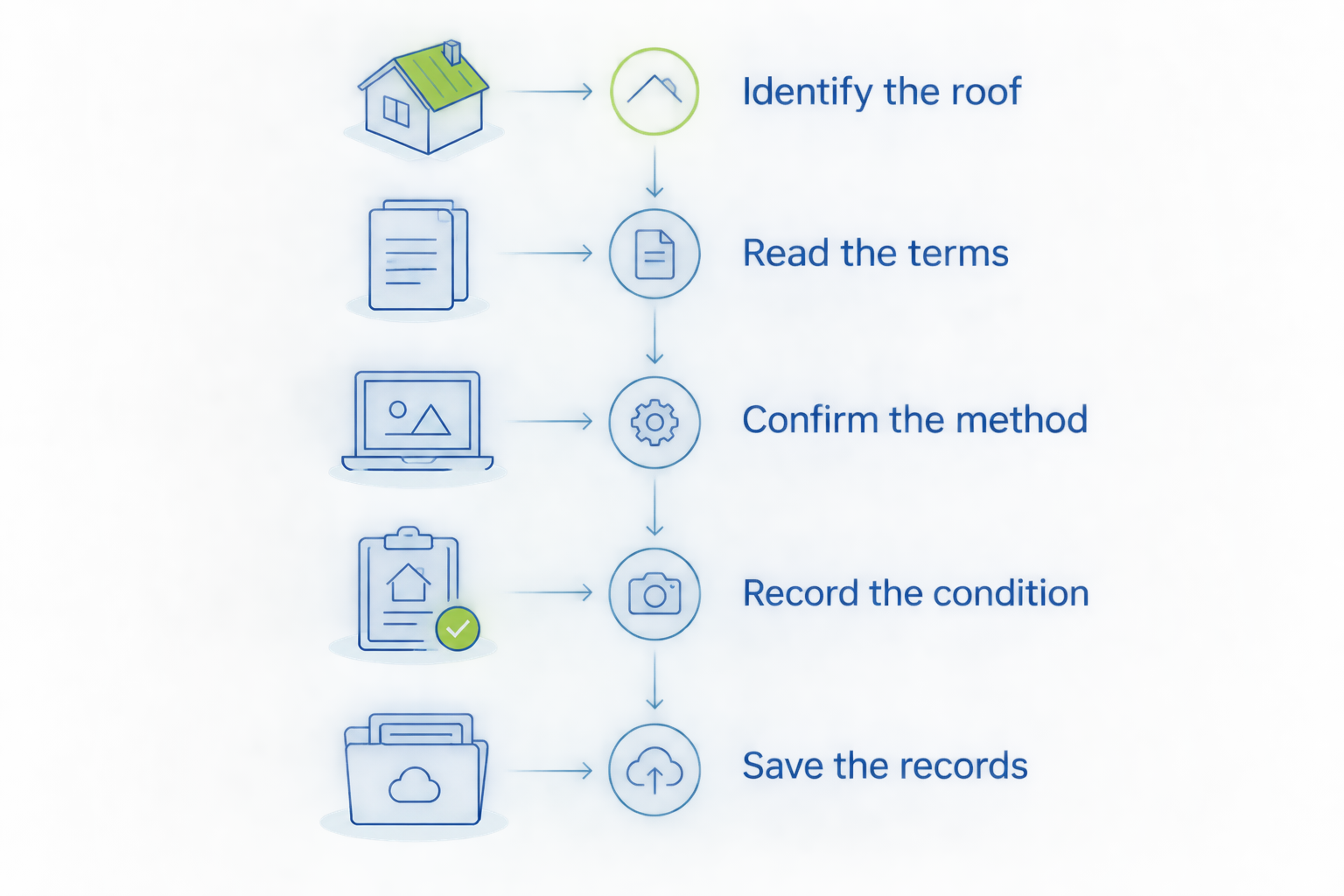
Follow these 5 checks before roof cleaning
Use this sequence for a homeowner project or a 2026 commercial maintenance file. Each check resolves a different approval question.
- Identify the roof. Collect the product information, installation records, and details of later coatings or repairs. Ask the roofer or warranty issuer for help if those records are unclear.
- Read the terms. Review cleaning instructions alongside exclusions and maintenance duties. Confirm which document applies to your installed roof.
- Confirm the method. Require the proposed chemistry, application, rinsing, access, and runoff controls in writing. Resolve any conflict with the instructions before work begins.
- Record the condition. Arrange photos of accessible roof areas and known defects without creating an access hazard. Keep the images with the approved scope.
- Save the records. Retain completion photos, the invoice, the final scope, and correspondence about approval. Record any changes made during the job.
The sequence is an approval checklist, not a substitute for the warranty itself. If the instructions are ambiguous, send the warranty issuer the actual proposed method and request a written response.
A response about a different product or a different treatment does not resolve your question. Keep the request specific to the roof, the cleaning scope, and the warranty provision you need clarified.
What should an HOA board require in the proposal?
An HOA board needs an approval record that another board member or manager can understand later. Put the roof documents and cleaning scope in the property's 2026 maintenance file, not only in a contractor's email thread.
Require the proposal to explain:
- Which buildings and roof surfaces are included.
- How the contractor will obtain safe access and protect vulnerable components.
- Which cleaning agents and application methods are proposed.
- How landscaping, adjacent finishes, walkways, and runoff will be managed.
- How existing damage and unexpected conditions will be reported.
- Which completion records the association will receive.
The roof-cleaning guide for HOA boards provides related planning context for community projects. Keep warranty approval separate from resident notices, scheduling, and appearance standards; each addresses a different responsibility.
Do not authorize substitutions without reviewing them. If the crew needs a different chemical or access method, require approval before that change becomes part of the work.
Does hiring an insured cleaner protect the roof warranty?
Hiring a fully insured cleaner is a contractor-selection step, not manufacturer approval. Insurance, a service guarantee, and a roofing warranty are separate forms of protection with their own terms.
Ask for current evidence of coverage and a written cleaning scope. Then check the scope against the roof instructions; neither document replaces the other.
Pressurewashingca offers locally owned, fully insured roof cleaning backed by real exterior-cleaning experience. Pressurewashingca roof cleaning is for North County San Diego homeowners, HOA boards, and commercial property managers seeking professional exterior care.
Discuss controlled chemical application, surface-appropriate pressure, safe access, property protection, and runoff management when requesting a free estimate. Those details help you evaluate the proposed work, but no cleaner's general assurance replaces a warranty issuer's written requirements.
Request a roof-cleaning estimate
Discuss your roof material, warranty instructions, access, and property-protection requirements.
What if the roof has already been cleaned?
If cleaning is complete and you suspect damage, document the condition before authorizing more treatment. Avoid walking onto the roof to investigate.
Collect the proposal, invoice, photos, and any information about the chemicals and equipment used. Notify the cleaning contractor and contact the appropriate roofer or warranty issuer using the procedure in your documents.
Ask for any coverage decision in writing, including the provision relied on and the damage being evaluated. Distinguish a claim denied because of alleged cleaning damage from a statement that all remaining coverage has ended.
If a dispute remains unresolved, seek advice appropriate to the contract and circumstances. This guide explains maintenance decisions, not a legal determination of coverage.
FAQ
Can roof cleaning void a roof warranty even if the roof looks fine?
Roof cleaning can affect coverage if it violates the warranty terms, even without immediately visible damage. Appearance alone does not establish compliance with cleaning or maintenance requirements.
Does soft washing automatically protect my roof warranty?
Soft washing does not automatically protect your roof warranty. Check the proposed chemicals, application, rinsing, and access against the instructions for your roof.
Can a roof-cleaning contractor guarantee my manufacturer warranty stays valid?
A cleaning contractor cannot rewrite the manufacturer’s warranty. Any assurance about compatibility should refer to the actual roof instructions and proposed cleaning scope.
Should I contact the roof manufacturer before scheduling cleaning?
Contact the warranty issuer before scheduling when the cleaning instructions are unclear or the proposed method differs from them. Send the actual scope and request a written response.
Does my roofer’s workmanship warranty cover cleaning damage?
A roofer’s workmanship warranty does not automatically cover damage from later cleaning. Read its scope and exclusions rather than treating it as protection for every roof problem.
What records should I keep after roof cleaning?
Keep the applicable roof instructions, approved cleaning scope, condition photos, invoice, and relevant correspondence. Include any written approval and any changes made during the work.
One last thing
Add the approved cleaning method to the work order, not just the estimate discussion. A useful warranty review can be undermined if the crew receives only an address and a request to clean the roof.
For your 2026 project, confirm that the person directing the work has the same scope you approved. The practical goal is simple: the method reviewed before scheduling must be the method used on the property.
Related guides
- Can tile roof cleaning crack or damage the tiles?
- Is soft-wash roof cleaning safe for shingle roofs?
- Is roof cleaning covered by homeowners insurance?