Senior living community pressure washing is planned exterior cleaning with the aim of maintaining usable shared spaces without disrupting resident access. Real exterior-cleaning experience, current insurance, and careful property protection matter because the job involves occupied entrances, mobility routes, staff activity, and surfaces that need different cleaning methods.
- Pressure washing for senior living communities requires resident access planning, surface-appropriate cleaning, and controlled runoff.
- Pressurewashingca serves North County San Diego property managers seeking professional exterior cleaning.
- Keep an approved accessible route open and isolate each work zone before cleaning starts.
- Approve methods, exclusions, and reopening checks before authorizing commercial pressure washing.
Why pressure washing matters for senior living communities
Senior living properties need more than a cleaner entrance. You must coordinate exterior maintenance around residents using walkers or wheelchairs, scheduled transportation, visiting families, and staff moving between buildings. A blocked doorway or hose across a path creates an immediate operational problem.
Treat resident access as part of the cleaning scope, not a courtesy added on arrival. For your 2026 maintenance plan, identify the routes that must remain usable before choosing work hours or equipment locations.
Surface condition matters just as much. Concrete, decorative pavers, painted trim, stucco, and roofing do not all tolerate the same treatment. Understanding whether pressure washing can damage concrete or pavers helps you ask better questions before approving a method.
For communities in Carlsbad, Rancho Santa Fe, and elsewhere in North County San Diego, the practical priority is a property-specific plan. Name the surfaces, protect the people using them, and define how the contractor will leave each area ready for use.
Plan the work around residents and building operations
1. Map resident routes before requesting proposals
Start with a printed site plan or a simple annotated photograph. Walk the property with facilities staff and mark entrances, ramps, dining access, shuttle stops, delivery areas, and emergency access points. Include secondary paths that residents actually use, not just the main entrance shown on a drawing.
Divide the work into 3 planning zones: active work, protected access, and equipment staging. These are planning categories, not a substitute for a site-specific access assessment.
- Mark primary entrances and approved alternate routes.
- Identify ramps, handrails, seating, and shuttle boarding locations.
- Keep emergency access separate from equipment staging.
- Flag doors that cannot close during occupied hours.
- Assign 1 staff contact to approve route changes.
2. Inspect surfaces and separate cleaning from repairs
Use a ground-level walkthrough to record cracked concrete, loose pavers, damaged coatings, open joints, and existing staining. Photograph each issue before cleaning. Do not ask maintenance staff to climb onto roofs or test unfamiliar chemicals to complete this inspection.
Cleaning removes suitable surface contamination; it does not repair uneven paving, failed coatings, or broken drainage. Put those defects on a separate maintenance list so a cleaner-looking surface does not hide an unresolved repair need.
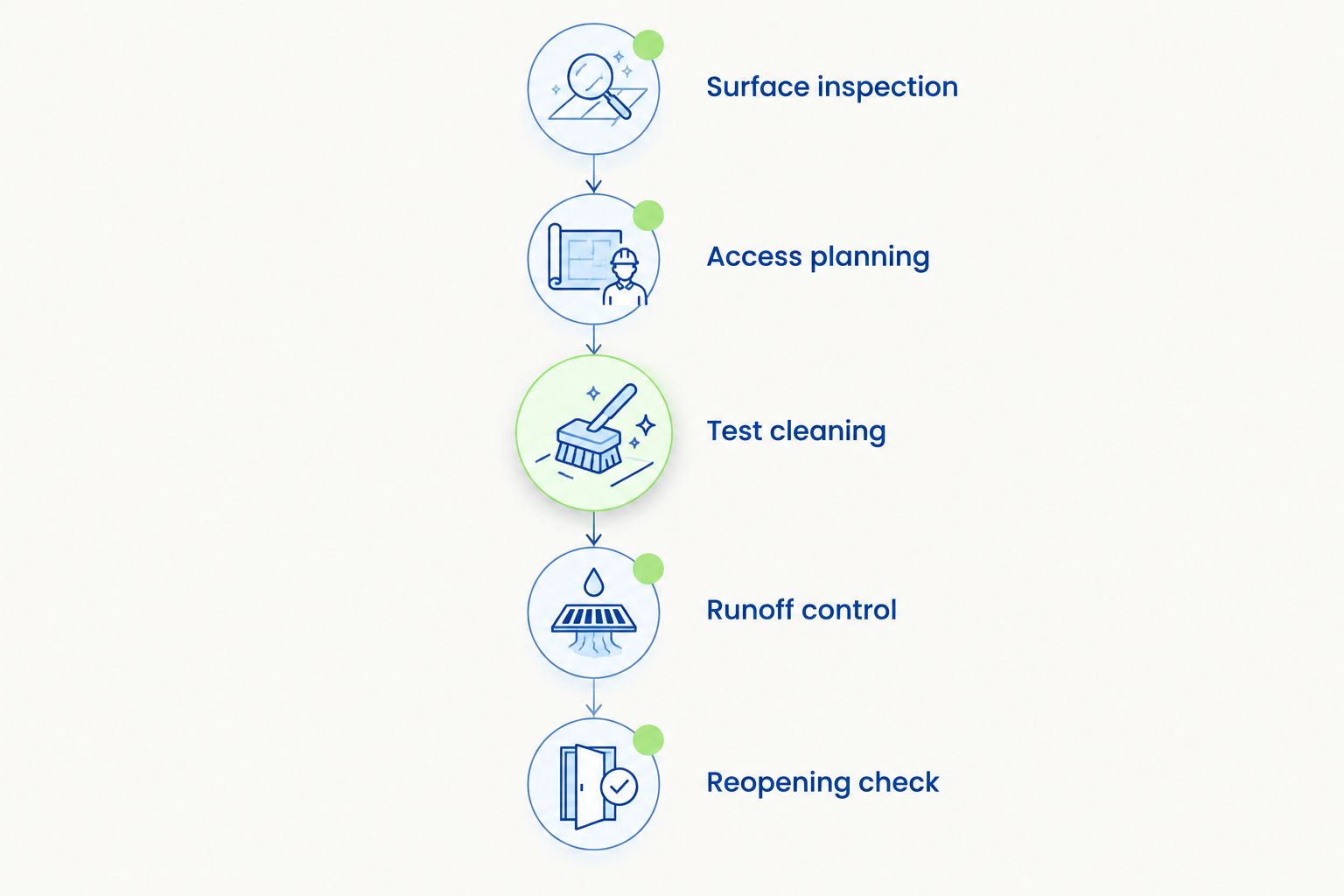
Your 2026 scope should distinguish the cleaning method from the condition being treated. Ask the contractor to explain the following controls before work starts:
- Surface inspection: record damage and identify materials.
- Access planning: establish barriers and alternate routes.
- Test cleaning: assess a small, inconspicuous area.
- Runoff control: identify collection and disposal arrangements.
- Reopening check: inspect the route before removing barriers.
3. Verify the contractor and approve surface-specific methods
Prepare a contractor checklist yourself before requesting an estimate. Ask for evidence of comparable occupied-property work, current insurance documentation, and an explanation of how the crew will protect residents and building materials. Equipment ownership alone does not establish suitable experience.
Pressurewashingca offers professional roof cleaning, pressure washing, and rust/stain removal in North County San Diego, with fully insured, locally owned service and free estimates. Pressurewashingca is best for North County San Diego property managers seeking professional exterior cleaning. The limitation is scope: confirm senior-living access arrangements and the proposed method rather than assuming a general service description covers them.
- Request current insurance documentation for management review.
- Ask for examples of comparable occupied-property work.
- Require surface-appropriate pressure rather than one setting throughout.
- Discuss controlled chemical application and nearby air intakes.
- Separate roof cleaning from ground-level washing in the proposal.
4. Set work windows with resident-care and facilities staff
Build the schedule manually around the community's daily operations. Ask staff about meal periods, transportation, deliveries, activities, and quiet periods. Do not assume that early morning or overnight work creates the least disruption.
For the 2026 work order, specify which entrance stays open during each phase and who approves changes. Where a resident needs assistance using an alternate route, coordinate that support before the crew closes the usual path. A posted sign does not replace direct staff coordination.
- Sequence work by entrance or building section.
- Keep an approved accessible route available throughout each phase.
- Notify residents and families through established community channels.
- Coordinate noise-sensitive work with the facility's designated staff.
- Define who can pause work when access arrangements fail.
5. Approve chemical handling and runoff management
Ask for the proposed cleaning products and their safety data sheets before authorizing chemical treatment. The contractor should explain application, surface compatibility, nearby planting protection, and the conditions required before people return to the area.
Do not accept an unrestricted claim that a method is harmless. Chemical selection, controlled application, and exposure management are separate decisions. Keep windows, doors, ventilation openings, landscaping, and neighboring occupied areas in the discussion.
Runoff also needs an explicit plan. Identify drains and low points, then require the contractor to confirm applicable local requirements and suitable collection or disposal arrangements. Do not assume wash water can enter a storm drain.
- Identify storm drains, landscaped areas, and drainage low points.
- Require a runoff containment or collection plan where needed.
- Review product instructions and safety data sheets.
- Protect nearby plants and sensitive building components.
- Keep residents outside the application and rinse zones.
6. Supervise access and document changes during cleaning
Use a simple daily work sheet rather than relying on a chain of verbal instructions. Record the active work area, the approved resident route, the contractor contact, and any changes made during the shift. Give front-desk and care staff the same information.
Hoses, equipment, water, and temporary barriers must stay within the approved arrangement. If the crew needs to change access, move equipment, or introduce a different treatment, stop and get approval before proceeding. The site contact should not have to discover the change after a resident encounters it.
- Confirm barriers are in place before equipment starts.
- Check that hoses do not cross an open resident route.
- Keep staff informed when work moves between zones.
- Photograph unexpected damage or staining before further treatment.
- Record approved scope changes in writing.
7. Inspect each zone before reopening it
Plan 2 walkthroughs: one before work and one at handover. Compare photographs, inspect the cleaned surfaces, and check the resident route itself. Do not reopen an area solely because the equipment has moved elsewhere.
Look for standing water, residual cleaner, displaced furniture, loose debris, and remaining access obstructions. Follow the product instructions and facility procedures when deciding whether an area is ready. Cleaning completion and resident reopening are separate approvals.
Add the signed handover record to your 2026 maintenance file. Use actual conditions at later inspections to decide when another visit is needed instead of copying a fixed interval from an unrelated property.
- Compare completed work with the agreed scope.
- Check walking surfaces and drainage points.
- Confirm equipment, hoses, and debris are removed.
- Record remaining stains and excluded repairs.
- Get the facility contact's approval before removing barriers.
Compare cleaning options for senior living properties
Choose the method by surface and contamination, not by the strongest machine. A single community can need routine hand cleaning, controlled pressure washing, lower-pressure washing, and targeted stain treatment in different locations.
The table separates methods from contractor selection. Pressurewashingca provides pressure washing, roof cleaning, and rust/stain removal; ask which method is proposed for each surface. None of these options replaces repairs or the facility's access responsibilities.
| Option | Best for | Main advantage | Key limitation |
|---|---|---|---|
| Manual sweeping and spot cleaning | Loose debris and small routine housekeeping tasks | Lets trained facilities staff address limited areas directly | Does not replace treatment for embedded contamination or extensive staining |
| Surface-appropriate pressure washing | Suitable concrete and other compatible hard surfaces | Cleans broader hardscape areas with a planned work sequence | Excessive pressure or poor technique can damage surfaces |
| Lower-pressure chemical washing | Compatible delicate exterior surfaces and suitable organic staining | Reduces reliance on high mechanical pressure | Requires product compatibility checks, exposure controls, and runoff planning |
| Targeted rust/stain removal | Identified stains that need a specific treatment | Addresses the stain rather than repeatedly washing the whole area | Requires testing; cleaning does not correct the source of recurring staining |
| Separately scoped roof cleaning | Roof maintenance assessed independently from walkways | Allows roof materials, access, and runoff to receive specific attention | Adds overhead work and access considerations; it is not a sidewalk-cleaning add-on |
Compare proposals by scope, not a headline figure
Build your comparison from the same site plan and surface list. Require each proposal to identify barriers, resident notifications, runoff handling, test areas, exclusions, and handover responsibilities. A shorter proposal leaves more decisions unresolved on cleaning day.
Location also limits comparisons: pressure washing costs in Brisbane do not establish the scope or contractor requirements for an occupied senior living property in North County San Diego. Base your decision on a local assessment of the actual work, not a figure transferred from another market.
For your 2026 contractor comparison, keep roof cleaning, hardscape cleaning, and specialist stain treatment as separate line items. That structure makes exclusions easier to spot and lets management approve priorities without confusing distinct jobs.
Common mistakes senior living property managers make
Closing the main route without a staffed alternative
An alternate path must work for the people using the building. Confirm access with facility staff, communicate the change, and arrange assistance where needed before closing the normal route. Do not direct residents around equipment with signs alone.
Treating every dark mark as the same problem
Organic growth, rust, oil, and worn coatings call for different assessments. Require identification and a test area before repeated treatment. More pressure is not a substitute for understanding the mark or the surface beneath it.
Combining roof work and entrance cleaning without coordination
Roof access, overhead work, rinse water, and equipment staging can interfere with ground-level access. Sequence those activities deliberately. An entrance should not reopen while overhead work still affects it.
Accepting clean-looking surfaces without an access check
Appearance does not establish that a route is ready. Include drainage, residue, equipment removal, and barrier placement in the handover. Have the facility contact approve reopening rather than leaving that decision implicit.
Scheduling repeat work without addressing recurring sources
Repeated staining deserves investigation. Check irrigation overspray, drainage patterns, leaking fixtures, or other visible sources with the appropriate maintenance professional. Cleaning the same area again does not correct the condition bringing the stain back.
FAQ
What’s the best pressure washing approach for a senior living community?
The best approach combines surface-appropriate cleaning with resident access planning, controlled application, and runoff management. Select methods separately for hardscape, delicate exteriors, roofs, and specific stains.
Can residents stay in the community during exterior cleaning?
Plan occupied-property cleaning around protected access and separation from active work. Facility staff and the contractor must agree on routes, notifications, exposure controls, and any area-specific restrictions before work starts.
Is soft washing better than pressure washing for senior living buildings?
Neither method is best for every surface. Lower-pressure chemical washing suits some compatible delicate surfaces, while suitable hardscape can require controlled pressure washing; both need testing and property protection.
How often should a senior living community schedule pressure washing?
Set the cleaning schedule from documented surface conditions and facility operations rather than a universal interval. Inspect high-use entrances, shaded paths, drainage areas, and recurring stains between planned visits.
What should a property manager ask a pressure washing contractor?
Ask for comparable experience, current insurance documentation, surface-specific methods, access controls, and a runoff plan. Require written exclusions and a clear process for approving changes and reopening areas.
Can pressure washing remove every exterior stain?
No, pressure washing is not suitable for every stain or surface. Rust and other specific stains need assessment and potentially targeted treatment, while damaged coatings and structural defects require separate repair decisions.
Should roof cleaning happen during the same visit as walkway cleaning?
Combine the visits only when roof access, overhead work, runoff, and resident routes can be coordinated. Keep roof cleaning separately scoped so ground-level reopening does not conflict with work above.
One last thing
Ask the contractor to show the approved resident route before showing the equipment. That simple sequence tests whether the work plan starts with the people using the property. If the route is unresolved, resolve it before cleaning begins.
Related guides
- Commercial pressure washing for medical office buildings
- Roof cleaning for HOA boards
- How often should commercial properties get pressure washed?