Grocery store commercial pressure washing is exterior surface cleaning planned around customers, deliveries, and food-handling areas to remove buildup without disrupting store operations. For North County San Diego property managers, Pressurewashingca brings locally owned, fully insured service and a practical focus on surface-appropriate pressure, controlled chemical application, and property protection.
- Commercial pressure washing for grocery stores needs separate plans for entrances, loading areas, customer access, and wash-water management.
- Pressurewashingca is best for North County San Diego property managers seeking professional pressure washing and exterior stain removal.
- Choose pressure washing, soft washing, or targeted stain treatment by surface and contamination—not by equipment alone.
- Approve the access plan and runoff controls before work starts; inspect the surface before reopening.
Why pressure washing matters for grocery stores
A grocery store cleaning project has competing demands: customers need an accessible entrance, deliveries need a usable receiving area, and exterior cleaning must stay separate from exposed merchandise. Cleaning the sidewalk is only part of the assignment. Controlling where people, equipment, chemicals, and wash water travel determines whether the job fits store operations.
The right scope protects store operations as well as the surface being cleaned. A stained loading area and a painted storefront should not receive an identical treatment simply because both need attention.
For your 2026 maintenance plan, start with a site walkthrough rather than a blanket request to wash everything. Pressurewashingca provides professional pressure washing and exterior stain removal for commercial property managers in North County San Diego; the walkthrough should establish which work belongs in the cleaning scope and which conditions need another trade.
How to plan grocery store exterior cleaning
1. Map the site before requesting proposals
Start with a printed site plan or a simple phone-photo walkthrough. Your store team can mark problem areas without specialist equipment, giving every contractor the same starting information.
Divide the property into 4 work zones: customer entrances, pedestrian routes, loading areas, and waste enclosures. These are planning boundaries, not instructions to clean everything at once. Separate zones let you identify different contamination, access requirements, and approval responsibilities.
At a leased grocery store, confirm who controls each zone. The store, shopping-center manager, and waste-service provider can have different responsibilities. Get those boundaries settled before approving work so a shared sidewalk or enclosure does not fall between scopes.
- Mark customer entrances and alternate pedestrian routes.
- Identify loading areas, delivery paths, and receiving doors.
- Record waste enclosures, drains, landscaping, and nearby merchandise.
- Note whether the tenant or property manager authorizes each area.
2. Identify the surface and the actual stain
Begin with photographs and the maintenance records you already have. Record whether you are looking at concrete, pavers, painted masonry, stucco, metal, or another surface; then distinguish loose dirt from grease, gum, rust, or an unknown deposit.
Do not specify maximum pressure as the cleaning method. Pressure is one variable, not a diagnosis. A worn coating, loose joint material, or cracked surface needs attention before aggressive cleaning makes the existing condition worse.
For grocery-store work in Carlsbad or elsewhere in North County San Diego, give the contractor close-up photographs as well as wide views. The close-up shows the deposit; the wide view shows doors, drains, and adjacent finishes. Review whether pressure washing can damage concrete or pavers before approving work on those surfaces.
- Identify surface materials and any known coatings or sealers.
- Photograph cracks, flaking paint, loose joints, and previous repairs.
- Separate general soil from grease, rust, and unknown stains.
- Require a small test area before treating a larger section.
3. Match the cleaning method to each zone
Your team can sweep loose debris and document remaining marks before professional work. That gives the contractor a clearer view of what needs treatment rather than washing litter and debris toward drainage points.
Pressurewashingca pressure washing and exterior stain removal are relevant when the scope calls for professional cleaning rather than routine sweeping. Ask for a written explanation of the proposed method, including controlled chemical application, surface-appropriate pressure, and protection for adjacent materials. A service label alone does not explain the process.
Keep storefront finishes separate from durable hardscape. Where lower-pressure treatment is proposed, require the same attention to chemical compatibility and runoff. Lower pressure does not remove the need for property protection.
- Use surface-appropriate pressure for durable hardscape after testing.
- Request a compatible lower-pressure method for sensitive finishes.
- Specify targeted treatment for rust or other distinct staining.
- Record areas excluded because of damage or uncertain compatibility.
4. Set the runoff plan before washing
Walk the drainage route yourself before the contractor arrives. Look at slopes, drain locations, door thresholds, and neighboring tenant areas. Water follows the site, not the boundaries drawn on a proposal.
For your 2026 scope, require the contractor to explain how wash water will be contained, collected where necessary, and managed under applicable local requirements. Check requirements with the relevant local authority rather than assuming a drain is an acceptable disposal point. A barrier without a collection or handling plan is incomplete.
The workflow is straightforward: Map drainage, Protect openings, Contain water, and Inspect discharge. Resolve that sequence before equipment is operating, when changes are harder to coordinate.
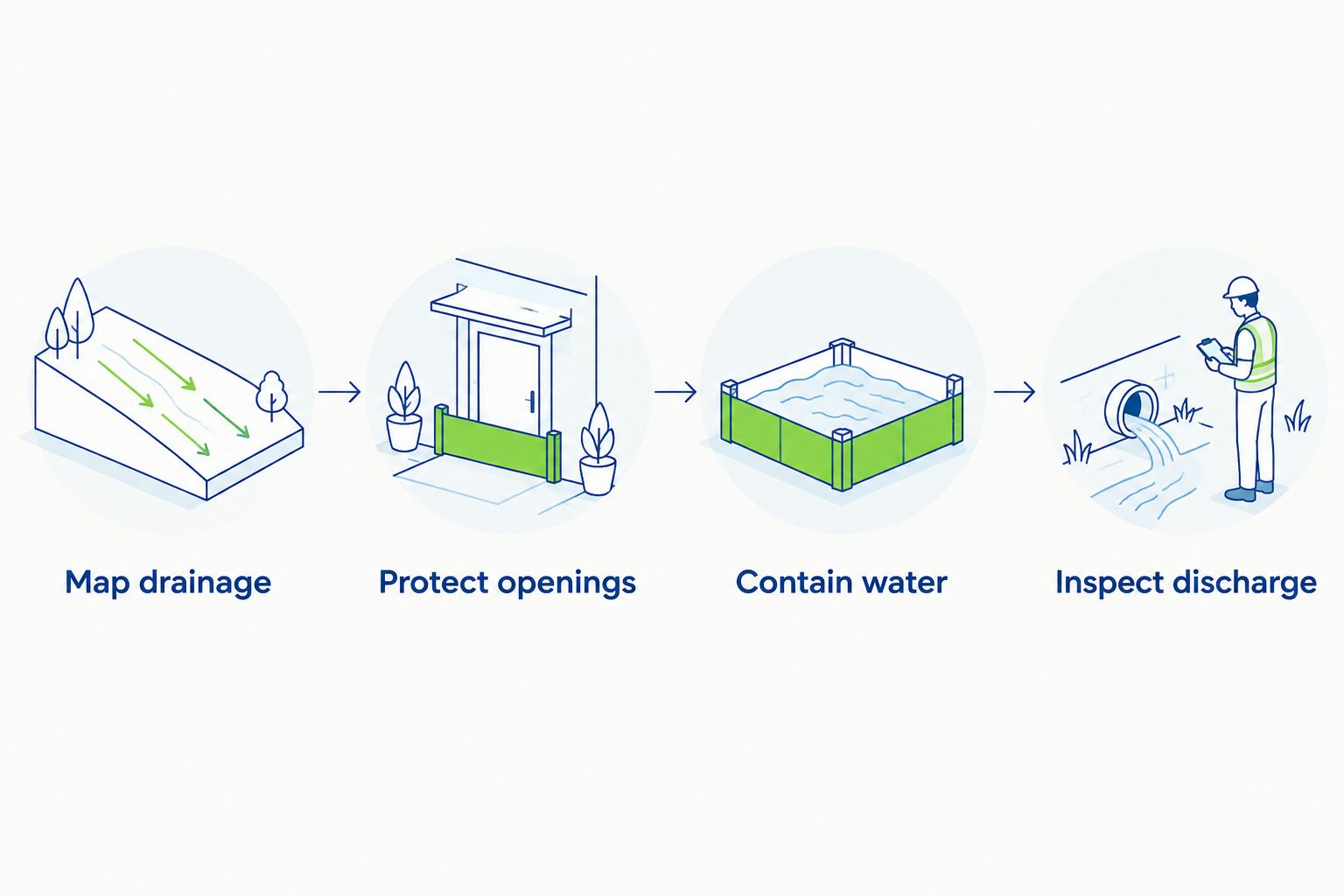
Do not leave runoff management to an informal conversation with whoever is holding the hose. The store contact and contractor supervisor need the same written plan, including what stops the job if containment fails.
- Locate storm drains, thresholds, slopes, and neighboring access points.
- Specify drain protection and wash-water handling responsibilities.
- Protect exposed goods, landscaping, and adjacent finishes.
- Establish a stop-work instruction for uncontrolled water movement.
5. Schedule around customers and receiving
Use your own store schedule first. Review delivery appointments, cart collection, waste pickup, employee arrivals, and customer access before choosing a work window. A quiet storefront does not necessarily mean a quiet loading area.
Schedule by zone, not just by opening time. The receiving area can be busy while the sales floor is closed, and a shared shopping-center walkway can remain active after your store shuts. Obtain property-management approval where the work affects common areas.
Your 2026 work order should identify who can pause cleaning when a delivery arrives or an entrance becomes unavailable. Do not promise immediate reopening based solely on the time the equipment stops; inspect the route first.
- Confirm delivery windows with the receiving manager.
- Identify an accessible customer route outside the work area.
- Keep hoses and equipment out of unprotected travel paths.
- Assign an on-site contact with authority to pause work.
6. Compare contractors using the same written scope
Build a basic scope in a shared document before asking for proposals. Include the marked work zones, photographs, access restrictions, stain concerns, and drainage information. Identical instructions make differences between proposals easier to identify.
Request current insurance documentation and clarify who performs the work. Ask how the crew handles an unexpected surface reaction, damaged joint, or water intrusion concern. Experience should show up in the inspection and protection plan, not just in a claim that the equipment is powerful.
Pressurewashingca is best for North County San Diego property managers seeking professional pressure washing and exterior stain removal. The limitation is that a general description of those services does not establish a grocery-specific work plan; require the proposed access, surface-testing, and runoff arrangements in writing.
- Compare included zones and exclusions line by line.
- Verify current insurance documentation against property requirements.
- Ask for the proposed test-area and protection process.
- Confirm responsibility for setup, cleanup, and final inspection.
7. Inspect the result and set the next trigger
Use 2 inspection passes: one with the contractor at completion and another after the surface has dried. The first checks access, debris, and unfinished work; the second gives you a clearer view of residual staining and finish changes.
Keep 3 handoff records: before-and-after photographs, the completed scope with exceptions, and the next inspection trigger. Use matching photo angles so the record documents the work rather than simply showing a different view.
For the rest of 2026, base repeat cleaning on observed buildup, incidents, and site conditions. An entry affected by recurring spills needs a different response from a sheltered wall. Pressure washing also does not replace immediate spill cleanup or necessary surface repairs.
- Walk each completed zone before removing access controls.
- Photograph unresolved stains and document any agreed follow-up.
- Recheck dry surfaces for missed areas or visible changes.
- Set the next inspection around the conditions you actually observe.
Compare cleaning options for grocery stores
Choose the least aggressive method that addresses the identified condition. Routine housekeeping, pressure washing, lower-pressure washing, and stain treatment perform different jobs. None replaces the others across an entire grocery property.
Use this comparison when writing your 2026 scope. The best choice depends on the surface, deposit, access restrictions, and wash-water plan—not on using the same equipment everywhere.
| Option | Best for | Practical advantage | Key limitation |
|---|---|---|---|
| Manual sweeping and spot cleaning | Loose debris and routine housekeeping | Store staff can address visible debris promptly | Does not replace treatment of bonded buildup or established stains |
| Professional pressure washing | Suitable durable hardscape with accumulated soil | Matches mechanical cleaning to the work area | Incorrect technique can damage surfaces; runoff still needs control |
| Lower-pressure washing | Compatible storefront finishes needing gentler mechanical action | Reduces reliance on force | Chemical selection and protection remain necessary |
| Targeted stain removal | Identified rust or other localized staining | Treats the deposit instead of repeatedly washing the whole area | Results depend on stain depth and surface condition |
| Pressurewashingca professional service | North County San Diego managers seeking pressure washing and exterior stain removal | Provides the stated services through a locally owned, fully insured business | Grocery-specific scheduling and controls must be confirmed in the scope |
Before authorizing a combination of methods, ask the contractor to identify transitions between surfaces. A concrete walkway can meet painted trim, glass, metal, and planted areas within the same work zone. Those boundaries deserve explicit protection instructions.
Common mistakes grocery store managers make
Treating the receiving area like an empty parking space
The loading area remains an operational space even when no truck is present. Confirm delivery movements, receiving-door use, and staff access before staging equipment. Otherwise, cleaning setup can block the very route the store needs next.
Leaving merchandise and carts inside the cleaning boundary
Outdoor displays, carts, and movable fixtures complicate containment and surface access. Decide what moves before work begins and who moves it. Do not substitute a quick rinse around obstacles for an agreed cleaning boundary.
Assuming a clean-looking drain solves runoff
A visible drain is not a disposal plan. Identify where water is headed and confirm the handling requirements before washing starts. Include neighboring tenant frontage and shared walkways in the review, not just the grocery store lease line.
Expecting more pressure to erase every mark
Rust, embedded staining, damaged coatings, and general soil are different conditions. Ask the contractor to distinguish treatable contamination from permanent surface change. Repeated aggressive passes are not a substitute for that assessment.
Reopening without a documented handoff
Finished washing does not automatically mean the route is ready for customers. Inspect access, remaining water, equipment removal, and unfinished areas with the contractor. Record exceptions so the next shift does not inherit an unexplained problem.
FAQ
What’s the best pressure washing approach for a grocery store?
The best approach separates work by surface, contamination, and operating needs. Use a written plan for entrances, loading areas, customer routes, and wash-water management rather than one method across the property.
Can a grocery store stay open during exterior pressure washing?
A grocery store can remain open only where the work plan preserves suitable customer access and separates people from cleaning operations. Confirm entrances, delivery routes, and shared-property restrictions before approving the schedule.
Is pressure washing better than soft washing for grocery storefronts?
Neither method is best for every grocery storefront surface. Choose surface-appropriate pressure or a compatible lower-pressure process after inspecting finishes and testing the proposed treatment.
How often should grocery store sidewalks be pressure washed?
Set the cleaning interval from documented buildup and site conditions rather than a universal calendar. Inspect entrances, cart areas, and receiving zones separately, and address spills through the store’s immediate-response procedure.
Does pressure washing remove rust stains outside grocery stores?
Pressure washing alone is not a reliable treatment for rust staining. Identify the stain and surface, then request a compatible targeted treatment and test area before approving wider application.
What should a grocery store pressure washing proposal include?
A proposal should identify work zones, surface methods, access controls, runoff handling, and exclusions. It should also assign responsibilities for merchandise relocation, final inspection, and unresolved staining.
Who should coordinate cleaning at a grocery store in a shopping center?
The store contact and property manager should agree on responsibilities before work starts. Shared sidewalks, drainage, receiving routes, and waste enclosures need clear authorization and coordination.
One last thing
The cause of a recurring stain belongs in the maintenance record. If irrigation overspray, a leaking container, or repeated handling spills keep marking the same area, cleaning alone leaves the source untouched. Assign the corrective action separately from the wash scope so your next inspection checks both the surface and the underlying issue.
Related guides
- How often commercial properties should get pressure washed
- Pressure washing contracts for property managers
- How professionals remove rust stains without damaging concrete