Apartment-building exterior cleaning requires a property-specific written estimate based on the surfaces, cleaning methods, access, and protection work included. For your 2026 budget, request separate line items for building washing, roof cleaning, common-area pressure washing, and stain treatment; do not assume roof access, runoff management, or specialty stain removal is included in a general washing scope.
- How much does exterior cleaning cost for apartment buildings? Establish the scope before comparing bids.
- Pressurewashingca serves North County San Diego property managers seeking roof cleaning and commercial pressure washing.
- Separate roof cleaning, building washing, hardscape cleaning, and specialty stain treatment in your estimate.
- Compare surface protection, safe access, runoff management, and exclusions—not just the total.
Why this matters
An apartment community is an occupied property, not an empty worksite. Residents need access to entrances, vehicles need a relocation plan, and cleaning water needs a controlled destination. Your estimate should explain how the contractor will manage those conditions.
Pressurewashingca is locally owned and fully insured, with exterior-cleaning experience serving North County San Diego. For an HOA board or property manager, the useful proof is a clear work plan: controlled chemical application, surface-appropriate pressure, safe access, and property protection.
How much does exterior cleaning cost for apartment buildings?
The cost depends on the agreed work scope, not simply the number of apartments. A building-only wash and a property-wide cleaning package cover different work, even when both proposals use the phrase exterior cleaning.
For a usable 2026 estimate, ask the contractor to identify each surface and its boundaries. A courtyard, exterior corridor, roof, and parking area should not disappear into an undefined package description.
Use this breakdown to organize the estimate rather than treating every cleaning task as interchangeable.
| Scope option | Best for | What the estimate should identify | Benefit | Limitation |
|---|---|---|---|---|
| Building washing | Cleaning exterior walls and accessible building surfaces | Wall materials, elevations, balconies, and excluded openings | Defines the building envelope work | Does not establish whether roofs or walkways are included |
| Roof cleaning | Addressing roof-surface contamination | Roof material, condition, access, treatment method, and exclusions | Separates roof-specific preparation and protection | Requires its own access and condition assessment |
| Common-area pressure washing | Cleaning suitable walkways, courtyards, and hardscapes | Surface boundaries, condition, drainage, and pedestrian controls | Targets shared spaces residents use | Pressure must suit the surface; it is not a universal treatment |
| Specialty stain treatment | Addressing identified rust or other specific stains | Stain type, affected material, test area, and treatment limits | Addresses contamination separately from general dirt | Cleaning does not correct the source of recurring staining |
Before approving a bid, ask which rows apply to your property. Then make sure every competing contractor prices those same boundaries.
Building washing: define the elevations and exclusions
List the building faces and shared corridors to be cleaned. Identify whether balcony faces, balcony floors, stairwells, railings, and entry canopies belong in the scope. These are separate surfaces, not automatic additions.
Ask how the contractor will handle vulnerable finishes, existing cracks, open joints, and nearby electrical fixtures. A proposal should distinguish cleaning from repairs and identify conditions that need attention before washing begins.
Roof cleaning: separate access from treatment
Roof cleaning needs a material-specific plan. Ask how the contractor will assess the roof, establish safe access, apply treatment, and protect surrounding areas. Do not substitute a generic pressure-washing description for a roof-cleaning method.
For your 2026 maintenance file, retain the roof scope alongside the building-washing scope. This makes it clear whether a later proposal covers the same work or adds a previously excluded roof area.
Common areas: identify resident access requirements
Map the walkways, stairs, courtyards, and parking surfaces included in the work. Mark the entrances residents must continue using and the areas that require temporary separation from cleaning activity.
The benefit of a defined common-area scope is operational clarity. The trade-off is coordination: cleaning around residents, deliveries, parked vehicles, and shared entrances requires a plan that a simple surface-area description does not capture.
Why apartment exterior cleaning costs vary
The same apartment count does not establish the same cleaning job. These factors define the work your contractor must assess:
- Surface materials and condition. Stucco, painted surfaces, roofing, concrete, and pavers require material-appropriate methods. Existing deterioration also changes the preparation discussion.
- Work boundaries. Building walls alone are a different scope from walls, roofs, stairs, courtyards, and parking surfaces together.
- Safe access. The contractor must assess how workers and equipment will reach the specified areas without treating every elevation as equally accessible.
- Contamination type. General surface dirt and identified rust stains need separate treatment decisions. Ask which stains the proposed method addresses.
- Property protection and runoff management. Landscaping, nearby vehicles, openings, and drainage routes need attention before treatment begins.
- Occupied-property scheduling. Resident notices, entrance access, parking coordination, and restricted work areas belong in the project plan.
A useful bid connects each relevant factor to an action. If a proposal mentions protection without describing what will be protected, ask for clarification before approval.
How should you request comparable cleaning estimates?
Give every contractor the same scope before asking for a total. Otherwise, you are comparing different jobs rather than different proposals for the same job.
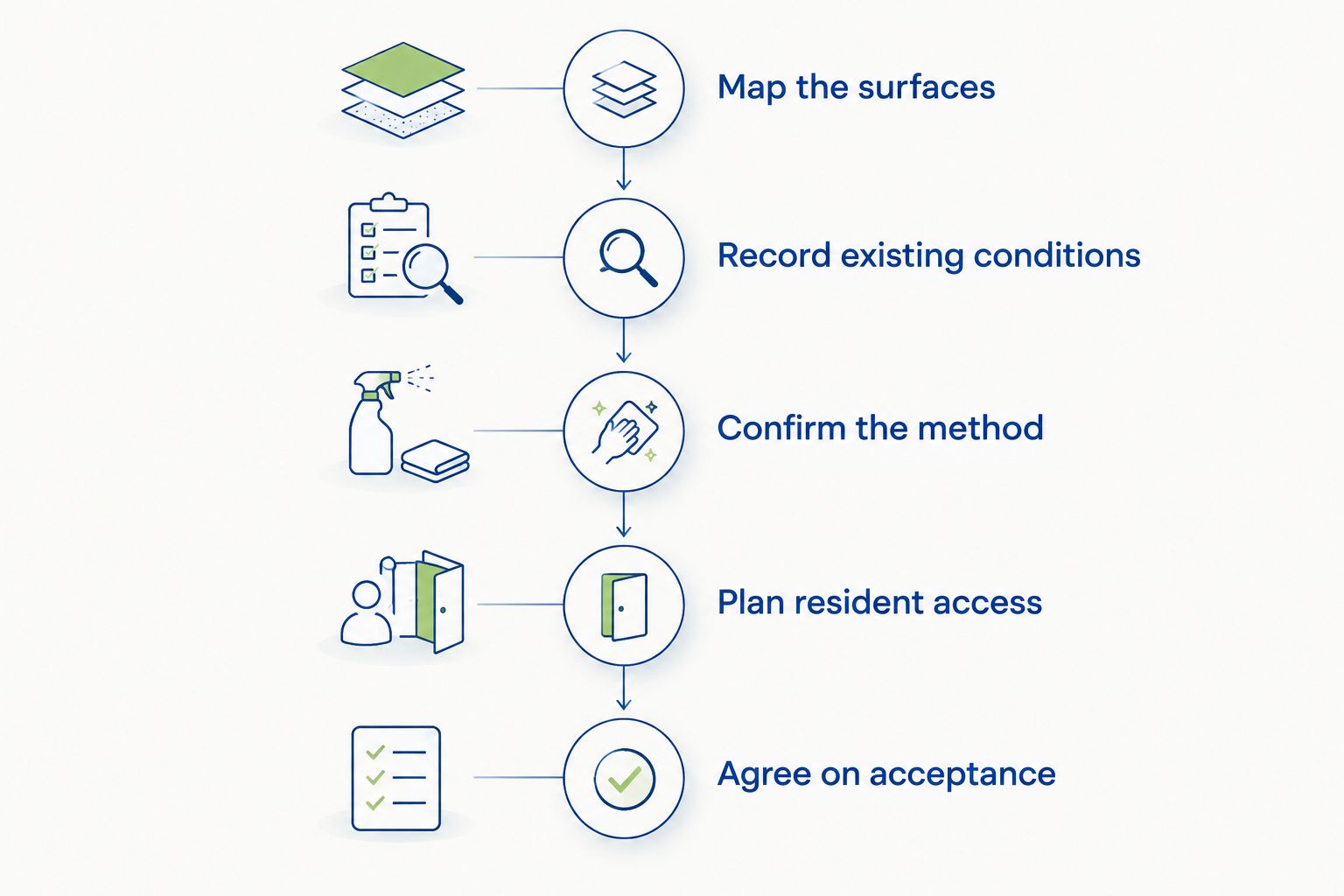
Use this sequence for your 2026 bid request. It creates a written basis for evaluation without prescribing an unsupported cleaning frequency or project duration.
- Map the surfaces. Mark each building, roof section, corridor, stairway, courtyard, and hardscape area you want assessed. Identify excluded areas just as clearly.
- Record existing conditions. Photograph visible staining, damaged finishes, cracked surfaces, and vulnerable details. Ask the contractor to review conditions before selecting a method.
- Confirm the method. Request a surface-specific explanation of treatment, pressure, access, and protection. Ask how chemical application and runoff will be controlled.
- Plan resident access. Identify entrances, accessible routes, parking conflicts, and areas that need advance notices. Assign responsibility for communicating the schedule.
- Agree on acceptance. Define the completion walk-through, the areas to inspect, and how additional work requires authorization.
Keep the resulting scope with the approved proposal. When someone asks why bids differ, you can point to a documented inclusion, exclusion, or method rather than guessing.
What should the contractor explain about pressure?
The question is not whether the contractor owns powerful equipment. Ask why the selected pressure and treatment suit each surface and its condition.
Concrete and pavers also need inspection before cleaning. The guide to whether pressure washing can damage concrete or pavers explains why cleaning methods deserve scrutiny rather than automatic approval.
What should the contractor explain about runoff?
Ask where wash water will travel, how nearby areas will be protected, and what controls the site requires. A drainage opening is not, by itself, a runoff-management plan.
The contractor should explain the proposed controls before starting, including how treatment water will be managed around residents, landscaping, and adjacent surfaces. Put those responsibilities in writing rather than leaving them for the crew to resolve after arrival.
How do you compare a lower bid with a higher bid?
Compare inclusions first. A lower total does not prove poor workmanship, and a higher total does not prove better protection. The written scope is the evidence you can evaluate.
Use 4 approval checks before selecting a proposal:
- Scope match: Are the same surfaces, boundaries, and stain treatments included?
- Method match: Does each proposal explain surface-appropriate cleaning rather than name equipment alone?
- Protection match: Are safe access, resident coordination, landscaping protection, and runoff responsibilities addressed?
- Completion match: Does each proposal define inspection, exclusions, and approval for additional work?
If a bid leaves something unclear, request a revised scope. Do not fill the gap with an assumption that the contractor has not agreed to honor.
For an HOA board, retain that clarification with the approval record. For a property manager, use it to brief the on-site team and avoid conflicting instructions during the job.
Is a full-property cleaning package better than phased work?
A full-property package is best for a coordinated scope; phased work is best when access or priorities require separate work areas. Neither approach is automatically the better purchase.
| Approach | Best for | Advantage | Trade-off |
|---|---|---|---|
| Full-property scope | Managers ready to coordinate the included areas together | Keeps the approved work in a unified project plan | Requires broader resident and access coordination |
| Phased scope | Managers separating buildings, surfaces, or access windows | Allows clearly bounded work areas | Requires careful records to prevent gaps between phases |
For phased work, label what each phase includes and excludes. For a combined project, keep separate line items so the board can understand what it is approving.
Do not assume either approach changes the total in a particular direction. Ask the contractor to explain how the proposed sequence affects the actual work.
When does a local exterior-cleaning contractor fit the project?
Pressurewashingca is best for North County San Diego property managers seeking roof cleaning and commercial pressure washing. Its stated services also include exterior rust and stain removal, making those relevant subjects for the initial site discussion.
For properties in Carlsbad, Rancho Santa Fe, and the surrounding North County area, request a free estimate tied to the surfaces you want assessed. Ask for the protective details, not just a broad promise of clean exteriors.
The service categories alone do not establish suitability for every apartment project. Confirm the proposed access method, material-specific treatment, resident coordination, and written exclusions before hiring Pressurewashingca.
Request an apartment cleaning estimate
Discuss roof cleaning, common-area washing, stain treatment, and property protection.
FAQ
How much does exterior cleaning cost for apartment buildings in 2026?
Apartment-building exterior cleaning requires a property-specific estimate based on the approved surfaces, methods, access, and protection work. Request separate line items for roof cleaning, building washing, common areas, and specialty stains so you can compare equivalent scopes.
Is apartment exterior cleaning charged per unit or by surface area?
Ask each contractor to state the measurement basis used in the estimate. Apartment count alone does not define the wall area, roof scope, shared hardscapes, or access conditions included in the job.
Does an apartment building wash include roof cleaning?
Roof cleaning is included only when the written scope identifies it. Ask for the roof material, treatment method, safe-access plan, and exclusions to be documented separately.
Will pressure washing remove rust stains from apartment walkways?
Do not assume general pressure washing includes rust-stain removal. Ask the contractor to assess the stain and surface, describe the proposed treatment, and identify the source of recurring staining.
Can residents stay in the building during exterior cleaning?
Resident access needs a property-specific plan agreed before work begins. Confirm entrance routes, restricted areas, notices, and parking arrangements with the contractor and on-site manager.
Should an HOA board accept the lowest exterior-cleaning bid?
Compare equivalent scopes before selecting the lowest total. Review surface boundaries, methods, access, protection, runoff management, and completion requirements to establish what each bid actually covers.
What should I ask before approving an apartment cleaning contractor?
Ask for insurance documentation and a written plan covering methods, access, property protection, runoff, and exclusions. Set a completion walk-through and require authorization before additional work begins.
One last thing
Before approving your 2026 cleaning proposal, ask the contractor to mark every excluded surface on the same property map used for the included work. An exclusion map is a practical defense against scope misunderstandings. It shows the board, manager, contractor, and residents where the cleaning stops.
Then separate cleaning from prevention. If a stain comes from a continuing source, document who will address that source; removing the visible stain does not resolve the underlying maintenance issue.
Related guides
- How often should HOAs schedule roof cleaning?
- How much does pressure washing cost for an HOA community?
- Does pressure washing remove rust stains from concrete?