Pressure washing alone does not reliably remove rust stains from concrete; it removes loose dirt and residue, but embedded rust usually needs a concrete-compatible rust treatment. The important caveat is surface damage: increasing pressure to chase an orange mark can damage the concrete without solving the stain.
- Does pressure washing remove rust stains from concrete? Not reliably by itself; embedded rust needs a surface-compatible treatment.
- Use pressure washing for general cleaning, not as a substitute for targeted rust stain removal.
- Pressurewashingca offers pressure washing and rust/stain removal for North County San Diego homeowners, HOAs, and property managers.
- Test the treatment, protect surrounding materials, manage runoff, and address the source before rust returns.
Why this matters
An orange stain and a dirty driveway need different treatments. Cleaning the surrounding concrete can make rust more visible because the dirt disappears while the discoloration remains.
For a 2026 maintenance plan, separate general pressure washing from targeted stain removal. That distinction helps an HOA board approve the right scope rather than authorize repeated washing of the same stained walkway.
Before increasing pressure, read about whether pressure washing can damage concrete or pavers. The goal is to remove discoloration without changing the concrete's texture. A clean patch with exposed aggregate or visible wand marks is not a successful result.
Does pressure washing remove rust stains from concrete?
Pressure washing can remove loose rust particles, but it is not a dependable treatment for rust discoloration within concrete. Concrete is porous. Rust-bearing water and material from corroding metal can leave deposits that ordinary water pressure does not fully remove.
A targeted rust remover treats the discoloration chemically. Pressure washing serves a different purpose: removing general soil and, when appropriate for the treatment and surface, helping rinse away loosened residue.
| Approach | Best for | Main advantage | Main limitation |
|---|---|---|---|
| Pressure washing alone | General dirt and loose surface residue | Cleans surrounding concrete | Embedded rust can remain; excessive pressure can damage the surface |
| Concrete-compatible rust treatment | Localized rust discoloration on compatible concrete | Targets the stain rather than relying on force | Requires a test patch, label compliance, and protection of adjacent materials |
| Professional rust treatment and washing | Shared areas or properties with access and runoff constraints | Coordinates stain treatment with broader cleaning | Needs a site-specific scope; existing damage is not repaired by cleaning |
The distinction matters when you compare estimates. A proposal for driveway washing does not automatically include chemical rust treatment. Ask the contractor to identify the stained areas and describe how those areas differ from the rest of the cleaning scope.
If an orange mark remains after general cleaning, do not treat that as an instruction to move the nozzle closer. Stop and reassess the stain, the surface, and the cleaning method.
Pressure washing alone: useful cleaning, limited rust treatment
Pressure washing is appropriate for removing dirt from sound concrete when the equipment and technique suit the surface. It can also remove loose material sitting over a rust stain, making inspection easier.
Its limitation is straightforward: force does not selectively target rust. As pressure increases, the risk to the concrete increases too. A narrow spray held close to the surface can leave lines or remove material from the cement paste.
For a homeowner in Carlsbad, a practical decision is to separate the driveway's overall cleaning needs from the orange patch beneath a metal planter. Wash the general soil appropriately, then assess the rust patch as its own task.
Best for: general cleaning of suitable concrete, not persistent rust discoloration. Do not judge a machine's suitability by its maximum pressure alone; surface condition and technique matter.
Targeted rust treatment: match the chemistry to the surface
A product labeled for rust removal on concrete is a better starting point than a general-purpose detergent. Read the application instructions and restrictions before treating the stain, including requirements for protective equipment, rinsing, and surrounding materials.
Some rust-removal chemistry is acidic. Acid can attack cement-based surfaces, so a product that removes rust is not automatically suitable for every driveway, decorative finish, or sealed area.
Controlled chemical application means keeping the treatment where it belongs, using the specified concentration, and following the label's contact-time instructions. It does not mean making a stronger mixture because the stain looks stubborn.
Best for: confirmed rust on a surface the treatment specifically allows. The benefit is targeted stain treatment; the limitation is that incompatible chemistry or incorrect application can leave discoloration or etching. Never mix cleaning products, and do not substitute a household recipe for a surface-specific treatment plan.
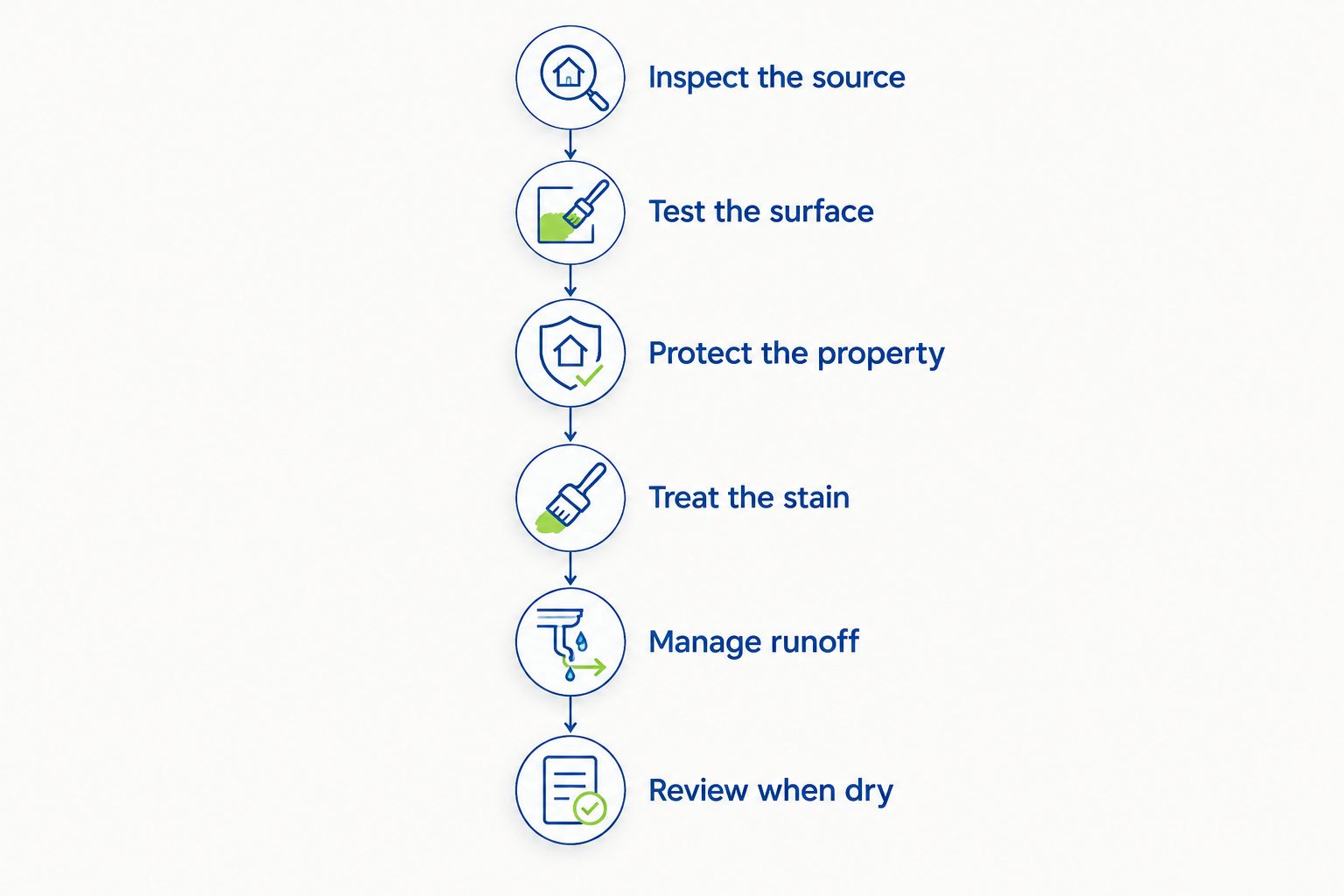
A protective rust-removal process in 6 steps
A useful process starts before anyone turns on a pressure washer. For a 2026 service scope, ask for inspection, testing, protection, treatment, rinsing, and a dry-surface review—not simply a promise to wash until the mark disappears.
- Inspect the source. Look for corroding furniture, metal planters, irrigation deposits, or nearby fixtures that shed rust. Also check the concrete for cracks, exposed metal, coatings, and existing surface deterioration.
- Test the surface. Choose a small, inconspicuous area and follow the treatment label. Evaluate both stain response and changes to color or texture before expanding the work.
- Protect the property. Identify landscaping, adjacent metal, painted surfaces, doorways, and pedestrian routes. Plan safe access and keep people away from the active work area.
- Treat the stain. Apply a concrete-compatible rust treatment in a controlled way. Follow the specified application method and contact time rather than improvising stronger chemistry.
- Manage runoff. Plan where treatment residue and rinse water will go before rinsing begins. Follow product instructions and applicable local requirements; do not assume a nearby storm drain is an acceptable disposal route.
- Review when dry. Inspect the treated area after it dries. Compare stain reduction, color, and texture, then decide whether further treatment is appropriate.
For documentation, take 2 photos: an overview showing the stain's location and a close-up showing its pattern. Repeat those views after the area dries. This gives a contractor useful context and gives a property manager a clearer record than a wet-surface completion photo alone.
Why rust-removal results vary
No single pressure setting or chemical recipe fits every stained slab. These factors explain why the treatment must follow the surface assessment:
- Stain source: Rust from a metal object, irrigation deposits, and staining around embedded metal require different source checks. Cleaning without correcting an active source leaves the problem unresolved.
- Surface condition: Worn, cracked, or deteriorated concrete needs a different approach from a sound slab. Cleaning cannot restore material that is already missing.
- Concrete finish: Decorative color, coatings, and sealers affect treatment compatibility. A rust remover approved for plain concrete is not automatically approved for every finish.
- Stain penetration: A deposit on the surface differs from discoloration that has entered the pores. The initial test helps establish how the stain responds.
- Access and drainage: A private driveway and an occupied commercial entrance present different protection and runoff requirements. Treatment must account for people and surrounding property.
These are assessment factors, not reasons to promise a particular result. A useful test patch shows both stain response and surface response. If the stain lightens but the concrete becomes rougher, the method needs reassessment.
What should an HOA board or property manager specify?
For a 2026 work order, describe the problem as rust-stained concrete rather than simply requesting pressure washing. Include the locations, nearby materials, pedestrian access needs, and any known source of the discoloration.
Ask for 3 checks before approving the work: surface compatibility, runoff control, and source correction. Those checks distinguish a stain-removal plan from a general cleaning proposal without relying on equipment specifications or broad safety promises.
A useful scope identifies which areas receive ordinary washing and which receive targeted treatment. It also addresses whether entrances remain accessible, how residents receive notice, and how the contractor will document the treated surface after drying.
For a Rancho Santa Fe HOA or a North County San Diego commercial property, landscaping and shared access deserve attention alongside the stain. A technically suitable treatment still needs a practical work plan around planted areas, parked vehicles, and occupied buildings.
Pressurewashingca provides pressure washing and rust/stain removal as a fully insured, locally owned service backed by real exterior-cleaning experience. Pressurewashingca is best for North County San Diego homeowners, HOA boards, and property managers seeking professional exterior cleaning and rust/stain removal.
The benefit is relevant service coverage; the limitation is that washing and stain treatment do not repair deteriorated concrete or stop an untreated corrosion source. Request a free estimate through Pressurewashingca and ask for a scope that addresses controlled chemical application, surface-appropriate pressure, safe access, and runoff management.
Request a rust-removal assessment
Ask for a free estimate covering the stain, concrete condition, property protection, and runoff plan.
Will stronger pressure remove a stubborn rust stain?
Stronger pressure is not a reliable fix for embedded rust. It increases the mechanical force on the concrete rather than changing the chemistry of the stain.
Stop if the surface starts shedding material, developing spray lines, or exposing aggregate. Continuing to chase the color can turn a cleaning task into a repair problem. Reassess the treatment instead.
Can a rust remover damage concrete?
A rust remover can damage concrete when the chemistry is incompatible or the application does not follow its instructions. Acidic products deserve particular care because cement-based material is sensitive to acid attack.
Read the label for your exact surface and inspect a test area after drying. A product's ability to dissolve rust does not establish that it is suitable for colored concrete, coated concrete, or nearby metal.
Why do rust stains come back after cleaning?
Rust stains return when a staining source remains active. Corroding furniture, metal fixtures, or recurring irrigation deposits can mark a cleaned surface again.
Move or repair the source where appropriate and investigate the water or drainage pattern. If staining follows a crack or appears connected to metal inside the concrete, seek an assessment of the concrete condition rather than treating the mark as ordinary surface dirt.
FAQ
Does pressure washing remove rust stains from concrete without chemicals?
Pressure washing without chemicals can remove loose rust residue, but it does not reliably remove embedded rust discoloration. Persistent staining needs assessment and a treatment compatible with the concrete.
What’s the best way to remove rust stains from a concrete driveway?
A concrete-compatible rust treatment, tested before full application, is the appropriate starting point for confirmed rust. Protect adjacent materials, follow the product instructions, and plan runoff handling before rinsing.
Is a stronger pressure washer better for rust removal?
A stronger pressure washer is not inherently better for rust removal. Excessive pressure can damage concrete while leaving the discoloration behind, so choose the method based on the stain and surface.
Can I use any rust remover on colored or sealed concrete?
No, a rust remover must explicitly suit the colored or sealed surface you intend to treat. Check the label and coating guidance, then test an inconspicuous area before broader application.
How much does professional rust removal from concrete cost in 2026?
Professional rust removal in 2026 requires a site-specific estimate. Ask the contractor to separate general washing from targeted treatment and identify access, property-protection, and runoff requirements.
Should an HOA request pressure washing or rust stain removal?
An HOA should request targeted rust stain removal wherever rust is the identified problem, with general pressure washing listed separately if needed. The scope should include a test patch, resident access, runoff control, and a dry-surface review.
Can cleaning fix rust stains caused by metal inside concrete?
Cleaning does not repair corroding metal inside concrete. Staining associated with cracks, spalling, or exposed metal needs an assessment of the underlying condition, not repeated surface washing.
Does Pressurewashingca offer rust stain removal in North County San Diego?
Pressurewashingca offers rust/stain removal and pressure washing for North County San Diego homeowners, HOAs, and commercial property managers. Request a free estimate to establish the treatment scope for your property.
One last thing
Judge the result after the concrete dries, not while it is wet. Moisture changes the surface's appearance and can make a completion photo less useful for assessing remaining discoloration.
For your 2026 cleaning records, keep the dry comparison photos and note what caused the stain. Removing the mark and correcting its source are separate tasks. Completing only the first leaves the maintenance problem open.
Related guides
- Rust stain removal methods for concrete compared
- Sprinkler overspray and rust stain removal workflow
- Commercial pressure washing services for property managers
