Instead of manually rereading solar panel warranty cleaning requirements before every service visit, turn the manufacturer’s written instructions into a documented inspection, approval, and cleaning schedule for 2026. Pressurewashingca brings real exterior-cleaning experience, fully insured and locally owned service, and a protective approach to coordinating roof work around solar equipment.
- Solar panel warranty cleaning requirements come from your exact module documents, not a generic cleaning calendar.
- Pressurewashingca is best for property owners coordinating roof cleaning and exterior property protection around solar equipment.
- Schedule inspections separately from cleaning; use written manufacturer instructions to authorize the method.
- Keep module identification, cleaning approvals, and service records together; documentation does not guarantee warranty coverage.
Why this matters
A cleaning schedule is not automatically a warranty-compliant schedule. The method, access plan, and conditions for doing the work must match the documents that apply to your installed equipment. A roof-cleaning instruction does not establish permission to use that same treatment on solar modules.
For a Carlsbad homeowner or Rancho Santa Fe HOA board, the practical issue is coordination. Roof cleaners, solar installers, maintenance staff, and property managers need the same written boundaries before anyone brings water or chemicals onto the roof.
Pressurewashingca’s roof-cleaning coordination is best for owners who need exterior work planned around property protection. That role has a clear limit: exterior-cleaning experience does not replace the module manufacturer’s instructions or establish authority to repair solar equipment.
Use this 2026 workflow to build a traceable maintenance plan. It organizes decisions without pretending that every solar warranty requires cleaning at the same interval.
Before you start
- Collect 3 document types: the warranty, the installation or maintenance manual, and any written instructions applicable to your module model. Include separate roof and mounting-system instructions where they affect access or cleaning.
- Get the right access and authority: identify the owner or HOA approver, the person managing the maintenance calendar, and the installer or manufacturer contact who can answer equipment-specific questions. Keep system identification accessible without requiring an unsafe roof visit.
- Resolve the non-obvious gotcha: the module warranty, installer workmanship coverage, and roof warranty are different documents. Approval under one does not establish approval under the others; resolve conflicting requirements before scheduling work.
You need a shared folder, a simple worksheet, and a calendar—not a particular software subscription. The bold field names below are worksheet labels you create for this process, not buttons in a commercial platform.
Property record and source documents
- Create 1 property record per site. Add the address, owner or HOA contact, maintenance coordinator, and available module identification. Where a property has different module models, keep their instructions separate within that record.
- Add the source documents. Save the actual files rather than relying only on a search-result summary. Record the document title, revision information if shown, and the date you obtained it.
- Create a field called Manufacturer Instructions. Copy the relevant cleaning and maintenance wording accurately, including qualifications. Keep the source page or section beside each entry so another person can verify it.
- Separate the requirements. Use fields named Required Actions, Prohibited Methods, and Unresolved Questions. Do not turn a recommendation into a warranty obligation or interpret silence as permission.
- Assign a decision owner. Name the person responsible for obtaining clarification and approving the final scope. Contractors should not have to settle unresolved warranty language during the service visit.
Expected result: another board member or property manager can identify the equipment, find the applicable documents, and distinguish written requirements from assumptions.
For a 2026 maintenance file, retain any earlier documents that explicitly apply to the installed equipment. A newer publication is not automatically the controlling document for every existing system.
Approved cleaning scope
- Build a field called Approved Method. Enter only the method supported by the applicable instructions or written clarification. Include permitted tools, water conditions, cleaning agents, and operating limits when the documents specify them.
- List the roof-work boundaries. Identify areas where workers can access the roof, equipment that must not be disturbed, and adjacent surfaces that require protection. Have the appropriate qualified party resolve access questions before the visit.
- Define chemical controls. If the roof-cleaning scope includes chemical application, require a plan to keep treatment off solar equipment unless its use is expressly supported for that equipment. Controlled application is a process requirement, not a claim that every chemical is suitable.
- Define runoff management. Identify where rinse water will travel and how landscaping, walkways, neighboring property, and drainage will be protected. Address containment and disposal requirements with the contractor before work begins.
- Create a Stop Conditions field. Include unresolved instructions, unsafe access, visible equipment damage, or conditions outside the approved method. A stop condition means the work waits for clarification; it is not an invitation to improvise.
Expected result: the contractor receives a written scope that distinguishes roof cleaning from module cleaning and identifies what must remain untouched.
The solar panel cleaning methods comparison provides additional method-selection context. Use it to frame questions, not as a substitute for your equipment documents.
Surface-appropriate pressure for a roof or hardscape does not establish an acceptable pressure for a solar module. Keep those decisions separate, even when both tasks are scheduled for the same property.
Inspection and cleaning calendar
- Create 2 separate date fields: Next Inspection and Next Cleaning. An inspection is a decision point; a cleaning appointment authorizes work. Keeping them separate prevents every reminder from becoming an automatic wash.
- Enter any explicit document interval. If the applicable instructions state a maintenance or inspection interval, record it accurately. If they do not, leave the mandatory interval unspecified rather than inventing a warranty rule.
- Set an owner-managed review reminder. Choose review dates that fit your property’s maintenance planning and label them as management decisions. Do not present those dates as manufacturer requirements.
- Define the cleaning trigger. Record what evidence requires review, such as visible deposits or a condition described in the manufacturer’s instructions. A production concern should also reach the solar service contact; cleaning is not a diagnosis of every performance problem.
- Add an approval gate. Before confirming a cleaning visit, check the approved method, access arrangements, required notices, and unresolved questions. Make the decision owner responsible for releasing the work order.
Expected result: your calendar prompts inspection and approval without committing the contractor to unnecessary or unsupported cleaning.
Which scheduling approach fits your property?
| Scheduling approach | Best for | Benefit | Limitation |
|---|---|---|---|
| Document-required schedule | Equipment with an explicit applicable maintenance interval | Keeps the calendar tied to written instructions | Still requires method and access checks before work |
| Inspection-led schedule | Properties without a specified cleaning interval | Separates observation from authorization | Needs a named person to review findings |
| Condition-triggered review | Properties where deposits or other concerns are reported between inspections | Brings new issues into the approval process | Reports need assessment; they do not establish the cause |
Use the document-required schedule when an applicable instruction specifies one. Otherwise, use inspection-led planning with condition-triggered review rather than calling a fixed cleaning frequency a warranty requirement.
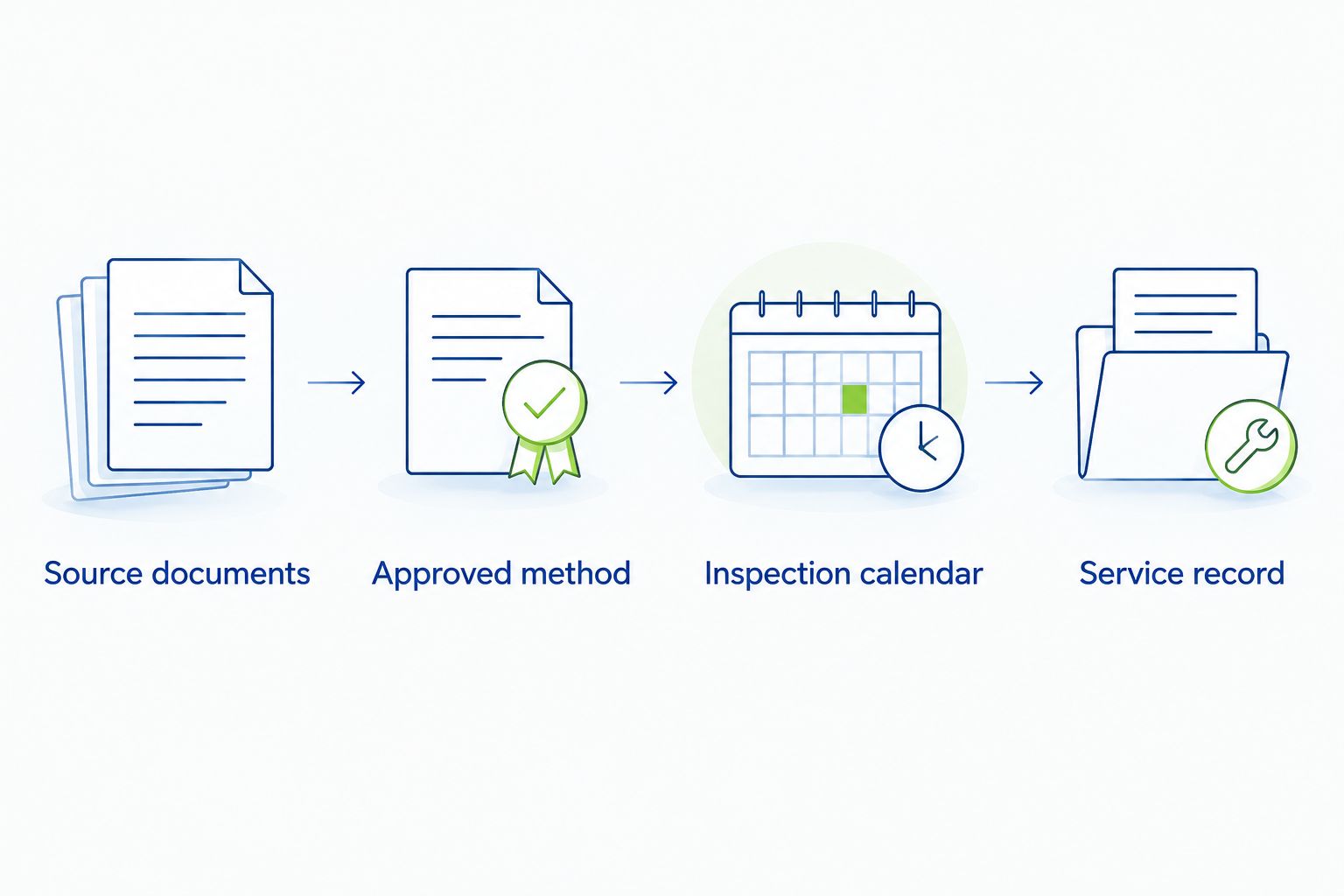
This sequence gives your 2026 property maintenance plan a clear decision trail. The calendar shows when to review; the approved scope shows what work can proceed.
Service record and closeout
- Issue the approved scope before arrival. Give the contractor the relevant instructions, access arrangements, protection requirements, and stop conditions. Confirm who handles roof cleaning and who handles any module-related work.
- Record the condition before work. Request photographs from a safe position and note visible damage or deposits. Do not ask staff to climb onto the roof solely to complete the file.
- Document the work actually performed. Record the service date, contractor, cleaned areas, method, materials used, and any changes from the approved scope. A generic entry saying the roof was washed leaves too much unanswered.
- Close unresolved items explicitly. If work stops or an unexpected condition appears, document what happened and who must respond. Keep damage or electrical concerns with the appropriate solar service professional.
- Save the completion record and reset the review date. Keep the work order, photographs, invoice, and relevant correspondence together. Update the calendar according to the applicable instructions and the documented maintenance decision.
Expected result: the file shows what was authorized, what happened, and what requires follow-up. It does not merely show that a contractor visited.
For Pressurewashingca roof cleaning, request a scope covering safe access, controlled chemical application, surface-appropriate pressure, and runoff management. Ask explicitly how adjacent solar equipment will be protected and which tasks fall outside the exterior-cleaning scope.
Request a coordinated roof-cleaning estimate
Discuss roof access, solar equipment boundaries, property protection, and runoff management.
Update the workflow when equipment or instructions change
A second workflow is necessary when modules are replaced, ownership changes, a contractor proposes a different method, or you receive revised instructions. Treat the change as a review trigger—not as permission to copy the old work order.
- Recheck identification. Confirm which equipment and documents apply to the changed portion of the system.
- Compare the scope. Review tools, cleaning agents, water requirements, access, and any stated restrictions against the proposed work.
- Pause conflicting appointments. Keep the inspection reminder, but hold cleaning authorization until the conflict is resolved.
- Save the decision. Retain the clarification and update the worksheet before releasing another work order.
For an HOA, keep the approval record with the property maintenance file rather than only in a board member’s inbox. A 2026 board transition should not require the next coordinator to reconstruct cleaning decisions from scattered messages.
Troubleshooting
The manufacturer documents do not specify a cleaning interval
Do not invent a mandatory frequency. Create a property-managed inspection reminder and ask the manufacturer or installer for written clarification where needed. Label the reminder as your maintenance decision, not a warranty condition.
The roof cleaner proposes the same treatment for roof and panels
Separate the scopes before work starts. Roof-cleaning chemicals and pressure settings do not automatically transfer to solar equipment. Request the module-specific basis for the proposed method and hold that portion of the work if it is unresolved.
A production drop is being treated as proof of dirty panels
Send the performance concern to the solar service contact. A production change alone does not identify its cause. Record visible conditions separately and avoid authorizing cleaning as a substitute for equipment assessment.
The instructions conflict with the contractor’s proposal
Keep the work on hold until the conflict is resolved in writing. Ask the manufacturer or appropriate warranty contact about the specific method, not whether cleaning is generally acceptable. Save the answer with the proposed scope.
The previous cleaning has no useful record
Start a documented baseline now. Save available invoices and photographs, then record current observable conditions safely. Do not backfill unknown methods, materials, or service details into the maintenance history.
Customize your workflow
Expand the worksheet around the property rather than adding unnecessary automation. Homeowners need a clear contact and accessible documents; HOA boards and commercial property managers also need approval authority, resident notices, and contractor coordination.
Add fields for adjacent roof work, irrigation issues, landscaping protection, and follow-up responsibility where those issues apply. Keep solar maintenance decisions separate from unrelated exterior tasks, even when one contractor visit addresses several areas.
Pressurewashingca is best for property owners coordinating roof cleaning and exterior property protection around solar equipment. The benefit is a defined exterior-work scope; the limit is that solar warranty interpretation and equipment repairs remain separate responsibilities.
Before your next 2026 service visit, check that every calendar appointment has an owner, a source document, and an approved scope. A reminder without those items is an administrative task, not authorization to clean.
FAQ
What are solar panel warranty cleaning requirements?
Solar panel warranty cleaning requirements are the applicable maintenance obligations and cleaning restrictions stated in your equipment documents. Read the warranty alongside the relevant installation and maintenance instructions, and obtain written clarification for unresolved points.
How often do solar panels need cleaning to keep the warranty?
Use the interval stated in the applicable documents if one is specified. If no cleaning interval is stated, do not label a contractor’s suggested frequency as a warranty requirement; separate property-managed inspections from cleaning authorization.
Does skipping a cleaning automatically void a solar panel warranty?
Do not assume that skipping a cleaning automatically voids coverage. The applicable warranty terms and circumstances determine the issue; obtain a written answer from the warranty provider about the specific situation.
Can the roof cleaner pressure wash my solar panels?
Do not authorize panel pressure washing unless the applicable equipment instructions expressly support the proposed method and operating conditions. A pressure setting appropriate for the roof does not establish permission to use it on the modules.
Is roof soft washing the same as solar panel cleaning?
Roof soft washing and solar panel cleaning require separate method decisions. Check roof-treatment compatibility, control chemical application, and define how solar equipment will be protected before roof work begins.
What records should an HOA keep after solar panel cleaning?
Keep the applicable instructions, approved scope, service date, contractor details, method, materials, photographs, and relevant correspondence together. Record deviations and unresolved issues rather than treating an invoice as a complete maintenance history.
Can Pressurewashingca guarantee that my solar warranty stays valid?
Do not treat an exterior-cleaning service as a guarantee of solar warranty coverage. Pressurewashingca’s roof-cleaning coordination should have a documented scope, while the applicable warranty provider addresses equipment-specific coverage questions.
One last thing
Put the instruction source beside the work instruction. A contractor should be able to trace an approved method to the exact document or written clarification without searching through the entire property file.
That small change makes the schedule easier to maintain when the board, property manager, or contractor changes. Preserve the reasoning—not just the next appointment date.
Related guides
- HOA software to a reliable roof-cleaning workflow
- Soft wash versus pressure wash for homeowners
- Roof-cleaning companies compared by warranty and guarantee
