Six methods actually clean rooftop and ground-mounted solar arrays without shortening their lifespan, and only two of them belong on a steep tile or shingle roof without a trained crew. Best overall for North County San Diego rooftops: professional soft-wash roof and panel cleaning. Best for routine dust maintenance between services: deionized water rinse. Best for hard water spot removal: mild detergent treatment. Best for large commercial arrays: robotic waterless cleaning.
- Professional soft-wash cleaning wins for rooftop arrays in North County San Diego because it protects panel coatings and manages runoff.
- Deionized water rinsing prevents mineral spotting but won’t cut through baked-on bird droppings.
- Low-pressure washing works only when calibrated under panel-rated PSI – the wrong nozzle cracks glass.
- Robotic cleaning scales for commercial solar farms, not single residential rooftops.
- Soiling can cut panel output by up to 25%, which is why the best solar panel cleaning methods matter more than most homeowners assume in 2026.
Why this matters
A dusty panel doesn't just look dirty – it produces less power. Dust, pollen, salt spray and bird droppings can reduce output by up to 25% when soiling is heavy, which is a real number on a homeowner's electric bill, not a cosmetic issue. North Coast Exteriors has spent years cleaning roofs across North County San Diego where coastal salt air and inland dust both hit the same rooftop, and the method matters as much as the schedule.
The wrong method is worse than no cleaning at all. A narrow-tip pressure washer can crack tempered glass or lift a frame seal. Hard tap water left to air-dry leaves mineral spotting that shades cells the same way dirt does. Getting the method right in 2026 means matching the tool to the surface, not just spraying whatever is on hand.
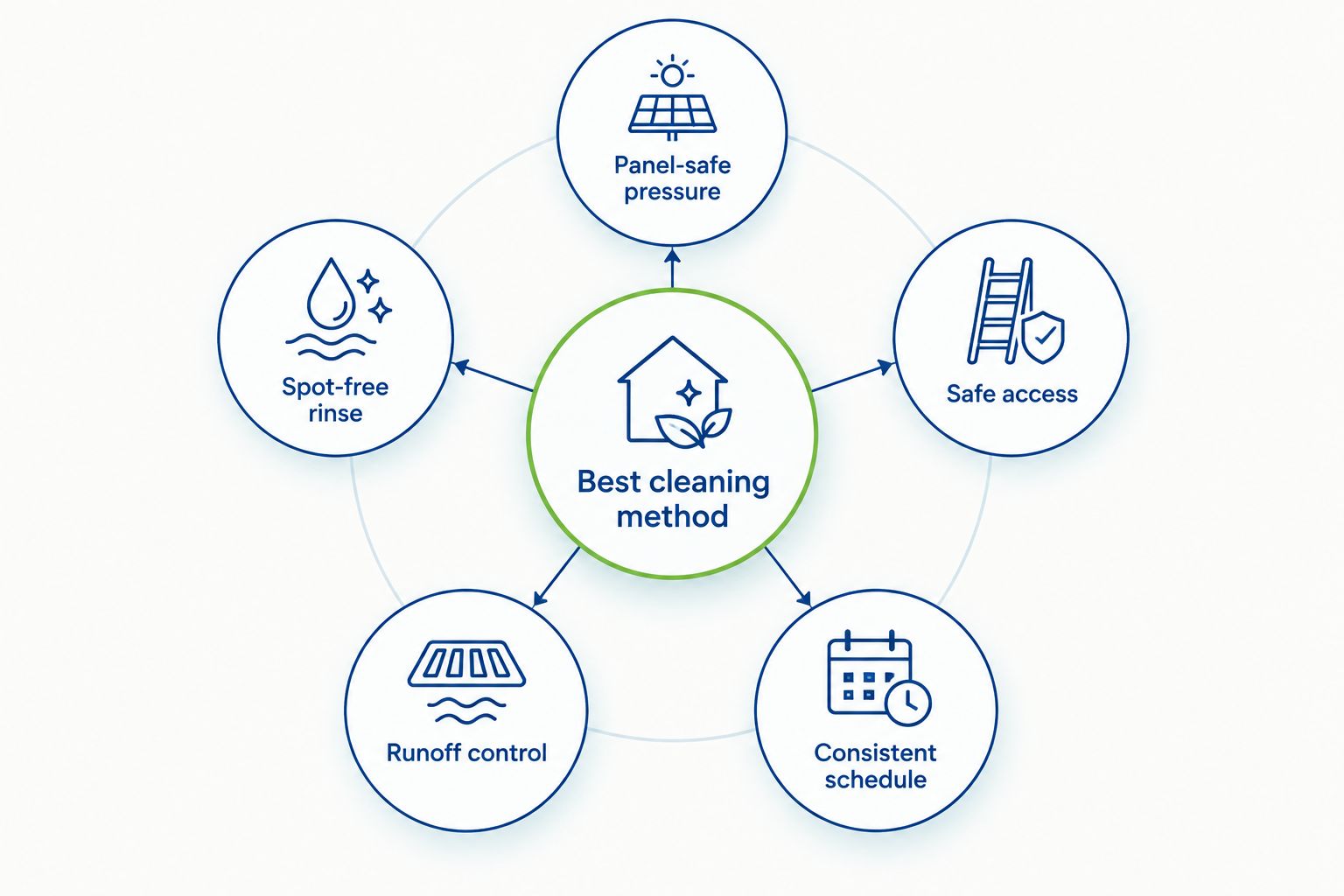
What makes the best solar panel cleaning method
- Panel-safe pressure and chemistry – no scratching, no coating damage, no voided warranty
- Spot-free rinse water – deionized water where possible so nothing dries into streaks
- Safe rooftop access – reaching multi-story arrays without stepping on tile or displacing mounts
- Runoff control – keeping chemical residue out of gutters, planting beds and storm drains
- Consistency across a schedule – some methods only work as maintenance between full cleanings, not as the whole job
Solar panel cleaning methods at a glance
| Method | Best for | Standout feature | Key limitation |
|---|---|---|---|
| Professional soft-wash cleaning | North County San Diego rooftop arrays | Panel-safe process with safe roof access | Requires scheduling, not instant |
| Deionized water rinse | Routine dust maintenance | Zero spotting, no chemicals | Won't remove baked-on grime |
| Manual brush + deionized water | Single-story or ground-mounted DIY | Full control, low cost | Risky above one story without fall gear |
| Calibrated low-pressure washing | Heavy bird-dropping buildup on accessible arrays | Cuts through caked debris fast | Wrong PSI or tip cracks glass |
| Robotic waterless cleaning | Large commercial solar farms | Scales across rows without crews | High upfront cost, impractical residential |
| Mild detergent treatment | Hard water spot and mineral scale removal | Dissolves scale plain rinse leaves behind | Needs a deionized rinse-off after |
1. Professional soft-wash roof and panel cleaning: best for North County San Diego rooftops
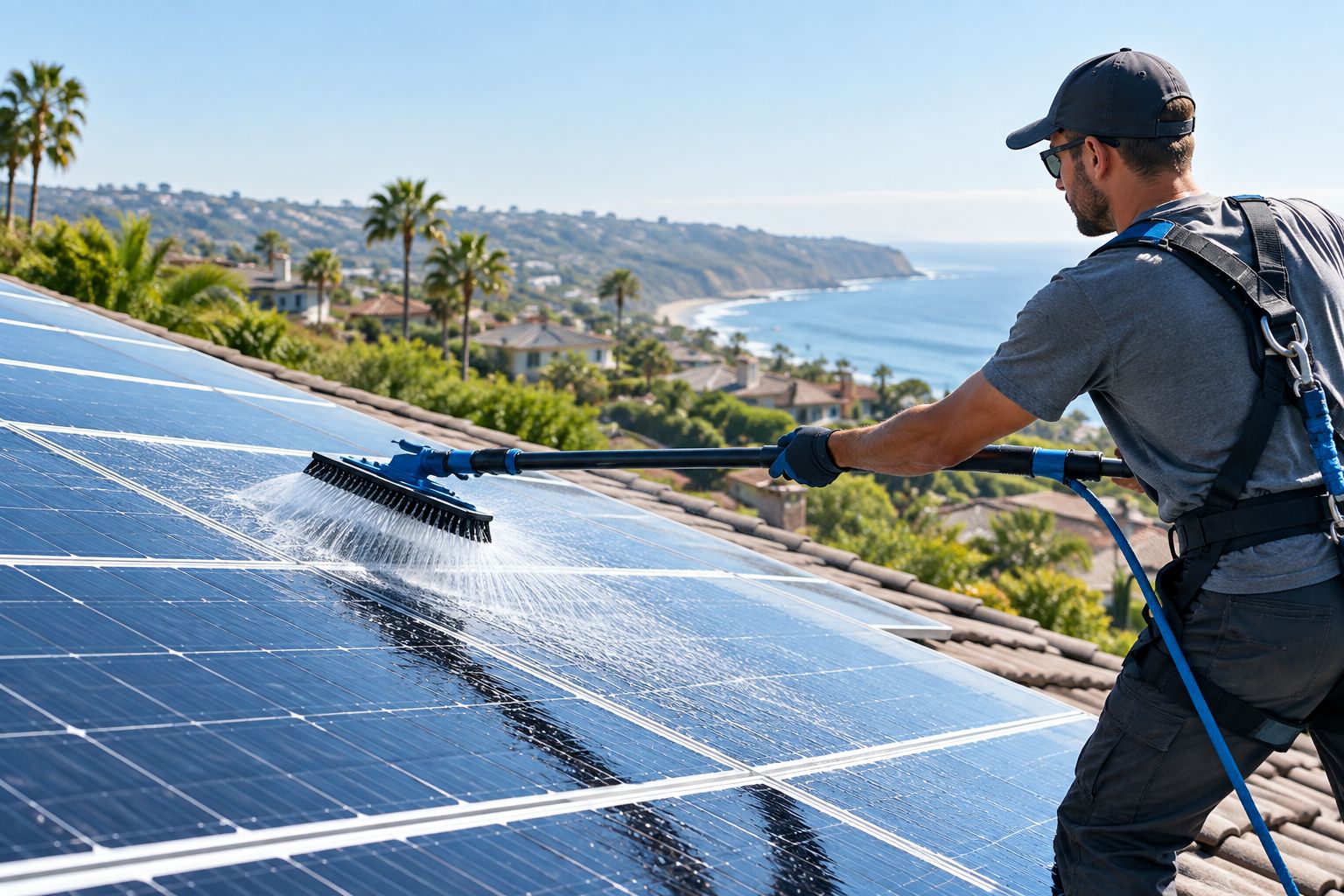
A soft-wash approach pairs low-pressure rinsing with a controlled, panel-safe chemical application that lifts dust, salt residue and bird droppings without an abrasive brush touching the glass. Technicians already trained on tile and shingle roof safety apply that same care around mounted arrays, and runoff gets managed so residue doesn't wash into gutters or landscaping. The soft-wash roof cleaning products used in this process are chosen specifically to avoid stripping anti-reflective coatings.
North Coast Exteriors soft-wash pros:
- Panel-safe chemistry protects coatings and warranty terms
- Safe access equipment reaches multi-story roofs without stepping on tile or mounts
- Fully insured coverage on rooftop work
- Runoff management protects hardscape and planting beds below
North Coast Exteriors soft-wash cons:
- Costs more than a garden-hose rinse for small ground-mounted systems
- Requires scheduling rather than immediate self-service
Best for: North County San Diego homeowners and HOA boards with rooftop-mounted solar who want the array cleaned as part of routine, insured roof maintenance.
Verdict: Buy.
2. Deionized water rinse: best for routine dust maintenance
Deionized water carries no dissolved minerals, so it sheets off glass and air-dries without leaving streaks. Fed through a pole system with a soft brush head or a plain flow nozzle, it works as a between-service step to knock down pollen and light dust in dry inland stretches of North County.
Deionized rinse pros:
- No mineral spotting, ever
- No chemical residue to manage
- Safe for weekly or biweekly light maintenance
Deionized rinse cons:
- Doesn't cut through baked-on bird droppings or oxidized grime
- Deionizing filter equipment needs its own upkeep
Best for: homeowners who want a quick maintenance rinse between full cleanings.
Verdict: Hold – useful as upkeep, not a full annual solution on its own.
3. Manual soft-bristle brush with deionized water: best for DIY ground-level arrays
A long-handle soft brush paired with a deionized water feed lets a homeowner scrub light grime off single-story or ground-mounted panels by hand. It's the lowest-cost option and gives full control over pressure.
Manual brush pros:
- Cheapest option with no equipment rental
- No chemicals required
- Full control over contact pressure
Manual brush cons:
- Unsafe on steep or multi-story roofs without fall protection
- Inconsistent results without a spot-free rinse afterward
- Wrong brush stiffness can scratch anti-reflective coating
Best for: DIY homeowners with single-story or ground-mounted systems within safe reach.
Verdict: Buy for ground-level DIY, Skip for anything above one story.
4. Calibrated low-pressure washing: best for heavy bird-dropping buildup
A wide fan tip run under manufacturer-rated PSI (commonly kept well under 1,500 PSI on glass surfaces) cuts through caked bird droppings and stubborn grime faster than rinsing or manual scrubbing alone. It only works when the operator knows the panel's rated tolerance and the correct nozzle spread.
Calibrated pressure washing pros:
- Removes buildup a rinse or brush won't touch
- Faster than manual scrubbing on heavy soiling
Calibrated pressure washing cons:
- Wrong PSI or a narrow tip can crack tempered glass or lift frame seals
- Not a DIY-friendly method without training
Best for: accessible ground-mounted or carport arrays with heavy, caked-on debris.
Verdict: Buy only with a trained, calibrated operator; otherwise Skip.
5. Robotic waterless cleaning: best for large commercial solar farms
Brush-equipped robots or drones move across panel rows on a set schedule using microfiber pads instead of water, which matters where water access is limited on a utility-scale site. It scales across thousands of panels without crews walking every row.
Robotic cleaning pros:
- Scales across large arrays with minimal labor per panel
- Works on a set schedule without on-site crews
Robotic cleaning cons:
- High upfront equipment cost
- Impractical for a single residential rooftop
- Needs monitoring for stuck or skipped units
Best for: utility-scale or large commercial solar installations.
Verdict: Buy for commercial scale, Skip for residential.
6. Mild detergent treatment: best for hard water spot removal
Sprinkler overspray leaves mineral scale that plain water rinsing won't fully dissolve. A mild, panel-approved detergent breaks down that scale, but it has to be followed by a deionized rinse or it leaves its own streaking.
Detergent treatment pros:
- Dissolves mineral scale a rinse leaves behind
- Effective on irrigation overspray staining
Detergent treatment cons:
- Wrong product can streak or damage anti-reflective coating
- Requires a rinse-off step afterward, adding time
Best for: panels with visible hard water spotting from sprinkler overspray.
Verdict: Hold – use it targeted, not as the default method.
How we ranked these methods
Each method was measured against the same five factors: panel-safe pressure and chemistry, spot-free rinse quality, safe rooftop access, runoff control, and whether it holds up as a repeatable schedule rather than a one-time fix. Professional soft-wash cleaning is the only method that scores well on all five for rooftop arrays; the others each solve one piece of the problem.
Get a free solar-safe roof cleaning quote
Insured soft-wash service for North County San Diego rooftops and HOA properties.
Which solar panel cleaning method should you choose?
For a rooftop array in Carlsbad, Rancho Santa Fe or anywhere else across North County San Diego, professional soft-wash cleaning is the safest default in 2026 – it handles salt spray, dust and bird droppings in one visit without risking a cracked panel or a voided warranty. Keep a deionized water rinse as a between-service maintenance step if the array sits in a high-dust corridor. Reserve calibrated pressure washing and detergent treatments for specific problems – heavy caked debris or mineral scale – rather than as a default. Robotic cleaning only makes sense once the array is commercial scale.
FAQ
What is the best solar panel cleaning method for a rooftop array?
Professional soft-wash cleaning is the best method for rooftop arrays because it combines low-pressure rinsing with panel-safe chemistry and safe roof access. It avoids the scratching risk of manual brushing and the cracking risk of standard pressure washing.
Can pressure washing damage solar panels?
Yes, pressure washing above the panel’s rated PSI or with a narrow nozzle tip can crack tempered glass or lift frame seals. It only works safely when calibrated under manufacturer tolerance with a wide fan tip.
Is deionized water necessary for solar panel cleaning?
Deionized water prevents the mineral spotting that regular tap water leaves as it air-dries on glass. It’s best used for routine maintenance rinses between full cleanings, not as a stand-alone fix for heavy grime.
How much does professional solar panel cleaning cost in San Diego?
Cost depends on roof pitch, array size and access requirements, and varies by property. A local provider can quote an exact figure after seeing the roof.
How often should solar panels be cleaned in North County San Diego?
Most coastal and inland North County properties benefit from cleaning one to two times a year, since salt spray, dust and pollen build up differently depending on distance from the coast.
Can homeowners clean their own solar panels safely?
DIY cleaning with a soft brush and deionized water is reasonable for single-story or ground-mounted arrays within safe reach. Multi-story rooftop arrays call for trained access equipment and insurance coverage.
Does dirt actually reduce solar panel output?
Yes, heavy soiling can cut panel output by up to 25%, which shows up directly on an electric bill even when the panels still look mostly clean.
What’s the difference between soft washing and pressure washing solar panels?
Soft washing uses low pressure with a panel-safe chemical rinse to lift grime without abrasive contact, while pressure washing relies on higher water force that risks cracking glass if not calibrated correctly.
One last thing
Never rinse hot panels with cold water on a sunny North County San Diego afternoon – the temperature swing can stress the glass the same way pouring cold water on a hot windshield does. Early morning is the safer window for any of these methods, and it's also when panels haven't started producing peak output yet, so a missed hour of cleaning doesn't cost real generation.
Related guides
- Best pressure washing services for HOAs in San Diego
- How much roof cleaning costs in San Diego
- Best roof cleaning method for tile roofs
