Marina rust stain removal is targeted cleaning of iron-related discoloration on facility surfaces with the aim of restoring appearance without damaging materials or discharging contaminated washwater. For North County San Diego property managers, Pressurewashingca offers locally owned, fully insured exterior cleaning backed by real experience; waterfront work also requires careful access planning, surface checks, and runoff management.
- Rust stain removal for marinas starts with identifying the stain source, surface material, and washwater route.
- Pressurewashingca offers rust stain removal for North County San Diego commercial property managers; confirm the waterfront scope before booking.
- Use controlled chemical application and surface-appropriate pressure, not stronger pressure as the default response.
- Stop recurring stains at their source; cleaning does not repair corroded hardware or damaged concrete.
Why rust stain removal matters for marina managers
A marina is not a driveway with boats nearby. Walkways connect occupied slips, dock equipment sits beside sensitive finishes, and rinse water has a short route to the harbor. Your cleaning specification must address those conditions before work starts.
Rust-colored marks also need diagnosis. Corroding fasteners, metal furniture, equipment bases, and exposed reinforcing steel require different responses. Removing a stain without addressing its source leaves the underlying maintenance problem unresolved.
Pressurewashingca rust stain removal is best suited to North County San Diego property managers seeking professional exterior stain treatment. For a marina assignment, confirm the contractor's proposed access, containment, and disposal methods rather than assuming general pressure-washing experience covers every waterfront condition.
Your 2026 maintenance plan should distinguish cosmetic staining from defects needing repair. That distinction keeps a cleaning work order from becoming an unplanned attempt to fix damaged hardware, coatings, or concrete.
How to plan rust stain removal for marinas
Identify the source before selecting a cleaner
Start with a walking inspection, photographs, and your maintenance records. Trace the stain upward or toward nearby metal rather than treating every orange patch as an isolated cleaning task. Ask facility staff whether the mark appeared after equipment installation, a leak, or maintenance work.
Use 3 inspection zones: the stained surface, the suspected source, and the drainage route. This simple division prevents a visually focused inspection from missing the object creating the stain or the water carrying it elsewhere.
If rust staining accompanies concrete cracking, exposed steel, loose fittings, or movement, refer the condition for qualified assessment. Cleaning is not a structural repair. Keep the defect separate from the appearance work.
- Photograph the stain and its suspected source together.
- Check fasteners, rail bases, furniture feet, and equipment supports.
- Record cracking, flaking coatings, and exposed metal.
- Separate cleaning tasks from repair tasks.
Confirm the surface and approve a test area
Use facility drawings, maintenance records, or manufacturer information to identify the material. Concrete, natural stone, painted metal, composite decking, and boat gelcoat do not share a single cleaning specification. A cleaner intended for concrete is not automatically suitable for an adjacent finish.
Read the product label and safety data sheet before any application. Confirm both surface compatibility and the protective measures required. Some acidic cleaners attack cement-based materials or sensitive stone, so stain removal alone is not enough to judge success.
Approve 1 inconspicuous test area before treating the larger surface. Inspect it after the surface dries, checking color, texture, coating condition, and remaining discoloration. For concrete areas, the guide to rust stain removal methods for concrete provides a useful starting point for method selection.
- Identify the surface and any coating or sealer.
- Check the cleaner's labeled uses and restrictions.
- Protect neighboring metal, glazing, paint, and vegetation.
- Compare the dry test area with untreated material.
- Stop if the test causes visible surface damage.
Specify the work before appointing a contractor
Prepare a written scope yourself using photographs, marked locations, and the approved test result. This gives your maintenance team or contractor a defined task instead of an instruction to make the dock look better. Include areas that must remain untouched.
Pressurewashingca provides professional pressure washing and rust/stain removal for commercial property managers in North County San Diego. Use that service as an alternative to assigning specialist stain treatment to facility staff; request a site-specific proposal that addresses your waterfront restrictions.
Ask for current insurance documentation and identify who is responsible for containment, disposal, access control, and final inspection. Insurance does not replace a work method. Your 2026 work order should document both.
- Mark the surfaces included and excluded from treatment.
- Request the proposed cleaner and application method.
- Require a surface test and an approval point.
- Assign responsibility for washwater collection and disposal.
- Record access restrictions and repair exclusions.
Plan containment before wetting the surface
Walk the water route while the area is dry. Locate deck openings, drains, low points, slip edges, and places where rinse water can escape containment. A dock's gaps require a different collection approach from a continuous concrete apron.
Check marina rules and applicable discharge requirements before selecting the collection and disposal method. Product wording such as biodegradable does not establish permission to discharge cleaning solution into the harbor. Do not let the cleaner label substitute for a discharge plan.
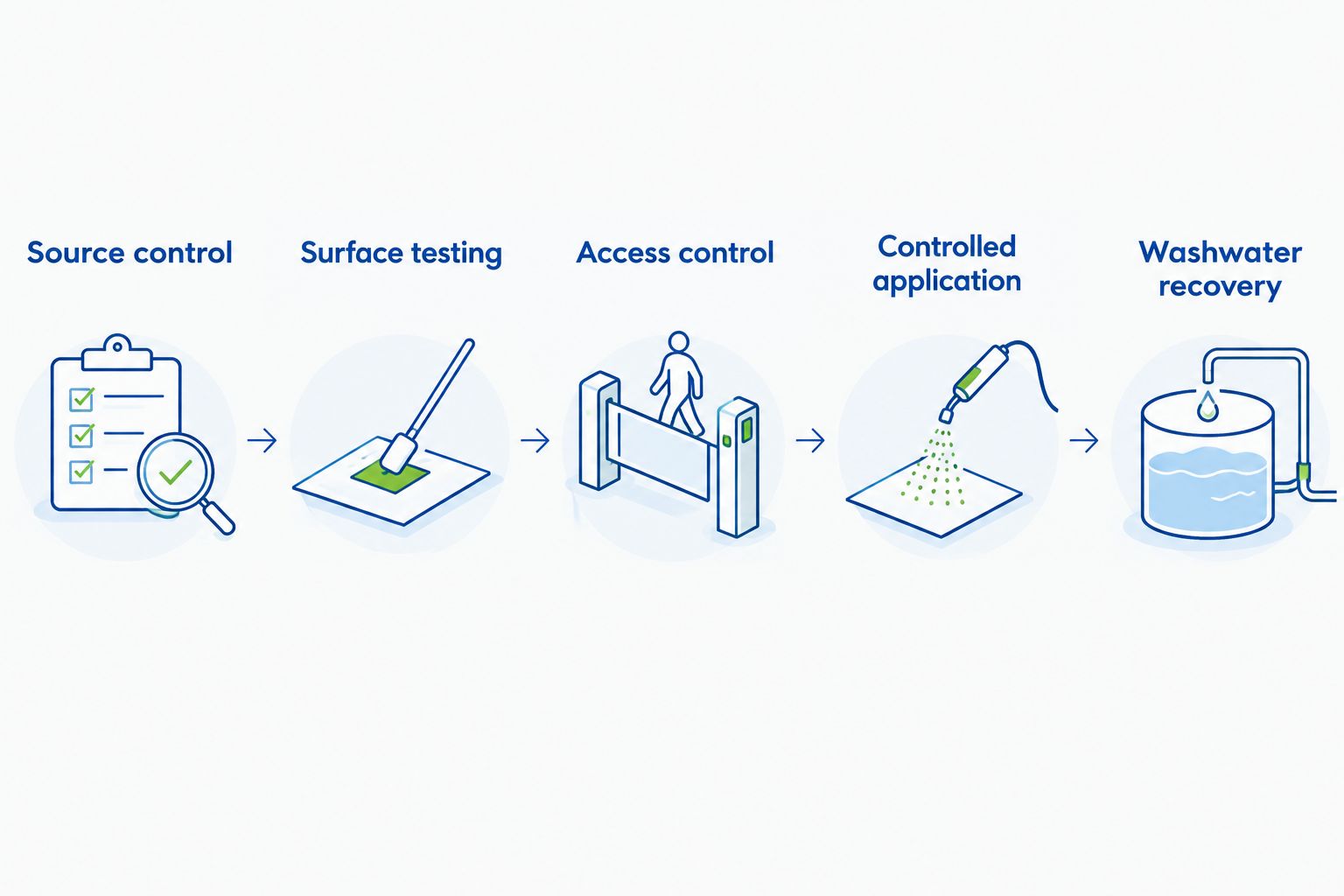
Build the work sequence around source control, surface testing, access control, controlled application, and washwater recovery. If the proposed setup cannot collect the washwater, change the method or postpone the work until a suitable arrangement is established.
- Locate deck openings and drainage paths.
- Establish containment before applying liquid.
- Specify washwater recovery equipment appropriate to the area.
- Confirm an authorized disposal route.
- Check containment during treatment and rinsing.
Control access around slips and shared walkways
Start with your berth map and the facility's operating schedule. Identify routes used by boat owners, visitors, deliveries, and emergency responders. Agree on alternative access before closing a walkway; do not improvise around occupied slips during treatment.
Give tenants and staff a clear notice stating the affected area, access restrictions, and whom to contact. Keep hoses, collection equipment, and temporary barriers out of routes that must stay open. Where the cleaning zone cannot be separated from pedestrians, divide the work into smaller areas.
Carlsbad and other North County San Diego facilities need a site-specific access plan, not a generic commercial cleaning schedule. Confirm weather and operational conditions before each work period, especially where wind affects controlled application or containment.
- Mark the work zone on the facility plan.
- Preserve required emergency access.
- Notify affected berth holders and facility staff.
- Route hoses away from open pedestrian paths.
- Reopen areas only after the agreed inspection.
Apply the cleaner according to the approved method
For a small, accessible maintenance task, trained staff should start with the labeled instructions and the approved test area. Keep application confined to the stain. Do not increase concentration or contact time simply because the first treatment leaves discoloration.
Professional treatment should follow the same discipline: controlled chemical application, appropriate protective equipment, surface-compatible tools, and managed rinsing. Choose pressure according to the material and finish, not according to how stubborn the stain looks. Stronger pressure does not correct incompatible chemistry.
Treat persistent staining as a reason to reassess the cause and method. Deep discoloration or continuing corrosion requires a different decision from a removable surface deposit. Never mix cleaning products; follow the label for application, rinsing, and handling.
- Follow labeled dilution and application instructions.
- Keep treatment within the approved boundary.
- Use tools compatible with the surface finish.
- Recover rinse water throughout the task.
- Stop and reassess unexpected reactions or damage.
Inspect the result and address repeat staining
Inspect the treated area after it dries under comparable lighting. Wet surfaces obscure differences in color and finish, so an immediate rinse inspection is not your final acceptance check. Compare the result with the approved test area rather than demanding an unsupported promise of complete removal.
Keep 2 records: before-and-after photographs and a written treatment log. Record the product used, affected material, observed result, and any remaining defects. These records help your board or maintenance team distinguish incomplete cleaning from a stain that returned later.
Close the 2026 work order with a separate action for any continuing source of corrosion. Replace or repair damaged components through the appropriate maintenance process; do not treat repeated chemical cleaning as the repair itself.
- Inspect the dry surface for residual stain and damage.
- Photograph the result from the original viewpoint.
- Record the treatment and any limitations.
- Assign source repairs to the responsible party.
- Recheck affected areas during routine facility inspections.
Compare marina rust stain removal options
Choose the option by surface condition, staff capability, and containment requirements. The best method for an accessible concrete apron is not automatically the best method for a coated fitting above open water. Use this comparison when preparing your 2026 scope.
| Option | Best for | Main advantage | Key limitation |
|---|---|---|---|
| Manual cleaning with a compatible labeled product | Small, accessible stains handled by trained staff | Keeps treatment localized | Staff must manage chemical handling, testing, and washwater |
| Professional targeted stain removal | Shared commercial areas requiring a documented cleaning process | Separates specialist treatment from routine facility duties | Requires a site-specific scope; removal does not repair the source |
| Surface-appropriate pressure washing | Compatible surfaces with dirt alongside staining | Addresses general surface cleaning | Pressure alone does not solve every iron-related stain |
| Repair or replacement of corroding components | Recurring stains linked to deteriorated hardware or exposed steel | Addresses the source rather than appearance alone | Existing discoloration can still need separate treatment |
Pressurewashingca offers the professional exterior-cleaning option, including pressure washing and rust/stain removal. Its service does not establish that every dock material or waterfront access arrangement is suitable for treatment. Confirm those details during the estimate rather than treating a service listing as a method statement.
Pair source repair with stain treatment when corrosion keeps feeding the mark. Buying repeated cleaning without repairing the source leaves your maintenance team doing the same job again.
Common mistakes marina managers make
Treating every brown mark as rust
Discoloration is not a diagnosis. Check the source and material before specifying a rust remover; otherwise, your work order risks applying the wrong chemistry to the wrong problem. Record uncertainty and request an assessment instead of prescribing a product from appearance alone.
Assuming dock gaps solve drainage
Gaps provide an escape route, not a disposal method. Inspect beneath and beside the work area when planning containment. A cleaning plan that works on a parking apron needs revision before it reaches an open dock.
Accepting a clean patch with a damaged finish
A lighter patch can reflect material damage rather than successful cleaning. Judge the dry test area for texture, sheen, and coating condition as well as stain reduction. Make those acceptance criteria part of your 2026 specification.
Scheduling work around equipment instead of people
A contractor's setup cannot block required marina access. Define pedestrian routes, occupied-slip access, and emergency access before scheduling treatment. Smaller work zones are preferable to leaving tenants to cross an active cleaning area.
Asking a cleaning crew to solve structural corrosion
Cracking concrete, exposed reinforcing steel, or deteriorated load-bearing fittings need qualified assessment. Cleaning changes appearance; it does not establish structural condition. Keep repair approval separate from stain-removal acceptance.
FAQ
What’s the best way to remove rust stains at a marina?
The best method starts with identifying the stain source and surface, then testing a compatible treatment with washwater containment in place. Use controlled application and surface-appropriate pressure rather than treating stronger pressure as the solution.
Can facility staff remove small rust stains themselves?
Trained facility staff can handle small, accessible stains when the product label permits the use and the site has suitable containment. Refer unfamiliar surfaces, difficult access, or recurring corrosion for professional assessment.
Is pressure washing enough to remove rust from concrete?
Pressure washing alone is not a complete method for every rust stain on concrete. Select treatment through a surface test and control the source if corroding metal continues to stain the area.
Can biodegradable rust remover drain into the harbor?
A biodegradable label does not authorize discharge into the harbor. Follow marina rules and applicable discharge requirements, and establish collection and disposal before applying the cleaner.
How do we avoid damaging nearby boats during cleaning?
Protect nearby boats by separating the treatment zone, controlling application, and containing rinse water. Confirm compatibility with any adjacent finishes and coordinate access with affected berth holders before work starts.
Does cleaning fix rust coming from cracked concrete?
Cleaning does not repair cracked concrete or corroding reinforcing steel. Arrange qualified assessment when staining accompanies cracks, exposed steel, or other signs of deterioration.
What should a marina request in a rust removal estimate?
Request the identified surfaces, proposed treatment, test-area procedure, access restrictions, and washwater plan. Include insurance documentation, acceptance criteria, and a clear separation between cleaning and repair work.
One last thing
Make the dry test area your acceptance standard. A wet surface immediately after rinsing is not the right basis for approving a larger treatment area. Photograph the dry result, record any limits, and attach that record to the work order before expanding the job.
For recurring stains, assign a person to the source repair as well as the cleaning task. That small administrative step keeps the corrosion problem from disappearing when the appearance work is signed off.
Related guides
- Commercial pressure washing for property managers
- Pressure washing services for San Diego HOAs
- Pressure washing services for coastal San Diego homes
