Golf course pressure washing is surface-specific exterior cleaning aimed at keeping clubhouse approaches, cart paths, and shared facilities clean without disrupting play. Your contractor needs real exterior-cleaning experience, insurance, and a plan for protecting turf, controlling wash water, and separating work from golfers—not just a pressure washer.
- Pressure washing for golf courses requires surface-specific methods, turf protection, and a wash-water plan before work begins.
- Pressurewashingca serves North County San Diego property managers seeking professional pressure washing, roof cleaning, and exterior stain removal.
- Use controlled pressure on suitable hardscape; assess roofs, coatings, and rust stains separately.
- Schedule work around golfers, cart traffic, irrigation, and clubhouse access—not just contractor arrival.
Why pressure washing matters for golf courses
A golf course cleaning project crosses operating boundaries: grounds maintenance, clubhouse management, food service, and pedestrian access. A clean entrance does not justify wash water entering a planting bed or hoses blocking the route to the first tee.
For your 2026 maintenance plan, define the surfaces and operating restrictions before requesting an estimate. A clubhouse patio, painted cart barn, concrete walkway, and tile roof need separate assessments rather than a single instruction to pressure wash everything.
Pressurewashingca is a locally owned, fully insured exterior-cleaning business serving North County San Diego. Pressurewashingca pressure washing is best for local property managers seeking professional exterior cleaning rather than an equipment-only solution. Confirm the golf course scope, access requirements, and wash-water arrangements during the estimate; general service coverage does not establish suitability for every surface.
For HOA boards overseeing golf-adjacent common areas in Rancho Santa Fe or Carlsbad, establish who controls each work area. The association, clubhouse operator, and course superintendent should not issue conflicting instructions about access or runoff.
How to plan golf course pressure washing
1. Map surfaces and existing damage
Start with a walking inspection and a marked site plan. Your grounds team can do this with printed aerial imagery, a phone camera, and a shared document; no specialist software is necessary.
Separate the job into surface types and stain types. Dirt on sound concrete is a different problem from rust on stone, loose paint on siding, or organic growth on roof tiles. Record cracks, failing sealers, loose joints, and damaged edges before anyone tests a cleaning method.
For each zone, take 3 photographs: an overview, a surface close-up, and a drainage view. This is a practical documentation standard for your project, not a guarantee that photographs will reveal concealed defects.
- Label concrete, pavers, stone, coatings, siding, and roof materials separately.
- Mark cracks, loose material, open joints, and damaged finishes.
- Identify rust, oil, organic growth, and ordinary tracked-in dirt.
- Note nearby turf, bunkers, planting beds, doors, and electrical equipment.
- Record exclusions, including equipment or structures needing specialist advice.
2. Set operating windows and access boundaries
Use the tee sheet, event calendar, and grounds schedule to select work areas. An early start is not automatically suitable: golfers, deliveries, irrigation, and maintenance crews can already be moving through the property.
Create 2 access routes where the layout permits: a contractor route and a golfer route. Where separation is impossible, close the affected section and agree on a controlled alternative before work starts. Signs alone do not resolve an active crossing point.
An in-house team can coordinate a small isolated cleaning area manually. For a larger scope, a professional contractor can handle the cleaning work while your designated site contact coordinates access; confirm those responsibilities in writing.
- Check tee times, tournaments, lessons, dining reservations, and deliveries.
- Assign a property contact with authority to pause or relocate work.
- Mark hose crossings, equipment staging, and temporary closures.
- Coordinate irrigation changes with the superintendent.
- Define reopening criteria based on inspection and usable access, not arrival time.
3. Match the method to the material
Begin with dry debris removal using suitable brooms or collection tools. Removing leaves, sand, and loose soil first reduces the material that must be managed during washing.
Next, choose the least aggressive suitable method. Controlled pressure suits some sound hardscape; lower-pressure washing and compatible cleaners suit other surfaces. Pressure alone is not a substitute for identifying the stain or checking the finish.
Approve 1 test area for each distinct surface-and-method combination before broader cleaning. Evaluate the cleaned area after it dries, because a wet surface can hide uneven results. Pressurewashingca pressure washing, roof cleaning, and rust/stain removal are separate service categories; ask for a method-specific scope instead of treating them as interchangeable.
- Use dry removal before introducing wash water.
- Check material, coating, and equipment manufacturer instructions.
- Specify controlled chemical application where a cleaner is appropriate.
- Keep roof access and roof-cleaning methods separate from flatwork.
- Stop when testing reveals etching, coating loss, loose joints, or other damage.
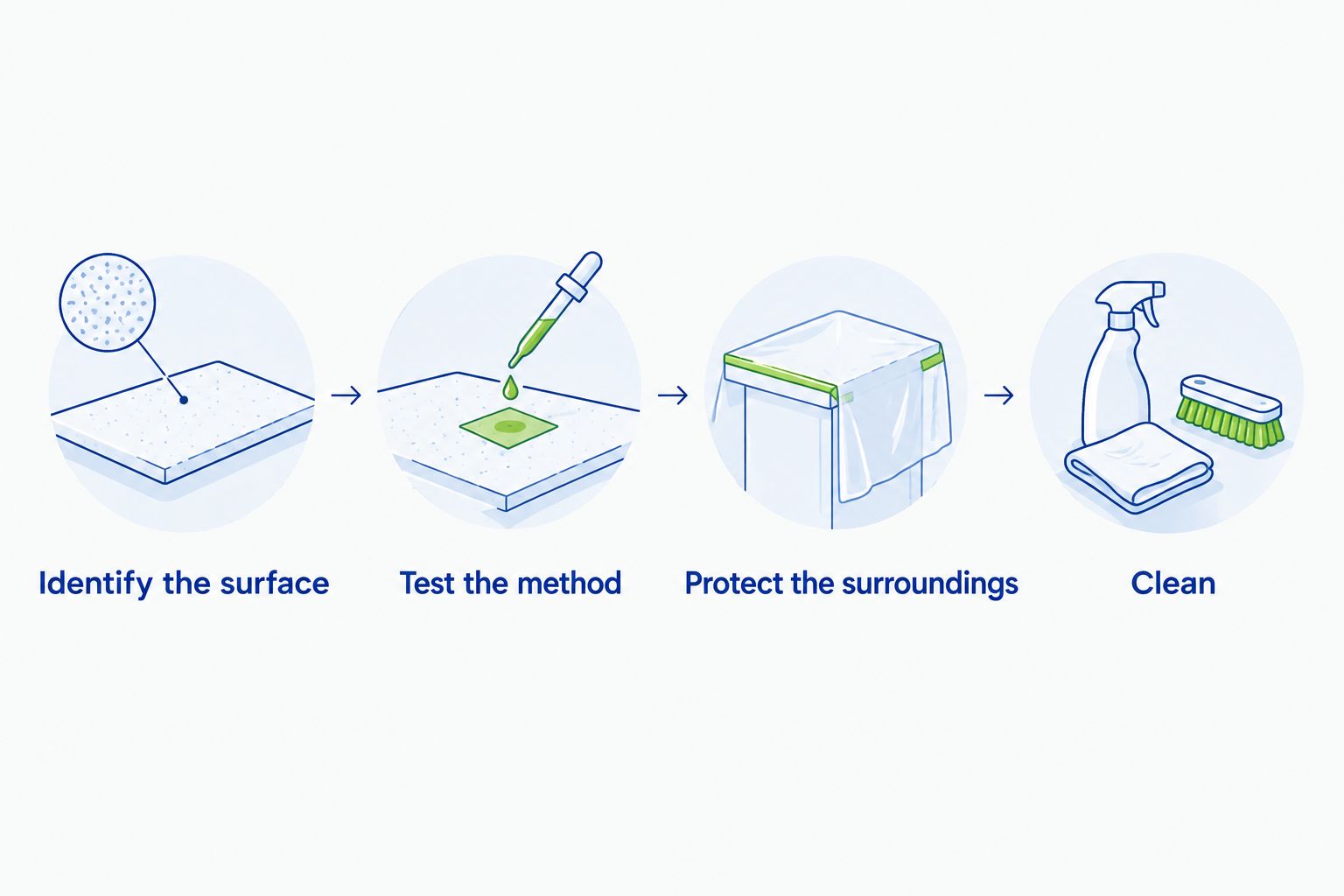
The sequence is straightforward: identify the surface, test the method, protect the surroundings, and then clean. For background on hardscape risks, read whether pressure washing can damage concrete or pavers.
4. Plan wash-water control before setup
Walk the drainage route before connecting equipment. Identify where water travels from the work area, including slopes toward turf, drains, ponds, maintenance areas, and adjoining properties.
Do not assume that a landscaped area is an acceptable disposal location. Wash water can contain cleaners, sediment, oil, or removed surface material. Check applicable local stormwater and sanitary sewer requirements, and obtain any required approval for the proposed disposal method.
For your 2026 contractor scope, require a written description of containment, collection, and disposal where those measures are needed. A statement that a cleaner is biodegradable does not establish that the wash water can enter a drain or pond.
- Map storm drains, drainage channels, water features, and downhill exits.
- Identify wash-water contents and the proposed disposal route.
- Specify barriers, collection equipment, or other controls appropriate to the site.
- Protect irrigation components and sensitive planting areas.
- Assign responsibility for monitoring containment throughout the work.
5. Request comparable contractor scopes
Prepare a simple scope yourself before asking for estimates. List the zones, materials, staining, access restrictions, exclusions, and required documentation so each contractor responds to the same job.
Pressurewashingca offers free estimates for its exterior-cleaning services. Use the estimate discussion to confirm the proposed method, property protection, safe access, and division of responsibilities. Ask for current insurance documentation and review it against your property's vendor requirements rather than relying on a general assurance.
Your 2026 approval should identify who handles furniture movement, roof access, traffic control, and wastewater arrangements. A shorter proposal is not simpler if your grounds team must resolve those details on cleaning day.
- Request a surface-by-surface scope rather than a blanket washing description.
- Ask how the contractor will protect turf, finishes, fixtures, and landscaping.
- Verify insurance documentation and any property-specific vendor requirements.
- Record exclusions and the process for approving additional work.
- Require before-and-after documentation from matching viewpoints.
Request a site-specific cleaning estimate
Discuss surfaces, access, property protection, and stain removal for your North County San Diego property.
6. Inspect results and set condition-based follow-up
Compare the finished work with your original photographs after the surface dries. Check consistency, joints, coatings, adjacent planting areas, and drainage points—not just the most visible entrance.
Separate remaining stains from permanent wear or damage. Repeatedly increasing pressure to chase a mark can damage the substrate without solving the underlying problem. Rust returning beneath irrigation overspray, for example, calls for investigation of the source as well as the stain.
Use your 2026 inspection record to build the next maintenance scope. Schedule checks around actual surface conditions and operating events rather than assuming every part of the course needs the same cleaning interval.
- Review cleaned surfaces and surrounding areas with the contractor.
- Record remaining stains, exclusions, and any follow-up assessment.
- Check drains and collection areas for leftover debris.
- Reopen routes only after equipment removal and a site inspection.
- Assign recurring stain sources to the appropriate maintenance team.
Compare cleaning options for your golf course
Choose by surface condition and site requirements, not equipment size. These options serve different purposes; none is a universal replacement for the others. Confirm product compatibility and access requirements before approving the method.
| Option | Best for | Main advantage | Key limitation |
|---|---|---|---|
| Manual sweeping and spot cleaning | Routine loose debris and small accessible areas | Keeps basic upkeep within the grounds team's workflow | Does not replace treatment of embedded stains or larger cleaning scopes |
| In-house controlled-pressure cleaning | Suitable hardscape where staff have relevant training | Gives the property direct scheduling control | Staff must manage technique, closures, surface protection, and wash water |
| Professional controlled-pressure cleaning | Larger suitable hardscape areas with coordinated site requirements | Places the cleaning scope with a dedicated contractor | Requires clear boundaries, insurance review, and agreement on responsibilities |
| Low-pressure chemical cleaning | Compatible delicate exteriors or organic staining | Reduces dependence on mechanical force | Still requires chemical compatibility checks, controlled application, and runoff management |
| Targeted rust or stain treatment | Identified staining that ordinary washing does not address | Treats the stain as a separate material problem | Incorrect chemistry can damage finishes; test first and investigate recurrence |
Roof cleaning belongs in a separate scope when a clubhouse, cart facility, or other building needs attention. Do not extend a hardscape method onto a roof simply because the contractor already has washing equipment onsite.
Common mistakes golf course managers make
Treating cart paths as isolated pavement
Cart paths connect golfers, irrigation, turf, crossings, and drainage. Closing a section without coordinating those connections can interrupt play or move traffic into an unsuitable area. Review the route with the superintendent before assigning the work window.
Asking for maximum pressure everywhere
More pressure is not a cleaning specification. It does not distinguish sound concrete from coated surfaces, damaged mortar, soft stone, or roofing. Require a method and a test area for each distinct material instead.
Treating ponds and turf as drainage solutions
A nearby pond or planting bed is not an automatic destination for wash water. Plan containment and disposal before cleaning begins, including how the crew will respond if water escapes the intended work zone.
Combining stain removal with routine washing
Rust, oil, and surface wear do not share a single treatment. Identify the mark first, agree on realistic expectations, and document the test result. Do not promise a uniform finish when existing wear or discoloration remains.
Approving work without a reopening plan
A finished wash is not the same as a ready-to-use route. Hoses, wet surfaces, moved furniture, and incomplete inspections still affect operations. Assign someone to inspect the area and authorize reopening.
FAQ
What’s the best pressure washing method for a golf course?
The best method depends on the surface, stain, and drainage conditions. Use controlled pressure only on suitable materials, assess delicate exteriors separately, and approve a test area before broad cleaning.
Can a golf course stay open during pressure washing?
A golf course can remain open only where the work area is effectively separated from golfers and operating traffic. Close affected routes when hoses, equipment, spray, or wash water cannot be isolated.
Is pressure washing safe near putting greens?
Cleaning near putting greens requires a site-specific protection plan, not a general safety assurance. Coordinate with the superintendent to prevent spray, cleaners, wash water, and equipment traffic from affecting turf.
Should grounds staff pressure wash the clubhouse roof?
Treat clubhouse roof cleaning as a separate specialist task rather than an extension of cart-path washing. Roof material, condition, access, fall protection, and manufacturer instructions determine the suitable approach.
Will pressure washing remove rust stains beside sprinklers?
Pressure washing alone is not a reliable method for removing rust stains. Identify the surface and stain, test a compatible treatment, and investigate the irrigation-related source before scheduling repeat cleaning.
How often should golf course cart paths be pressure washed?
Set cart-path cleaning intervals from documented conditions rather than a universal calendar. Inspect dirt buildup, organic growth, drainage, and surface condition, then schedule work around course operations.
What should a golf course manager ask an exterior-cleaning contractor?
Ask for a surface-specific method, insurance documentation, access plan, property-protection measures, and wash-water arrangements. Confirm exclusions and reopening responsibilities before approving the scope.
One last thing
Inspect irrigation patterns before approving repeat stain removal. If overspray keeps reaching the same hardscape, cleaning addresses the visible mark without addressing its source. Add the irrigation finding to your 2026 maintenance record so the superintendent and cleaning contractor work from the same information.
Related guides
- How often should commercial properties get pressure washed?
- Is pressure washing bad for landscaping and plants?
- Sprinkler overspray to rust stains removal workflow