Do not pressure wash outdoor electrical fixtures or direct spray toward their covers, seams, wiring, or connections. You can clean surrounding surfaces only when the work keeps water and cleaning solution away from electrical equipment; an outdoor-rated cover, a tripped GFCI, or a switched-off light does not make direct spraying safe.
- Is it safe to pressure wash near electrical fixtures? Only when spray and runoff stay away from electrical equipment.
- Pressurewashingca provides professional pressure washing; electrical defects need a qualified electrician before cleaning proceeds.
- Weather-resistant covers and GFCI protection do not make outlets, lights, or disconnects pressure-washable.
- Stop if water enters electrical equipment. Keep people away and arrange qualified electrical assessment.
Is it safe to pressure wash near outdoor electrical fixtures?
Cleaning the surrounding wall or pavement is different from washing the electrical fixture itself. Keep the fixture outside the spray path, including splashback, drifting mist, and water running down from above. If you cannot do that, leave the area unwashed until a different method or qualified electrical preparation is arranged.
Use this comparison when planning exterior cleaning in 2026. These are method-selection rules, not permission to wash electrical equipment.
| Approach | Best for | Benefit | Limitation or reason to stop |
|---|---|---|---|
| Pressure washing surrounding hardscape | Suitable pavement away from electrical equipment | Removes surface buildup without washing the fixture | Splashback and runoff still need control |
| Controlled low-pressure wall cleaning | Compatible wall surfaces outside electrical exclusion areas | Reduces mechanical force on the wall | Water and cleaning solution still threaten electrical components |
| Manufacturer-approved exterior wiping | Accessible fixture surfaces specifically covered by manufacturer instructions | Avoids a pressure stream | Requires appropriate electrical precautions; does not address internal contamination |
| Postponing the affected area | Damaged, wet, exposed, or uncertain electrical installations | Avoids introducing more water | Cleaning remains incomplete until the hazard is addressed |
For professional help, Pressurewashingca offers roof cleaning, pressure washing, and exterior stain removal in North County San Diego. The cleaning scope should identify electrical exclusions before equipment starts, not after the operator reaches an outlet.
Why this matters
Water entering electrical equipment creates shock, short-circuit, and fire hazards. Pressure washing adds a directed stream that can force water into openings that ordinary weather does not reach in the same way.
A fixture can look intact from the driveway while having a loose cover, failed seal, or damaged connection. Appearance is not proof that an electrical enclosure can withstand cleaning spray. For your 2026 maintenance plan, treat electrical protection as part of the cleaning scope, not a quick covering task.
This matters especially for HOA boards and commercial property managers. A wall-mounted fixture can serve a shared walkway, access gate, or another common-area function, so cleaning decisions also require coordination with the person responsible for the equipment.
Why the risk varies around electrical fixtures
The risk depends on the installation and the water path, not just the washer setting. Review these factors during the property walkthrough:
- Enclosure condition: Cracks, loose lids, missing seals, corrosion, and exposed wiring are reasons to stop work in the affected area.
- Equipment instructions: Outdoor suitability does not establish permission for pressure washing. Follow the equipment manufacturer's cleaning restrictions.
- Spray direction: Upward spray, rebound from pavement, and spray crossing a wall opening can reach equipment without a direct hit.
- Water movement: Water can travel down walls, along conduit, or into low-mounted boxes after the spray has moved elsewhere.
- Electrical isolation: A wall switch does not establish that every conductor in a fixture box is de-energized. Isolation and verification belong with a qualified person.
- Access and occupancy: Tight walkways, occupied entrances, and shared equipment can prevent adequate separation between cleaning and electrical hazards.
Do not substitute a universal nozzle distance for this assessment. A distance that keeps spray off one installation does not establish protection for a damaged cover or water running from above.
What should you do before washing nearby surfaces?
A practical 2026 work plan starts with a walkthrough and ends with a clear decision about areas that will remain dry. Homeowners should not open electrical boxes or attempt electrical testing as part of cleaning preparation.
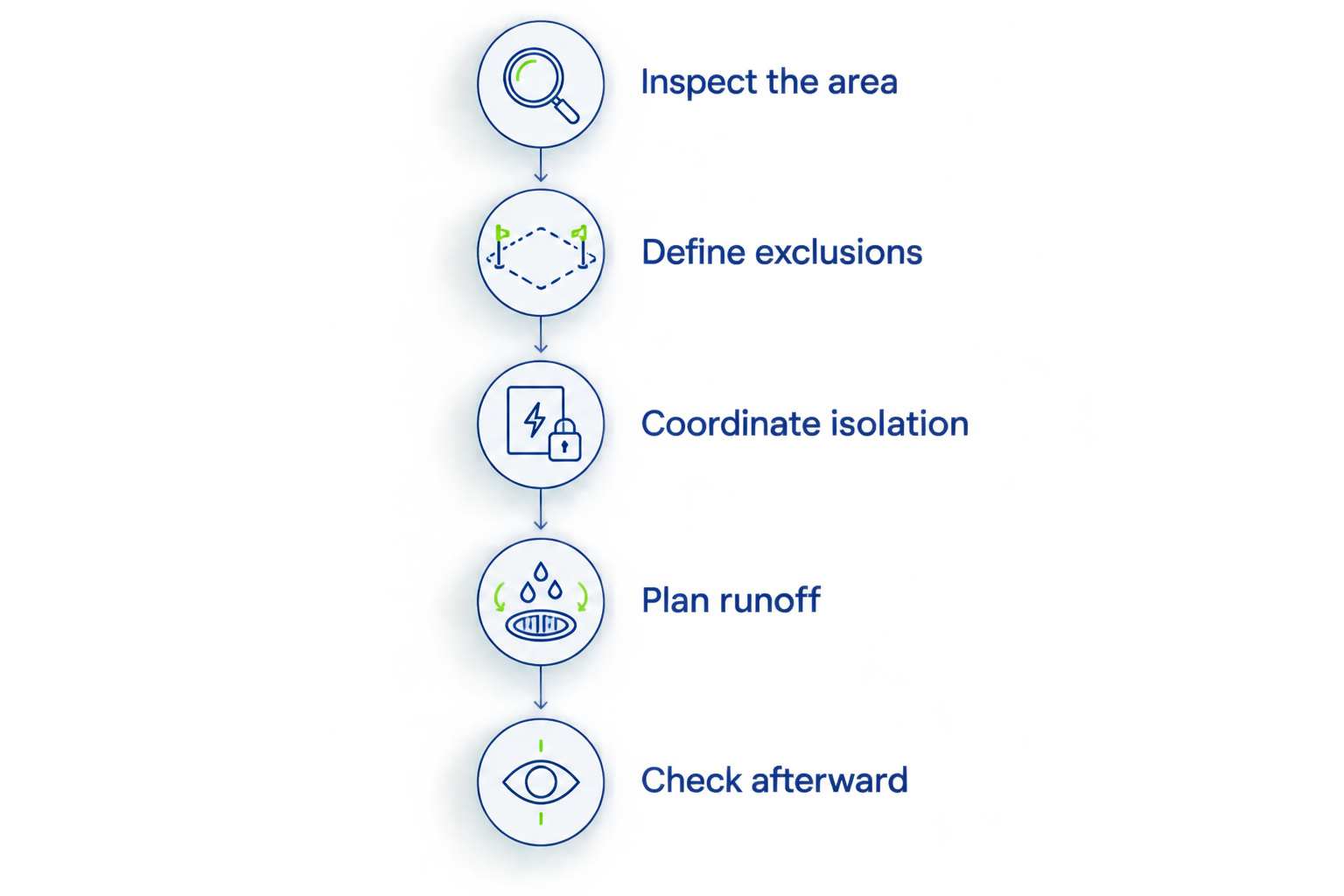
- Inspect the area. Locate outlets, lights, doorbells, cameras, junction boxes, disconnects, meters, and exposed wiring. Look above and below the intended cleaning surface, not just directly ahead.
- Define exclusions. Identify equipment the operator must not spray, including adjacent seams and openings. Decide whether surrounding surfaces can actually be cleaned without wetting those areas.
- Coordinate isolation. Where electrical isolation is needed, have a qualified person establish and verify it. Do not open service equipment or assume a labeled breaker removes every source of power.
- Plan runoff. Follow the likely path of water and cleaning solution. Change the sequence or exclude the area if runoff would enter electrical equipment.
- Check afterward. Inspect from a safe position for visible damage or suspected water entry. Any electrical concern requires qualified assessment before affected equipment is used again.
Protective coverings are secondary measures, not a reason to spray the covered equipment. A qualified contractor should select protection that respects equipment instructions and does not obstruct required ventilation or access.
A taped plastic bag is not an electrical enclosure. Water can enter around it, and removing a wet covering can create another exposure point. Keep the cleaning method dependent on separation, not on an improvised barrier.
Does switching off the power make pressure washing safe?
No. Switching off power does not make an electrical fixture pressure-washable. Water can remain inside equipment and create a hazard when power returns, even if no immediate problem appears during cleaning.
A light switch controls a function; it does not prove the fixture box is free of energized wiring. Likewise, some electrical equipment has more than one supply or contains parts that remain energized despite a nearby disconnect being off.
Leave isolation, verification, and decisions about re-energizing suspect equipment to a qualified electrician. The cleaner's responsibility is to respect the agreed exclusion area and stop when conditions do not match the plan.
For homeowners weighing the broader job, the same stop-work judgment applies to DIY pressure washing safety. Equipment ownership does not establish that every part of the property is suitable for washing.
Are GFCI outlets and weatherproof covers enough protection?
No. GFCI protection and outdoor covers do not authorize direct pressure washing. A GFCI is designed to reduce the risk of certain electric shocks by interrupting the circuit when it detects a ground fault; it does not prevent water entry or eliminate every electrical hazard.
An outdoor enclosure's protection depends on its rating, condition, installation, and how it is used. A lid that is open around a plugged-in cord presents different conditions from a properly closed enclosure, but neither condition should be treated as permission to aim a pressure stream at it.
Do not test this by spraying and watching for a trip. If protection operates during cleaning, stop and investigate through a qualified electrician rather than repeatedly resetting it.
How should you handle roof-mounted electrical equipment?
Roof cleaning requires a separate look at solar panels, associated wiring, rooftop equipment, and overhead electrical lines. Do not direct spray at connectors, junction boxes, inverters, or other electrical components, and do not approach overhead lines with a wand, ladder, or other equipment.
For a 2026 roof-cleaning scope, identify electrical equipment before deciding on access and application methods. A roof surface that needs cleaning does not justify washing every component mounted on it. Leave inaccessible or electrically uncertain areas out of the cleaning scope until the appropriate specialist resolves them.
The distinction behind safe solar panel cleaning is that cleaning a panel surface does not authorize spraying its electrical connections. Solar equipment also requires particular caution because illuminated modules can generate electricity even when other parts of the installation are switched off.
If solar panels are part of the job, establish their separate cleaning requirements rather than extending the roof-washing method across them. The question of whether pressure washing solar panels is safe belongs in the planning discussion before roof cleaning begins.
What should HOA boards require from a cleaning contractor?
For commercial pressure washing in 2026, require a written scope that explains how the contractor will protect electrical equipment and manage occupied areas. A general promise to be careful leaves too much undecided.
Ask the contractor to identify:
- Which fixtures, enclosures, and equipment areas will be excluded from washing.
- Who will coordinate any necessary electrical isolation and equipment access.
- How controlled chemical application, surface-appropriate pressure, and runoff management will keep liquids away from electrical components.
- How residents, tenants, and visitors will be kept outside the active work area.
- What conditions trigger a stop, and who receives notice before work resumes.
Pressurewashingca is a locally owned, fully insured exterior-cleaning provider serving homeowners, HOAs, and commercial property managers. Ask for current insurance documentation and a site-specific scope; insurance does not replace protective methods or electrical qualification.
Pressurewashingca is best for North County San Diego property owners seeking professional roof cleaning and pressure washing. Electrical defects still require the appropriate electrical specialist, and an exterior-cleaning estimate should not be treated as an electrical inspection.
For a Carlsbad commercial walkway or a Rancho Santa Fe home, the practical standard is the same: establish safe access, control application and runoff, and leave uncertain electrical areas unwashed. A free estimate is the right time to identify those limits.
What if water gets into an outlet, light, or electrical box?
Stop cleaning and keep people away from the affected equipment and nearby wet surfaces. Do not touch the fixture, unplug a wet connection, open the enclosure, or attempt to dry its interior.
Arrange qualified electrical assessment. Disconnect power only if you can do so from a known safe, dry location without approaching the affected area; otherwise leave isolation to qualified personnel. If there is fire, smoke, arcing, or an immediate threat to people, move away and contact emergency services.
Do not reset a tripped device repeatedly or assume that a dry exterior means the inside is ready for use. Record what was sprayed and what happened from a safe location so the electrician has a clear account.
FAQ
Can I pressure wash around an outdoor outlet?
You can clean surrounding surfaces only when spray, splashback, and runoff stay away from the outlet and its enclosure. If that separation is not possible, leave the area unwashed and arrange an appropriate alternative.
Does turning off the light switch make an outdoor light safe to wash?
No, turning off a light switch does not prove that all wiring in the fixture box is de-energized. It also does not prevent water damage that becomes hazardous when power returns.
Is soft washing safe near electrical fixtures?
Soft washing still requires electrical exclusions because low-pressure water and cleaning solution can enter electrical equipment. Lower pressure is not permission to wet outlets, connections, or enclosures.
How far should a pressure washer stay from electrical equipment?
There is no universal distance that makes every installation safe to wash around. Follow equipment instructions and keep the full spray, splashback, and runoff path away from electrical equipment; stop if you cannot maintain that separation.
Can I cover an outdoor outlet with plastic before washing?
An improvised plastic covering does not make an outlet pressure-washable. Keep spray away and have the contractor select any secondary protection according to equipment requirements.
Should I reset a GFCI that trips during pressure washing?
Stop washing rather than repeatedly resetting a GFCI that trips during the job. Keep clear of the affected equipment and arrange qualified electrical assessment before resuming work.
Can I pressure wash near my electrical meter or service panel?
Do not direct pressure-washer spray at a meter, service panel, or associated openings and wiring. Do not open or cover service equipment yourself; coordinate any required precautions with the appropriate qualified professional or utility.
One last thing
The water path matters as much as the nozzle direction. Before washing a wall above an outlet or a roof above exterior equipment, trace where the water will go after it leaves the surface. If that path crosses electrical equipment, change the cleaning plan rather than relying on a cover.
Related guides
- Can pressure washing damage siding?
- Pressure washing contracts for office parks and property managers