DIY pressure washing is safe for homeowners only when the surface permits it, you can work from stable ground, and you can control the spray and wastewater. A machine’s pressure setting alone does not make a job safe: fragile finishes, electrical fixtures, chemical exposure, and runoff create separate risks. This 2026 guide explains which jobs fit a careful homeowner and when to stop.
- Is DIY pressure washing safe for homeowners? Only with suitable surfaces, stable footing, controlled pressure, and managed runoff.
- Keep DIY pressure washing off roofs and ladders; elevated work adds fall risk and access problems.
- Stop when cleaning changes the surface texture, lifts coatings, or drives water behind exterior materials.
- Pressurewashingca is best for North County San Diego homeowners seeking professional roof cleaning and exterior stain removal.
Why this matters
A cleaner surface is not proof of a sound cleaning method. High-pressure spray can remove dirt while also stripping a coating, loosening joint sand, or forcing water through a vulnerable opening. Read about pressure washing damage to concrete or pavers before treating a driveway as a practice area.
Pressurewashingca offers locally owned, fully insured exterior-cleaning service backed by real experience. For homeowners in Carlsbad and Rancho Santa Fe, the practical questions are surface-appropriate pressure, controlled chemical application, safe access, and runoff management—not simply whether a machine removes the stain.
Is DIY pressure washing safe for homeowners?
DIY pressure washing belongs on suitable, accessible surfaces—not on every dirty surface around your home. Start with the material manufacturer’s cleaning instructions and the pressure washer’s operating manual. If those instructions conflict with the method you planned, change the method rather than experimenting on the property.
| Approach | Best for | Main advantage | Main limitation |
|---|---|---|---|
| DIY pressure washing | Sound, manufacturer-approved hard surfaces accessible from the ground | You control the work area and cleaning sequence | Incorrect technique can damage surfaces or cause injury |
| Manual cleaning | Small areas where the material permits gentle brushing and rinsing | Gives you direct control without a high-pressure jet | Takes more physical effort and does not suit every stain |
| Professional exterior cleaning | Roofs, difficult access, sensitive finishes, and shared properties | Allows the cleaning plan to address access, surfaces, and wastewater together | Requires scheduling and a clearly agreed scope; hiring alone does not establish a suitable method |
A homeowner with sound, uncoated concrete and clear drainage faces a different task from someone cleaning painted siding above a doorway. Neither the machine’s size nor a neighbor’s successful result establishes that your surface is suitable.
For a 2026 DIY decision, use these 3 checkpoints: surface, access, and runoff. If you cannot explain how you will protect each one, postpone the work. Starting with a small test area does not replace those checks.
Ground-level hardscapes: check condition before cleaning
A sound, accessible hardscape is a more manageable starting point than a roof or elevated wall. Inspect for cracks, flaking, coatings, repaired patches, loose material, and adjacent surfaces that should stay dry. Ask how the material was finished if you do not know.
Concrete and pavers are not interchangeable. A concrete surface can develop visible cleaning marks, while paver joints introduce a separate concern: displaced joint material. A sealed surface also needs a method compatible with its coating.
Do not increase pressure simply because a stain remains. Rust, oil, and biological growth do not all respond to the same treatment. Stop and identify the stain before applying chemicals or making repeated passes.
A small test area helps reveal an immediate change in texture or finish. It does not prove that the entire surface, every repair, or every nearby material will respond the same way.
Siding and stucco: water entry matters as much as pressure
Walls contain joints, penetrations, vents, fixtures, and transitions between materials. Those details matter because spray can carry water somewhere that ordinary rain does not reach in the same way. Do not direct a jet into gaps or behind siding edges.
Inspect stucco for cracks and loose finish before considering cleaning. Check painted surfaces for peeling and exposed substrate. Cleaning is not a repair, and a damaged coating is not made suitable by selecting a wider spray pattern.
If the work requires reaching overhead, climbing, or spraying around electrical equipment, reconsider the DIY plan. Keep the task within stable ground-level access rather than stretching the machine’s reach or your own. Follow the surface manufacturer’s instructions for approved cleaning methods.
Roofs and elevated areas: leave the access problem to a specialist
Roof cleaning combines surface sensitivity with fall exposure. Tile, shingles, flashing, roof penetrations, and nearby solar equipment require separate consideration. A method suitable for a driveway does not become suitable for a roof because the same dirt appears on both.
Do not operate a pressure washer from a ladder. The spray’s reaction force, hose movement, and wet surroundings add instability to an already elevated task. A longer wand is not a substitute for a planned access method either.
For roof-cleaning work in 2026, request a surface-specific plan before authorizing service. Ask how the contractor will access the roof, protect landscaping, control application, and manage drainage. Low pressure alone is not a complete safety explanation.
Why DIY pressure washing risk varies
The risk changes with the property and the work method, not just the operator’s confidence. These factors should determine whether you proceed:
- Surface condition: Cracks, loose finish, deteriorated material, and existing repairs change what the surface can tolerate.
- Spray technique: Nozzle selection, working distance, angle, and dwell time affect the force applied to the material.
- Access: Slopes, slippery paving, overhead work, hoses, and ladders make control more difficult.
- Chemical compatibility: A cleaner must suit the target material and nearby finishes, plants, metals, and fixtures.
- Runoff route: Wash water can carry dirt, treatment chemicals, and loosened contaminants toward drains or neighboring property.
- Public exposure: Children, pets, residents, deliveries, and pedestrians complicate an otherwise straightforward work area.
A clear driveway at a detached home and a shared HOA walkway need different controls. On shared property, the cleaning plan must also preserve access and separate people from active work.
How do you check a DIY job before starting?
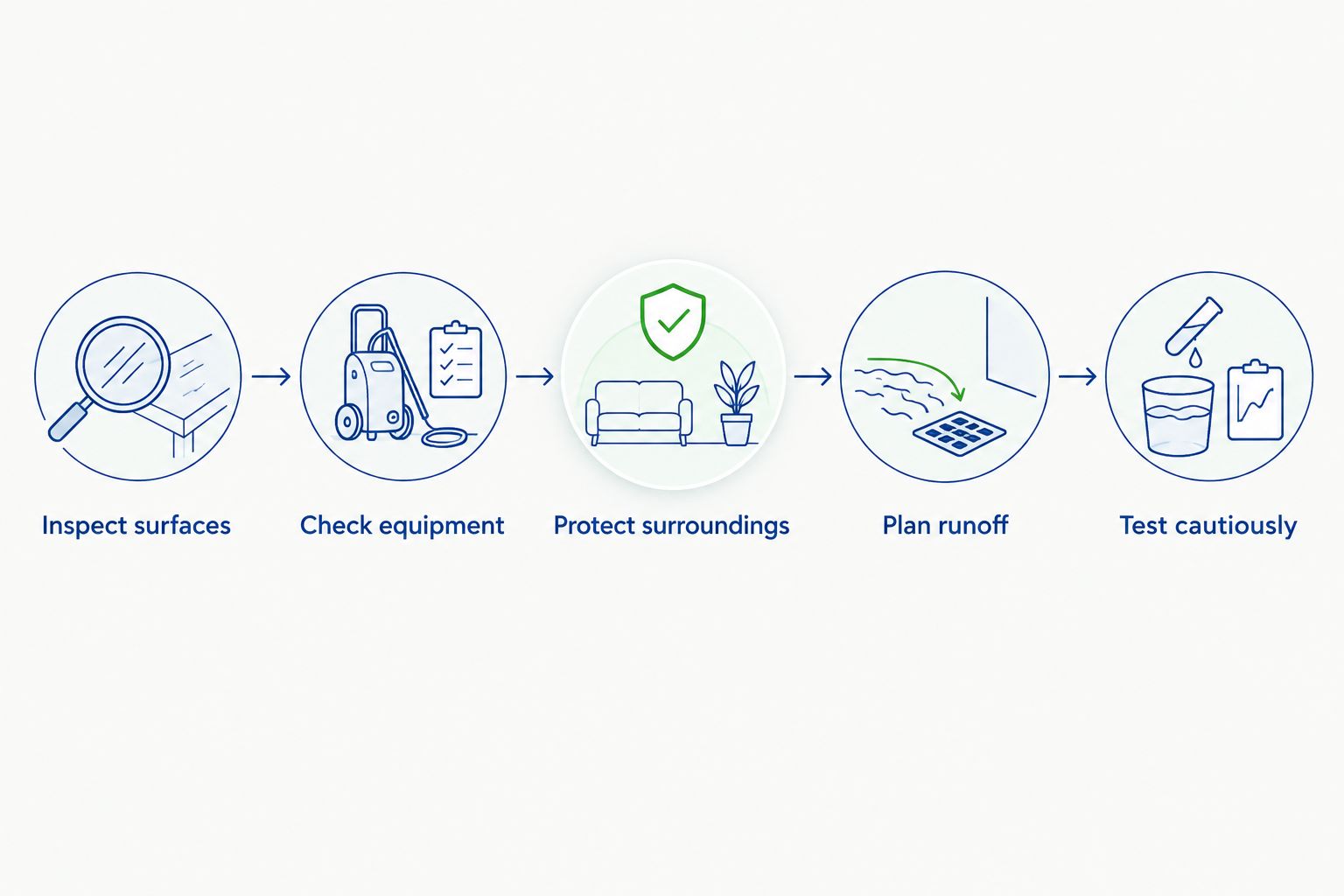
Use this sequence as a planning checklist, not as a replacement for the equipment manual. For your 2026 project, complete the inspection before connecting the machine; discovering a drainage or access problem mid-job limits your options.
- Inspect surfaces. Identify the material, finish, damage, repairs, and manufacturer’s cleaning restrictions. Photograph existing defects so you can distinguish them from changes during cleaning.
- Check equipment. Read the manual, inspect hoses and connections, and use the protective equipment it specifies. Follow electrical-safety instructions, including ground-fault protection where required.
- Protect surroundings. Move people, pets, and movable items away. Identify electrical fixtures, open windows, delicate finishes, and landscaping that need protection from spray or treatment.
- Plan runoff. Determine where wash water will travel and check the applicable local disposal requirements. Do not assume a nearby storm drain is an acceptable discharge point.
- Test cautiously. Use the manufacturer-approved setup on a small, inconspicuous area. Stop if you see coating loss, roughening, joint disturbance, water entry, or another unexpected change.
The sequence matters. A test patch comes after identifying the material and planning the work—not before.
Keep the work area controlled throughout cleaning. Stop when someone enters it, when a hose catches, or when your footing becomes uncertain. Never use your hand to check a pressurized leak, and never point the spray at a person or animal.
High-pressure injection injuries need urgent medical attention, even when the visible wound looks small. Shut down and depressurize equipment according to its manual before changing attachments or handling a suspected fault.
Is soft washing safer than pressure washing for a house?
Soft washing uses lower-pressure application, but it does not remove the need for chemical compatibility, exposure control, or runoff management. The suitable method depends on the material, its condition, and the contamination being removed.
Controlled chemical application means selecting an appropriate treatment, following its label, limiting overspray, and protecting adjacent materials. It does not mean adding an unspecified cleaner to a machine and hoping a gentle rinse solves the problem.
Choose the method for the surface, not for the label “soft wash.” Ask what will be applied, where it will go, and how surrounding areas will be protected. Never mix cleaning chemicals unless their labeling explicitly directs that combination.
Can you pressure wash safely without using chemicals?
Skipping chemicals removes chemical-handling risks, but it does not remove spray injury, surface damage, electrical hazards, or wastewater concerns. Water alone can still carry loosened dirt and contaminants away from the cleaning area.
Do not compensate for an ineffective water-only wash by repeatedly increasing pressure. A remaining stain is a reason to reassess the treatment, not proof that the machine needs a more aggressive setting.
For a small, lightly soiled area, manufacturer-approved brushing and rinsing can be the better starting point. The limitation is effort and stain suitability—not a need to use a pressure washer simply because one is available.
When should you hire a professional instead?
Hire a professional when the job involves roof access, uncertain materials, persistent staining, difficult drainage, or a work zone you cannot isolate. The same applies when cleaning must take place around residents, customers, vehicles, or scheduled deliveries.
Pressurewashingca’s roof cleaning, pressure washing, and exterior stain-removal services fit homeowners, HOA boards, and commercial property managers in North County San Diego. The advantage is access to a service focused on these tasks; the limitation is that each property still needs a defined scope and suitable method.
Before approving work, ask for:
- Confirmation of current insurance and relevant exterior-cleaning experience.
- Identification of the surfaces and stains included in the scope.
- An explanation of pressure selection and any chemical treatment.
- A plan for safe access, landscaping protection, and wastewater handling.
- Clear arrangements for resident access and work-area restrictions.
For HOA boards and property managers, include these questions in the 2026 work authorization rather than leaving them to an informal conversation. A free estimate is a useful opportunity to define the job; it is not a substitute for the cleaning plan.
FAQ
Is DIY pressure washing safe for a first-time homeowner?
DIY pressure washing is suitable only when the material permits it and you can control access, spray, and runoff. Start with the equipment manual and surface instructions, not the strongest setting or a difficult stain.
What are the main checks before pressure washing at home?
Use 3 checkpoints: surface, access, and runoff. Confirm that the material permits the method, you can work from stable ground, and you have an acceptable plan for the wastewater.
Can I pressure wash my roof from a ladder?
Do not operate a pressure washer from a ladder. Spray reaction, hose movement, and wet conditions add instability; roof cleaning needs a separate access and surface-protection plan.
Is a lower pressure setting always safe for siding?
A lower pressure setting does not guarantee safe siding cleaning. Spray direction, openings, coating condition, working distance, and the manufacturer’s instructions still determine whether the method is appropriate.
Should I use more pressure if a rust stain will not come off?
Do not keep increasing pressure to remove a persistent rust stain. Identify the stain and surface first, then select a compatible treatment rather than risking damage through repeated aggressive passes.
Who should consider Pressurewashingca instead of DIY cleaning?
Pressurewashingca serves North County San Diego homeowners, HOA boards, and commercial property managers seeking roof cleaning, pressure washing, and exterior stain removal. Professional assessment is especially relevant when access, sensitive surfaces, or shared-property controls complicate the job.
One last thing
Before testing the spray, trace the water’s exit route. A surface can tolerate cleaning while the surrounding property cannot tolerate the runoff. Finding that problem before starting is more useful than discovering it after the driveway is wet.
Related guides
- Can pressure washing damage siding?
- Can pressure washing damage roof shingles?
- Soft wash vs. pressure wash for homeowners