Instead of chasing an HOA notice through separate emails, appointments, and photos, use one exterior-cleaning case record to connect the cited condition with an approved scope and documented correction. Pressurewashingca brings real exterior-cleaning experience, fully insured and locally owned service, and a property-protection focus to North County San Diego homeowners, HOA boards, and property managers.
- Use an HOA violation notice exterior cleaning workflow that connects the notice, approved scope, cleaning evidence, and association review.
- Pressurewashingca exterior cleaning suits North County San Diego HOAs needing roof cleaning, pressure washing, and stain removal.
- Confirm maintenance responsibility before booking; the cited surface and the responsible party are separate questions.
- Keep completion and HOA acceptance separate: cleaning photos document work, while the association determines notice closure.
Why this matters
An HOA notice identifies a condition requiring attention. It does not automatically tell you which cleaning method to use, who authorizes the work, or what evidence the association needs afterward. Treating the notice as a complete work order leaves those decisions unresolved.
Pressurewashingca exterior cleaning is best for North County San Diego HOA boards and property managers coordinating roof cleaning, pressure washing, and exterior stain removal. The practical advantage is access to those cleaning services; the limitation is that hiring a contractor does not establish association approval or resolve maintenance responsibility.
For your 2026 workflow, separate physical correction from administrative closure. A cleaned surface and an accepted response are different outcomes, and each needs its own evidence.
Before you start
- Notice and governing documents: Gather the complete notice, its stated deadline, referenced rule, inspection photos, and documents defining maintenance responsibility. Preserve the original wording rather than replacing it with a summary.
- Access and authority: Identify the owner, association reviewer, person authorized to approve work, and contractor contact. Arrange access to gates, water connections, roof areas, and affected common spaces as applicable.
- The mid-setup gotcha: Do not assume the person receiving the notice can authorize every affected surface. Confirm responsibility and approval requirements before anyone schedules roof access or applies a cleaning chemical.
Use a spreadsheet, shared folder, or your existing property-management system. The field names below are proposed record labels, not instructions for a particular software interface. You do not need a new platform to run this process.
Notice record
Build 1 case record per notice so the deadline, scope, evidence, and correspondence stay together. For a 2026 notice, retain the actual issue date and response deadline; do not substitute the date you opened the record.
- Create fields named Property, Notice reference, Issue date, Response deadline, Cited condition, and Responsible party. Copy the notice reference and deadline exactly as issued.
- Attach the notice and original inspection photos. Record the cited location precisely: a street-facing roof slope, entry walkway, driveway section, or named common-area building is more actionable than simply exterior.
- Separate observations from conclusions. Record visible discoloration or staining without diagnosing its cause from a distant photograph. A cleaning assessment should establish whether the condition is removable soil, biological growth, staining, coating deterioration, or another issue.
- Assign a single case owner to coordinate the response. That person tracks decisions and documents; the role does not automatically grant authority to approve association expenditure or owner work.
- Record the association's requested response route. Use the designated portal, email address, or other channel stated in the notice rather than assuming a contractor's completion message reaches the reviewer.
Expected result: Anyone opening the record can identify the cited surface, deadline, responsible party, and next decision without searching an email thread.
Choose the authorization route
Owner-arranged work and association-arranged work are adjacent workflows, not interchangeable ones. Choose the route supported by the governing documents and the affected property's maintenance responsibility.
| Route | Best for | Advantage | Limitation |
|---|---|---|---|
| Owner-arranged cleaning | An owner-responsible surface with a defined correction requirement | Direct coordination between the owner and contractor | Association review and any required approvals still remain separate |
| Association-arranged cleaning | Association-maintained surfaces or approved common-area work | Shared access, communication, and work boundaries can be coordinated together | Approval authority and the permitted scope must be established before scheduling |
Do not select the association route simply because neighboring properties show similar staining. Similar appearance does not establish shared maintenance responsibility.
Cleaning scope
Translate the notice into a surface-specific work description before requesting or approving cleaning. A request to remove exterior discoloration is incomplete unless the contractor knows the material, location, access conditions, and property-protection requirements.
- Add Surface material, Affected area, Existing condition, and Excluded work to the record. Identify roof covering, painted siding, concrete, pavers, or other materials without guessing from an unclear image.
- Request a written cleaning approach. Ask how the contractor will choose surface-appropriate pressure, control chemical application, establish safe access, and manage runoff. Roof cleaning is not a service to learn on a customer's home.
- Request an assessment of uncertain conditions before committing to the method. Cracked materials, loose coatings, damaged joints, and discoloration that cleaning cannot correct need attention in the scope, not concealment in an after photo.
- Define property protection. Identify plants, outdoor furniture, vehicles, doors, electrical fixtures, adjoining surfaces, and pedestrian routes requiring protection or restricted access. Ask how those protections will be maintained during work.
- Define the completion evidence before approval. Specify the surfaces to photograph, the work summary to retain, and the person responsible for submitting the response to the association.
Expected result: The approved scope connects each cited condition to a cleaning task or an explicitly unresolved issue. It also makes clear what the contractor is not being asked to repair.
For 2026 work orders, include the approval date and the approved scope version. If a later message changes the requested area, update the record before work begins rather than relying on an informal conversation.
Surface-specific decisions
Roof cleaning requires an access and method decision before scheduling. Ask the contractor to explain the proposed approach for the actual roof material and condition; do not instruct a crew to increase pressure simply because staining appears persistent.
Concrete and pavers also need separate assessment. Surface finish, joints, sealers, and existing damage affect the cleaning plan. Rust or mineral staining requires identification and a suitable treatment rather than repeated general washing.
Access and work authorization
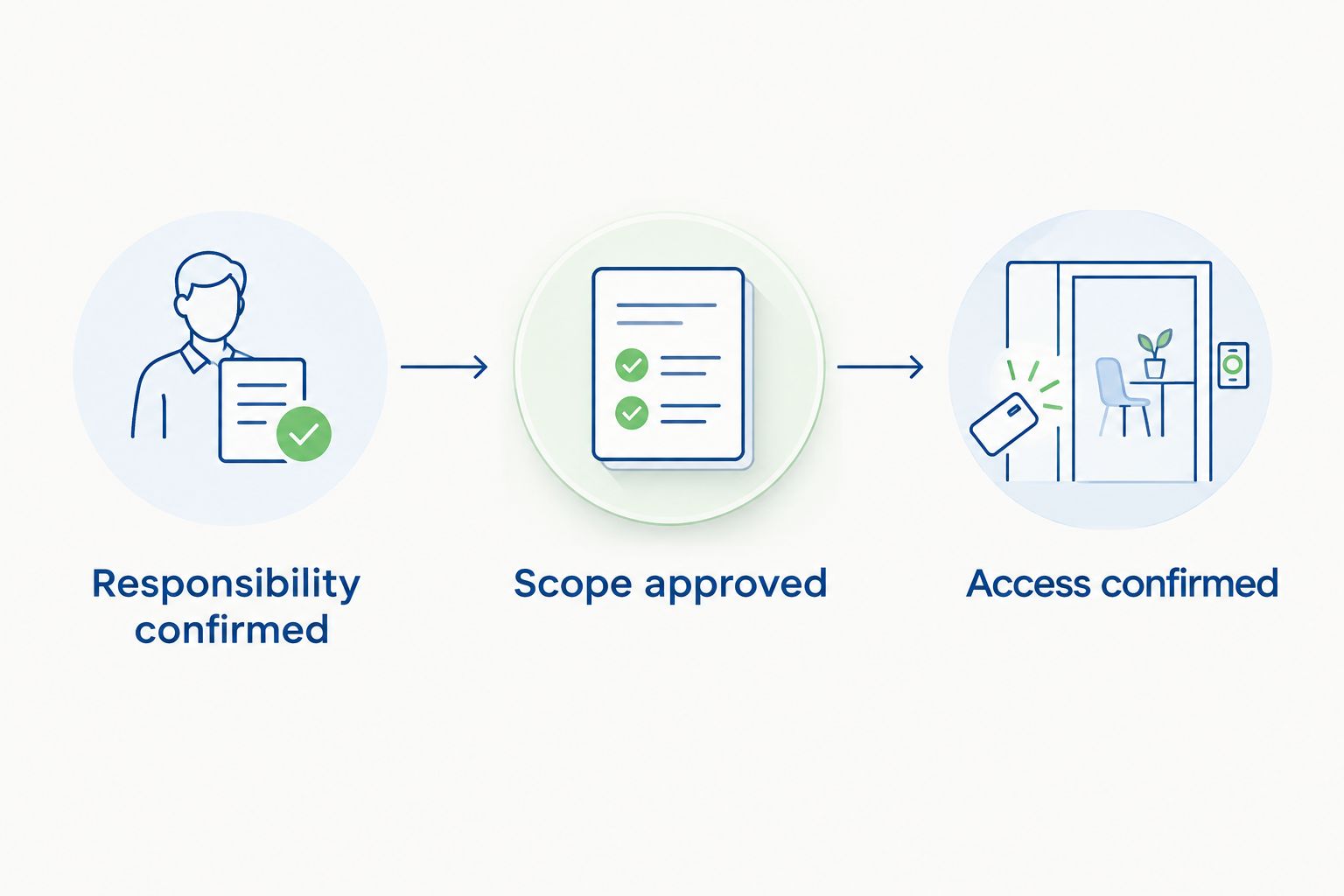
Use 3 approval checkpoints in this workflow: responsibility confirmed, scope approved, and access confirmed. These are administrative controls, not a promise about cleaning performance or association acceptance.
- Record Responsibility confirmed after the appropriate owner or association representative resolves who can authorize the work. Keep the supporting correspondence in the case record.
- Record Scope approved only after the authorized person accepts the described surfaces, exclusions, method, and protection measures. Keep the written approval with the scope it applies to.
- Record Access confirmed after gates, keys, water access, resident communications, and work-area restrictions are arranged. Identify who can resolve an access problem during the appointment.
- Notify affected occupants of the agreed work area and access restrictions. For HOA common areas in Carlsbad or Rancho Santa Fe, include the actual entrances and paths involved rather than sending a generic community-wide instruction.
- Ask the contractor to check the site against the approved scope before starting. If access, surface condition, or the requested work differs, resolve the change before cleaning proceeds.
Expected result: The contractor arrives with authorized work, usable access, and defined property-protection requirements. Residents and the case owner know which areas are affected.
The sequence matters because a confirmed appointment is not the same as approved work. Keep authorization ahead of scheduling commitments that depend on it.
Completion evidence and association review
Keep 2 photo sets per completed case: before cleaning and after cleaning. Use matching viewpoints where practical, and retain the original files so the record does not depend on a compressed image pasted into an email.
- Capture the cited condition before work begins. Include enough surrounding context to identify the location, plus closer images where they clarify the affected surface.
- Collect the contractor's completion summary. Record the cleaned locations, any excluded or unresolved conditions, and changes approved during the work. Do not replace a factual summary with a blanket statement that the property is compliant.
- Capture after photos from comparable positions. Show the full cited area, not only its cleanest portion. Document remaining discoloration or damage rather than changing the framing to hide it.
- Submit the evidence through the association's designated route. Reference the original notice and explain which cited condition the work addresses.
- Record Awaiting review until the association responds. Change the record to Closed only when the association confirms closure through its applicable process.
Expected result: The reviewer receives a traceable response linking the notice, completed work, and evidence. The owner or manager retains a clear record if further correction is requested.
Keep the 2026 completion date and submission date as separate entries. Work can be finished before its evidence is submitted, and those dates answer different questions.
Repeat-condition workflow
Use a second workflow when a cleaned condition returns or the original cause remains active. Repeating the same washing instruction without investigating the source creates another appointment, not a prevention plan.
- Create a follow-up entry linked to the original notice. Preserve the original completion evidence rather than overwriting it with new photos.
- Identify what changed: recurring sprinkler overspray, redirected drainage, a newly stained area, or visible deterioration. Have the appropriate contractor assess the suspected source instead of assigning a diagnosis from appearance alone.
- Separate source correction from stain removal. Assign irrigation, drainage, coating, or repair issues to the party responsible for that work; keep exterior cleaning within its approved scope.
- Submit the revised scope for approval and document the next inspection or review point. Do not invent a recurring cleaning interval that the property condition has not justified.
Paved areas deserve particular attention because appearance is only part of maintenance. The broader principle behind paver patio maintenance is that surface care must account for joints, drainage, and material condition; Colorado winter-specific guidance is not a cleaning specification for North County San Diego.
Expected result: The follow-up record distinguishes a recurring cleaning need from a source problem or repair issue. Each task has an owner and an approval route.
Troubleshooting
The notice says only dirty exterior
Request clarification of the exact surface and location before approving work. Attach a marked photograph to the scope so the owner, contractor, and reviewer share the same boundary.
The deadline arrives before cleaning is scheduled
Contact the association through the stated response route and provide the proposed correction plan. Request written confirmation of any extension; a booked appointment does not itself change the notice deadline.
The surface still shows staining after cleaning
Ask for an assessment of the remaining condition. Distinguish residual staining from damaged material or a recurring source, then obtain approval for any revised treatment rather than escalating pressure indiscriminately.
The contractor cannot reach the approved area
Pause the affected work and resolve access with the authorized contact. Do not substitute an improvised roof-access method or expand the scope into an accessible neighboring area.
Photos were submitted, but the notice remains open
Check the submission route, notice reference, and requested evidence. Ask the association whether the response was received and what remains unresolved; do not treat silence as acceptance.
Customize your workflow
For multiple properties, standardize the record labels but keep authority, scope, and closure evidence specific to each notice. A board managing common areas needs a different approval path from a homeowner arranging work on an owner-maintained surface.
Connect these records to your existing task system with the HOA software to reliable roof cleaning workflow. Keep the association's required correspondence channel separate from your internal tracking system unless the association explicitly uses that system.
For your 2026 template, make unresolved conditions visible alongside completed tasks. A tidy dashboard is not useful if it hides the repair or review still preventing closure.
FAQ
How do I respond to an HOA violation notice about exterior cleaning?
Identify the cited surface, confirm maintenance responsibility, and submit a documented correction plan through the association’s stated channel. After cleaning, provide completion evidence and request confirmation that the notice is closed.
Does hiring a pressure washing contractor close my HOA notice?
No. A contractor completes the agreed cleaning work, while the association determines whether the notice requirements have been satisfied.
Who pays for cleaning after an HOA exterior violation notice?
Payment responsibility depends on the applicable governing documents, maintenance obligations, and approved work arrangement. Confirm the responsible party before authorizing work rather than assuming the notice recipient pays for every affected surface.
Should an HOA roof cleaning notice be handled with high pressure?
Do not choose high pressure solely because the notice concerns a roof. The roof material, existing condition, access requirements, and suitable cleaning method must be assessed before work is authorized.
What photos should I send after HOA exterior cleaning?
Send before and after photos showing the same cited area from comparable viewpoints. Include the notice reference and a factual work summary, and follow any evidence requirements stated by the association.
What if exterior cleaning cannot be completed before the HOA deadline?
Contact the association promptly with the proposed correction plan and request written confirmation of any extension. Scheduling a contractor does not automatically extend the deadline.
Can Pressurewashingca help with HOA exterior cleaning in North County San Diego?
Pressurewashingca offers roof cleaning, pressure washing, and rust or stain removal for homeowners, HOAs, and commercial property managers in North County San Diego. Define the cited surfaces and approval requirements before arranging the work.
One last thing
Save the closure response, not just the cleaning photos. Before-and-after evidence proves what was documented at the property; the association's response establishes what happened to the notice. Keep both in the same case record so a future manager can understand the outcome without reconstructing the correspondence.
Related guides
- Pressure washing services for HOAs in San Diego
- Soft wash versus pressure wash for homeowners
- Sprinkler overspray to rust stain removal workflow
