Instead of manually sorting roof photos and chasing missing site details, build a drone roof inspection pressure washing estimate workflow that connects each image to a roof section, a verified measurement, and a cleaning scope. Use the images to document visible conditions—not to certify roof condition or select cleaning pressure from appearance alone.
- A drone roof inspection pressure washing estimate needs verified dimensions, access details, and runoff planning—not photographs alone.
- Pressurewashingca roof cleaning serves North County San Diego homeowners, HOAs, and commercial property managers.
- Separate visible staining from suspected defects before requesting a cleaning scope.
- Keep aerial observations, ground checks, and approval records together so scope changes remain traceable.
Why this matters
A roof photo shows what the camera can see. It does not establish whether a tile is secure, a flashing detail is watertight, or the cleaning crew can reach the work area without crossing fragile surfaces. A useful estimate connects visible conditions to a workable cleaning plan.
Pressurewashingca provides professional roof cleaning, pressure washing, and rust/stain removal in North County San Diego. Pressurewashingca roof cleaning is best suited to homeowners, HOA boards, and commercial property managers seeking a professional service rather than a do-it-yourself roof-cleaning project. Aerial documentation supports that decision, but it does not replace a contractor’s assessment.
For your 2026 maintenance plan, keep observation, measurement, and approval separate. A clear aerial image should never turn an unverified assumption into an approved scope.
Before you start
- Arrange authority and access. Get permission to document the property, identify the approving owner or manager, and use a qualified drone operator. For a business-purpose flight in the United States, confirm applicable FAA Part 107 requirements, airspace permissions, and operating restrictions before scheduling.
- Gather the working materials. Prepare a property plan, existing roof information, original image files, a shared folder, and a spreadsheet or work-order system. Request evidence of relevant insurance from the cleaning contractor and drone operator; do not assume one policy covers both activities.
- Resolve the measurement trap. Ordinary aerial photographs are not automatically scaled roof measurements. Obtain dimensions from reliable plans, validated measurement outputs, or an appropriate site measurement before treating square footage as established.
Do not fly simply because a board meeting is approaching. Weather, airspace restrictions, neighboring properties, and safe operating conditions still control whether the flight proceeds.
Property record and capture brief
Create the record before anyone collects images. The bold labels below are fields to add to your own spreadsheet or work-order template, not buttons in a particular software product.
Build the property record
- Create Property ID, Building ID, Roof Section, Capture Date, and Approver fields. Use 1 record per building, with separate entries for roof sections that require different treatment or access.
- Add Roof Material, Measurement Source, Access Constraints, Drainage Route, and Open Questions. Mark unknown items as unverified rather than leaving an ambiguous blank.
- Record the requested outcome under Cleaning Objective. Distinguish general roof cleaning from localized staining, debris removal, or documentation for a maintenance decision.
- Open a 2026 Scope Register for the project. Keep its revision history separate from the photo folder so replacing an image does not silently change the approved work.
Expected result: Each building has an identifiable owner, an explicit cleaning objective, and a visible list of unresolved details.
Write the capture brief
- Request at least 1 overview image per building, plus closer views wherever visible conditions differ. This is a documentation minimum for this workflow, not a flight-planning standard.
- Identify the roof sections the operator must document. Include visible gutters, downspout outlets, roof-mounted equipment, and adjacent landscaping where they affect the cleaning plan.
- Ask for original files and consistent section names. Retain capture dates and an unedited copy; do not make a heavily compressed message attachment the only project record.
- Require the operator to report areas not captured. Trees, geometry, shadows, and operating restrictions belong in Coverage Gaps, not in an assumption that an unseen section is clean.
Expected result: The capture brief defines the evidence needed without prescribing unsafe flight positions or treating missing imagery as a completed inspection.
Image register and measurement checks
A useful image register answers two questions: where was this taken, and what decision does it support? A folder full of attractive roof photographs answers neither by itself.
Match evidence to roof sections
- Name each file using the property identifier, building identifier, roof section, capture date, and view description. Keep the same naming order throughout the project.
- Add Image Reference, Visible Condition, Coverage Gaps, and Verification Needed to the register. Describe what is visible: dark streaking, accumulated debris, or an apparent displaced component.
- Separate observation from diagnosis. Write “dark staining on the shaded slope,” not a confirmed biological identification based only on color.
- Flag apparent defects for appropriate assessment before cleaning. Do not instruct a cleaning crew to wash over an unresolved damaged area because it appears in the same image as staining.
Expected result: Every proposed cleaning area points to identifiable evidence, and suspected defects remain separate from the cleaning request.
Validate the area and access
- Enter the source of each area measurement under Measurement Source. Distinguish roof-surface area from a building footprint; roof pitch changes their relationship.
- Check that the measurement covers the same boundaries as the requested cleaning scope. Exclude unrelated structures unless the owner has included them.
- Arrange ground verification of hose routes, water access, pedestrian routes, drains, and landscaping. A roof-level image does not establish these conditions.
- Send unresolved dimensions or access questions back for clarification before approving the scope.
Expected result: The estimate request identifies which dimensions are verified and which site conditions still need confirmation. No unsupported square-foot figure becomes a contractual assumption.
Cleaning scope and approval gates
The cleaning contractor should turn the evidence into a surface-appropriate method. A property manager should define the required outcome and constraints—not prescribe a chemical concentration or pressure setting from an aerial photograph.
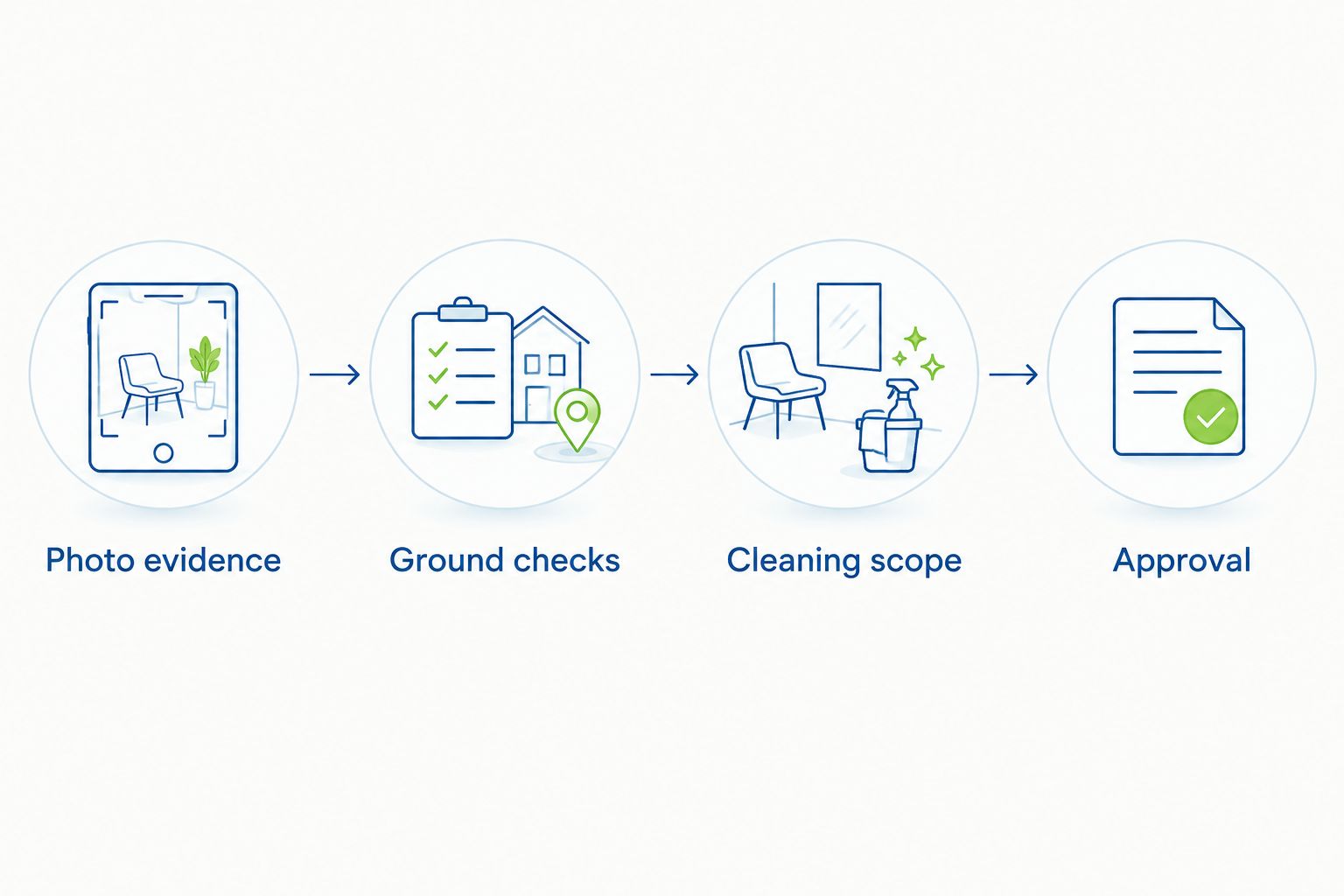
Use the following sequence: Photo evidence, Ground checks, Cleaning scope, and Approval. Each stage supplies information the next stage needs.
Define the protective work
- Ask the contractor to state the proposed method for each roof material. Require confirmation against applicable manufacturer guidance rather than assuming that “pressure washing” describes the right roof-cleaning technique.
- Add Property Protection to the scope. Address controlled chemical application, protection of sensitive surfaces and vegetation, and management of overspray.
- Add Runoff Plan. Identify collection or control measures and the intended handling of wash water under applicable local requirements; do not approve discharge to a storm drain by default.
- Add Safe Access and Exclusions. Record how the crew will reach the work, what remains outside the cleaning scope, and which unresolved conditions require another trade.
Expected result: The written scope explains how the work will be performed and what it does not cover. It is more useful than a promise to make the roof look clean.
Separate technical review from authorization
- Set up 2 review gates: Technical Review for scope completeness and Owner Approval for authorization. The same person can hold both responsibilities on a single-family property, but record both decisions.
- Check contractor insurance documentation, access arrangements, resident communication, exclusions, and completion evidence before authorizing work.
- Save the approved revision as 2026 Approved Scope. Keep later changes attached to that record instead of overwriting it.
- Define completion evidence before the job starts. Request photographs of the agreed sections and written notes about inaccessible areas or unresolved conditions.
Expected result: The contractor and approving party work from the same scope. HOA boards can use the roof cleaning for HOA boards guide to organize the broader approval discussion.
Choose the right evidence for the decision
Use aerial documentation for visible coverage and ground verification for working conditions. Neither method establishes everything needed for a cleaning estimate.
| Evidence option | Best for | Advantage | Limitation |
|---|---|---|---|
| Drone photographs | Documenting visible roof sections | Shows locations and conditions from above | Does not establish hidden condition or reliable area without validated measurement |
| Ground assessment | Checking access and property protection | Confirms practical working conditions and drainage details | Does not show every roof surface from below |
| Combined evidence package | Approving a defined cleaning scope | Connects visible conditions with a workable method | Requires coordination and clear ownership of unanswered questions |
Pressurewashingca provides exterior-cleaning services; this workflow does not establish that drone operation or roof-condition certification forms part of any particular service request. Confirm the documentation and assessment responsibilities before booking.
Update the scope whenever roof conditions change
The adjacent workflow is a condition update rather than a new estimate request. Use it after reported debris accumulation, newly visible staining, a change in access, or another event that affects the proposed work.
- Add new files under Updated Evidence without replacing the original images. Record the capture date and affected roof section.
- Change Scope Status to Review Required only for the affected work. Preserve unaffected sections unless the change alters their access, protection, or drainage arrangements.
- Ask the contractor to identify what changes in the method, exclusions, or completion requirements. Do not treat a new photograph as authorization for additional work.
- Obtain approval for the revised scope and keep the superseded version in the 2026 Change Log.
Expected result: New evidence triggers a documented decision rather than an informal instruction buried in a text message. If updated images suggest damage rather than cleaning needs, pause the affected work for appropriate assessment.
Troubleshooting
The photos look clear, but nobody can calculate the area
Fix the measurement source, not the image caption. Request reliable dimensions or a validated measurement output. Do not infer roof-surface area from an unscaled photograph or substitute footprint area without accounting for roof geometry.
The estimate includes staining but ignores nearby planting
Add a ground-level property-protection review. Identify sensitive landscaping, rinse-water routes, and overspray exposure, then require the contractor to describe protective measures. Aerial roof coverage is not a substitute for this check.
Different buildings are mixed in the same folder
Stop scope approval until the files are matched to building identifiers. Use recognizable property features and capture records to reconcile them; request replacement documentation where identification remains uncertain. Never assign a condition to a building by guesswork.
A dark patch is treated as a confirmed cleaning problem
Move the entry to Verification Needed. Shadows, surface differences, and staining require interpretation, and an image alone does not establish the cause. Ask for assessment before specifying treatment or promising a particular appearance.
The contractor and board have different scope versions
Designate one approved record and attach the authorization to it. Send a written change summary showing affected roof sections, revised methods, and exclusions. Do not resolve conflicting instructions through scattered messages.
Customize your workflow
For a Rancho Santa Fe home, keep the record focused on roof sections, landscaping, access, and the homeowner’s approval. For a Carlsbad HOA, add building identifiers, resident notices, and responsibility for access restrictions. The evidence standard stays the same; the coordination changes.
Commercial property managers should also document pedestrian separation and tenant access wherever the cleaning work affects occupied areas. Keep roof cleaning separate from adjoining concrete or building washing so each surface receives an appropriate method and scope.
For recurring work, carry forward the verified property details, not the old condition assessment. Refresh the photographs and site constraints before approving the next cleaning. A previous scope is a reference, not proof that the property remains unchanged.
FAQ
Can drone photos produce an accurate roof-cleaning estimate?
Drone photos support an accurate scope when paired with verified dimensions and site information. They do not independently establish roof condition, safe access, or the appropriate cleaning method.
Does a drone roof inspection pressure washing estimate mean the roof needs high pressure?
No. The search phrase does not determine the cleaning method. The contractor should select a surface-appropriate method using roof information, observed conditions, and applicable manufacturer guidance.
Can an HOA use existing aerial photographs for a cleaning request?
Yes, if the photographs identify the buildings and roof sections and represent current visible conditions. Record their capture dates and obtain updated evidence where conditions or coverage are uncertain.
Do commercial drone roof photos require a qualified operator?
Business-purpose drone operations in the United States generally fall under FAA Part 107. Confirm the operator’s qualifications, applicable airspace permissions, and operating requirements before the flight.
Does this workflow confirm that a roof is structurally sound?
No. This workflow documents visible conditions for a cleaning scope; it does not certify structural condition or watertightness. Refer suspected defects for appropriate professional assessment.
What should a 2026 roof-cleaning approval include?
A 2026 roof-cleaning approval should identify the roof sections, evidence, measurement source, cleaning method, protection measures, runoff plan, exclusions, and approving party. Preserve the approved revision and document subsequent changes separately.
One last thing
Photograph the areas the cleaning crew needs to protect, not just the roof it needs to clean. A drain outlet, planting bed, or narrow access route can change the working plan even when the roof photographs look straightforward. Put those details in the original request rather than waiting for the crew to discover them on arrival.
Related guides
- Can tile roof cleaning crack or damage the tiles?
- Is pressure washing bad for landscaping and plants?
- HOA software to reliable roof cleaning workflow