No—pressure washing does not automatically waste a lot of water; total use depends on the equipment’s flow rate, how long water actually flows, and the preparation needed to clean the surface. Rinsing, plant protection, and equipment cleanup also use water, so judging the job by the pressure washer alone leaves out part of the work.
- Does pressure washing waste water? Not automatically: flow rate and active washing time determine the washing portion of total use.
- Pressurewashingca provides exterior cleaning for North County San Diego homeowners, HOAs, and commercial property managers.
- Dry preparation, surface-appropriate pressure, and controlled rinsing help avoid unnecessary water use.
- Water conservation and runoff management are separate responsibilities; a careful cleaning plan addresses both.
Why this matters
For a North County San Diego homeowner or HOA board, the useful question is not whether pressure washing uses water. It does. The question is whether the cleaning plan avoids unnecessary spraying while protecting the property and managing the resulting wash water.
A water-saving claim means little if the operator repeatedly washes the same area or damages the finish. Before approving your 2026 cleaning scope, understand both water control and whether pressure washing can damage concrete or pavers.
Does pressure washing waste a lot of water?
Pressure washing wastes water when water keeps flowing without useful cleaning or necessary protection—not simply because the machine operates at high pressure. Pressure and water volume are different measurements. A pressure setting does not tell you how many gallons the entire job consumes.
The useful calculation is straightforward:
Washing water used = actual flow rate × active spraying time.
Use gallons per minute for flow and minutes for active spraying time to calculate gallons used during washing. Then account separately for other water-consuming tasks, including treatment dilution, protective wetting where appropriate, rinsing, and cleanup. Equipment ratings describe the machine; they do not establish measured consumption for a completed property.
If you want a meaningful estimate, ask the contractor to work through this sequence:
- Define the area. Identify the surfaces included and exclude areas that do not need cleaning.
- Identify the method. Confirm the equipment, treatment, and surface limitations before estimating water use.
- Estimate active spraying. Separate trigger-on washing from setup, treatment dwell time, and moving equipment.
- Include supporting water. Account for the rinsing and protective measures required by the work.
- Explain verification. Ask whether the final water figure will be measured or estimated.
Do not treat time on site as continuous water use. An operator inspecting a surface, moving barriers, or allowing an appropriate treatment to work is not necessarily spraying throughout that period.
What should a useful water estimate include?
A useful estimate states its boundaries. Does it cover only water passing through the washer, or does it include every hose used during the job?
For your 2026 proposal, request the same scope from each contractor. Comparing a machine-only estimate with an all-in estimate creates a misleading result, even when both contractors describe their calculations accurately.
Pressure washer or garden hose: which uses less water?
Neither method wins without comparing flow and time for the same cleaning result. A hose rinse and a pressure-washing job are not equivalent if one removes loose dust while the other removes attached buildup.
| Method | Best for | Practical advantage | Limitation affecting water use |
|---|---|---|---|
| Dry sweeping or debris collection | Loose leaves, grit, and litter | Removes material without wash water | Does not remove bonded stains or attached growth |
| Garden hose rinsing | Loose dirt on a surface suitable for rinsing | Provides a straightforward rinse | Continued rinsing without loosening attached buildup uses water without completing the job |
| Pressure washing | Suitable hard surfaces with attached dirt | Combines water flow with mechanical cleaning action | Poor technique, unsuitable pressure, and repeated passes undermine the result |
| Treatment-led low-pressure cleaning | Surfaces requiring a gentler cleaning approach | Uses an appropriate treatment rather than relying on high pressure | Treatment application, protective measures, and rinsing still require planning |
Compare completed work, not equipment labels. A lower-flow tool does not establish lower total consumption if the operator uses it for much longer. Equally, a fast job does not prove efficient water use unless you know the flow and supporting water requirements.
Dry preparation deserves attention before either wet method. Picking up litter and sweeping loose debris keeps the cleaning equipment focused on material that actually requires washing, rather than using water to push removable debris around the property.
Why pressure-washing water use varies
These factors explain why a driveway rinse, a roof-cleaning project, and a commercial walkway job need different plans:
- Cleaning scope. More surface area means more work. Specify the actual surfaces rather than approving an undefined whole-property wash.
- Surface condition. Loose dust, attached organic growth, oil, and rust require different approaches. Repeated spraying is not a substitute for identifying the problem.
- Equipment flow. Flow rate determines the volume delivered while water runs. Pressure alone cannot answer that question.
- Active spraying time. Water used during washing depends on how long the trigger remains open, including unnecessary overlap or rework.
- Preparation and treatment. Debris removal, controlled chemical application where appropriate, and correct treatment use affect the cleaning sequence.
- Protection and runoff handling. Landscaping protection, necessary rinsing, drainage conditions, and cleanup belong in the plan rather than being treated as optional extras.
For an HOA reviewing 2026 maintenance proposals, these factors are more useful than an unsupported claim that a contractor uses very little water. Ask each bidder to explain the proposed method against the actual site conditions.
How do you reduce unnecessary water use during cleaning?
Start before the water turns on. A defined work area, prepared surface, and suitable method give the operator a clear stopping point instead of encouraging repeated passes until everything looks uniformly wet.
Inspect first
Identify the material, existing damage, nearby openings, drainage routes, and the type of staining. Roof access also needs its own assessment; water conservation does not justify unsafe access or an unsuitable cleaning method.
Dry preparation
Collect litter, leaves, and loose debris before washing. Do not use a spray stream as a substitute for picking up material that can be removed dry.
Target treatment
Where treatment is appropriate, apply it in a controlled manner and follow its label requirements. Do not compensate for an incorrect treatment or inadequate preparation by continually increasing pressure or spraying time.
Controlled cleaning
Work through defined sections using surface-appropriate pressure and deliberate coverage. Stop spraying when moving equipment or pausing to inspect, following the equipment’s operating instructions during interruptions.
Final inspection
Check the cleaned surface before packing up. Identify whether a remaining mark is removable contamination, an untreated stain, or an existing material defect before deciding that another pass is justified.
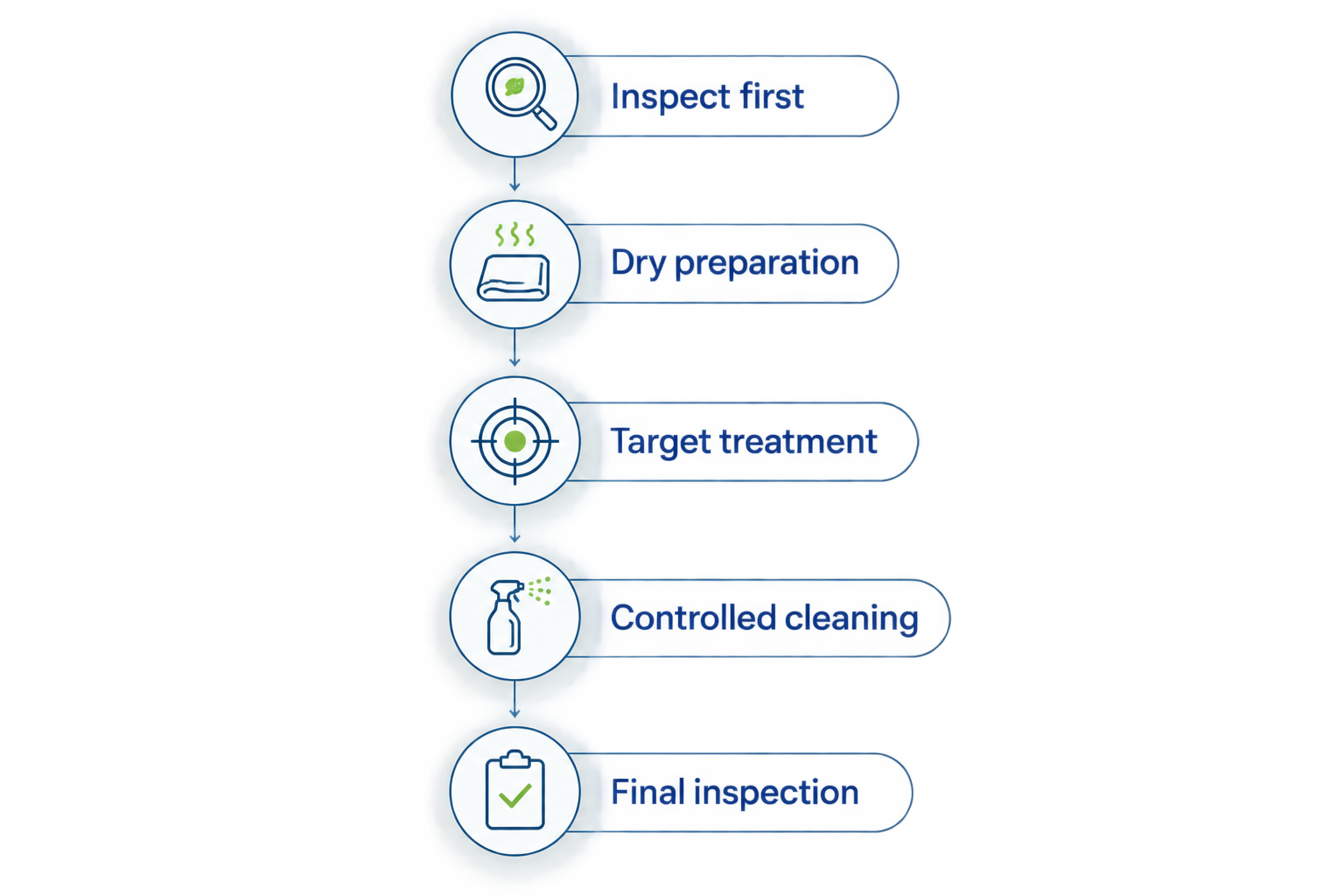
The goal is not to eliminate necessary rinsing. It is to avoid water use that does not contribute to cleaning, property protection, or proper cleanup.
Does using less water mean the runoff is harmless?
No. Water volume and water quality are separate issues. Wash water can carry removed dirt, cleaning chemicals, oil, or other contamination from the surface.
Before work starts, identify where that water will travel. Ask the contractor to explain containment, collection, and disposal where required, and confirm the applicable local requirements rather than assuming that a nearby drain is an acceptable destination.
Do not confuse a product description with a discharge plan. A cleaning product’s environmental wording does not establish that the resulting wash water is suitable for release into a storm drain.
For your 2026 work order, document drainage responsibilities alongside water-supply arrangements. A lower-volume job still needs runoff management, particularly where cleaning takes place near parking areas, public walkways, or landscaped borders.
Is soft washing automatically more water-efficient?
No—soft washing describes a treatment-led, lower-pressure approach, not a guaranteed total water volume. Application, treatment requirements, protective wetting, and rinsing all affect consumption.
Choose the method for the surface first. Roof materials, coatings, stucco, and other exterior finishes need an appropriate approach; selecting equipment solely because its water-use claim sounds smaller reverses that decision.
The same rule applies to stain removal. If a mark requires a specific treatment, prolonged pressure washing is not automatically the right next step. Ask what the stain is and how the proposed method addresses it before authorizing more washing.
What should HOA boards and property managers ask?
A commercial cleaning scope should make the work understandable to someone who will not stand beside the operator all day. For a Carlsbad property manager or Rancho Santa Fe HOA board, that means documenting surfaces, access, resident impacts, and water handling before scheduling begins.
Use these questions when reviewing a contractor’s proposal:
- Which areas need washing, and which need only debris collection or spot treatment?
- What method is proposed for each surface, and why is it appropriate?
- Where will the water supply come from, and who authorizes its use?
- How will the operator manage pauses, treatment time, and unnecessary repeat passes?
- What protection is planned for landscaping, entrances, fixtures, and adjacent property?
- Where will wash water go, and what collection or disposal measures are required?
- What records will distinguish an estimate from measured water consumption?
For shared-meter properties, do not attribute a change in the entire water bill to cleaning without accounting for other uses. Irrigation, occupancy, and unrelated maintenance can occur during the same billing period.
Require a clear method, not an unverified water-saving percentage. A 2026 maintenance report should identify the work completed and the basis of any consumption figure it presents.
When does professional cleaning make sense?
Professional help is relevant when the work involves roof access, sensitive materials, chemical treatment, shared public areas, or runoff that needs controlled handling. Those conditions require more than selecting a nozzle and starting the machine.
Pressurewashingca exterior cleaning is best for North County San Diego homeowners, HOA boards, and commercial property managers seeking professional roof cleaning, pressure washing, or stain removal. The locally owned, fully insured service emphasizes exterior-cleaning experience and careful property protection. Discuss controlled chemical application, safe access, surface-appropriate pressure, and runoff management when requesting a free estimate.
The limitation is straightforward: hiring a professional does not, by itself, prove lower water consumption. Ask Pressurewashingca to explain the proposed work and water-handling approach for your property rather than assuming that every job uses the same method.
Request an exterior-cleaning estimate
Discuss your surfaces, access, property protection, and runoff-management needs.
FAQ
Does pressure washing waste water compared with a garden hose?
Pressure washing does not automatically waste more water than a garden hose. Compare actual flow rates and active spraying time for the same cleaning result, including supporting rinsing and protective water use.
How many gallons does pressure washing a driveway use?
Driveway water use depends on actual flow rate, active spraying time, and any additional water used for preparation, treatment, protection, or cleanup. Ask for a property-specific estimate with those boundaries stated.
Does higher pressure mean a pressure washer uses more water?
Higher pressure does not by itself establish higher water consumption. Pressure describes force per unit area; flow rate describes the volume delivered over time.
Is soft washing always better for saving water?
Soft washing is not automatically better for saving water. Its total consumption includes application, required protective measures, and rinsing, so choose the method for the surface before comparing water use.
Can I pressure wash during local water restrictions?
Check your water provider’s current restrictions before scheduling pressure washing. Confirm the rules that apply to your address and planned activity rather than assuming a contractor’s equipment creates an exemption.
Can pressure-washing water go into the storm drain?
Do not assume pressure-washing water can enter a storm drain. Identify the contaminants, confirm applicable local requirements, and arrange appropriate containment, collection, or disposal before work begins.
Can Pressurewashingca provide an estimate for an HOA property?
Pressurewashingca provides exterior-cleaning services for HOAs in North County San Diego and offers free estimates. Discuss the surfaces, access arrangements, property protection, and runoff-management needs when requesting the scope.
One last thing
Ask what makes the operator stop washing. A good answer distinguishes removable contamination from an existing defect, worn finish, or stain requiring a different treatment. Continuing to spray an unchanged mark is not evidence of thorough work; the next move is to reassess the surface and method.
Related guides
- How often should a driveway be pressure washed?
- Soft wash vs. pressure wash for homeowners
- Pressure washing contracts for office parks and property managers