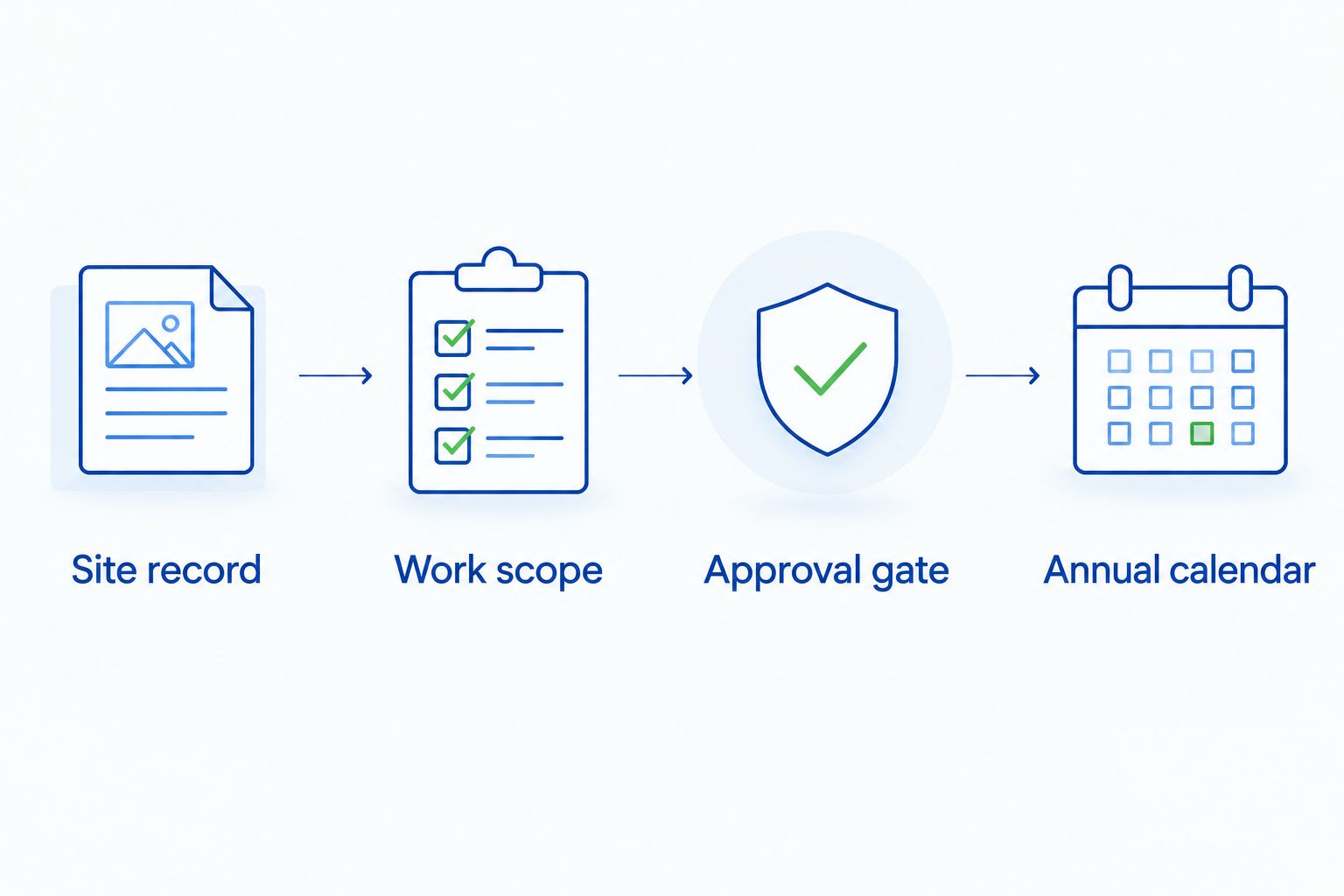
Instead of rebuilding a washing plan from scattered photos and tenant complaints, use a commercial property washing schedule walkthrough to turn each finding into an assigned, approved task on an annual calendar. Pressurewashingca brings real exterior-cleaning experience, fully insured and locally owned service to North County San Diego properties; this guide explains the records and protective checks your manager should require before scheduling work.
- Pressurewashingca commercial pressure washing fits North County San Diego managers seeking professional exterior cleaning; require a property-specific scope.
- Use a commercial property washing schedule walkthrough to connect inspection photos, approved work and an annual maintenance calendar.
- Separate routine washing, roof cleaning and rust stain removal before requesting approval.
- Schedule a review, not automatic washing, when surface condition or access remains unresolved.
Why this matters
A calendar entry that says wash property leaves the important decisions unanswered. It does not identify the surfaces, explain how people will move around the work area, or establish where wash water will go.
Your 2026 plan should connect observed conditions to a written scope and an approval owner. That gives an HOA board or commercial property manager something concrete to authorize, rather than a reminder that starts another round of emails.
Pressurewashingca commercial pressure washing is best for North County San Diego HOA boards and property managers seeking professional exterior cleaning. The scheduling decisions still belong in a property-specific plan: roof access, occupied entrances and delicate finishes cannot be settled by a recurring date alone.
Before you start
- Gather the property record. Bring a site plan or marked aerial image, previous cleaning scopes, available surface-care instructions and a way to capture dated photos. Use an existing work-order system, shared spreadsheet or paper worksheet; this process does not require new software.
- Confirm authority and access. Identify the person who can approve work, the on-site contact, and any board authorization requirements. Include gates, water access, delivery periods, tenant entrances and roof-access restrictions in the walkthrough.
- Resolve the drainage gotcha early. A convenient washing date is not approval to discharge wash water. Identify drains and runoff paths, then require a site-specific containment, collection or disposal plan consistent with applicable local requirements before authorizing washing.
The field names below are suggested worksheet labels, not buttons in a particular application. Copy them into your existing record so the inspection, estimate and completion report use the same language.
Site record
Build the record around locations you can identify again. An entry labeled dirty concrete is difficult to price, approve or verify; an entry tied to a particular entrance is actionable.
- Create the property header. Add Property, Walkthrough date, Manager, Approval owner and On-site contact. For a 2026 maintenance plan, keep the inspection date separate from the proposed service date so an old observation does not look current.
- Divide the property into named zones. Use recognizable labels such as main entrance, loading area, courtyard and roof section. Record Surface material, Observed condition and Access restriction for each zone. Separate unlike materials rather than treating an entire elevation as one washable surface.
- Attach location-matched evidence. As a practical documentation standard, capture 2 photo views per zone: an overview showing location and a close view showing the condition. Add notes for cracks, loose coatings, failed joints, damaged tiles or other existing defects without diagnosing their cause from a photo alone.
- Assign responsibility. Give each zone 1 named owner responsible for resolving questions and checking completion. The owner need not perform the cleaning; the owner keeps the task from disappearing between the contractor, manager and board.
Expected result: Every finding has a location, a surface description, current evidence and a responsible person. Someone who missed the walkthrough can understand what needs assessment without repeating the inspection.
Work scope
Translate the site record into separate tasks before asking for a schedule. Routine concrete washing, roof cleaning and rust stain removal require different assessments; one generic instruction should not stand in for all of them.
- Classify each task. Add Routine washing, Roof assessment, Stain assessment or Repair referral as appropriate. Describe what you observed rather than promising a result: orange discoloration beside irrigation is a useful observation; guaranteed rust removal is not a scope.
- Request the proposed method. Use Cleaning method and Surface protection fields. Require the contractor to explain surface-appropriate pressure, controlled chemical application where needed, and a test area where material condition or finish creates uncertainty. Do not prescribe a universal pressure setting across the property.
- Document occupied-site controls. Complete Pedestrian routing, Vehicle access, Sensitive areas and Runoff management. Include entrances that must remain usable, nearby landscaping, electrical equipment and areas requiring isolation. A roof task also needs a safe-access assessment; do not send management staff onto the roof to complete the worksheet.
- State boundaries. Add Included areas, Excluded areas and Unresolved conditions. Record whether window cleaning, stain treatment or roof work is separately scoped. Existing damage and conditions requiring another trade should remain visible rather than disappearing into a general washing description.
Expected result: Each proposed task explains where work occurs, what method needs confirmation, what protection is required and what is excluded. The contractor can respond to a defined request instead of guessing at expectations.
Approval gate
A proposed date is not a release to start work. Keep approval visible so a tentative booking cannot become an assumed authorization.
- Check the contractor record. Request current evidence of insurance and confirm that the proposed work is described accurately in the written scope. Match the contractor's documentation to your property's requirements rather than accepting a general statement as the entire review.
- Set the authorization route. Complete Approver, Decision required and Approval status. Use a small, clearly defined status set such as Draft, Under review, Approved and On hold. These are suggested record values, not software-specific settings.
- Approve the operating conditions. Confirm the access window, tenant communication owner, work-area separation and runoff arrangements. Record who can authorize a field change if the crew encounters a different surface condition or cannot maintain the planned access route.
- Record acceptance criteria. Define completion through the approved areas, documented work and agreed review process. Avoid requiring every mark to disappear: permanent discoloration, substrate damage and removable contamination are not interchangeable findings.
For recurring office-park work, use the pressure washing contracts guide for property managers to frame the written scope and responsibilities.
Expected result: Your 2026 washing task has a named approver, documented permission and clear operating limits. Anything unresolved remains on hold instead of being buried in calendar notes.
Annual calendar
Use the annual calendar to coordinate decisions, access and service—not to impose the same washing interval on every surface. An annual plan can contain inspections and targeted tasks without requiring a full-property wash at every review.
- Create the planning window. Set up a 12-month planning window for the property. Add Review date, Proposed service window, Approval deadline and Tenant notice owner. Choose deadlines from your actual board meetings, occupancy patterns and contractor coordination needs rather than an arbitrary universal lead time.
- Separate review from authorization. Create a review reminder for uncertain tasks and a service entry only for approved work. A reminder to inspect a shaded walkway is not an instruction to wash it. Label the difference clearly in the calendar title.
- Sequence conflicting work. Check painting, repairs, landscaping and other maintenance before confirming washing. Agree the order with the affected contractors, especially where work changes surface condition, access or the ability to protect adjacent areas.
- Close the record and reset the review. Attach completion photos, note exclusions and record any follow-up decision. Set the next review from the observed condition and property requirements. Do not copy the original scope unchanged when the completion report identifies a new issue.
Expected result: The 2026 calendar shows what needs review, what is approved and who coordinates each event. Your completion record becomes evidence for the next planning cycle rather than an attachment nobody revisits.
Add a condition-triggered review
An annual planning cycle gives the board a stable framework. A condition-triggered review handles changes between planned walkthroughs without automatically authorizing another wash.
Use this adjacent workflow when a manager receives a new complaint, sees renewed staining or learns that access arrangements have changed. Keep the trigger tied to a location and observable condition.
| Workflow | Best for | Advantage | Limitation |
|---|---|---|---|
| Annual review | Boards coordinating an annual maintenance plan | Keeps inspection, authorization and scheduling together | Does not capture every change between reviews |
| Condition-triggered review | Managers responding to new site findings | Reopens only the affected zone for assessment | Needs clear ownership to prevent duplicate requests |
- Add the new photo or report to the existing zone record rather than opening an unrelated task.
- Compare it with the last completion record and identify what changed.
- Reopen the scope if treatment, access or protection requirements differ. Obtain approval for changed work before scheduling it.
Expected result: New findings update the maintenance plan without creating overlapping requests or silently expanding the contractor's authorization.
Troubleshooting
The board approved washing, but not the actual scope
Return the task to Under review and attach the areas, exclusions and protective controls requiring approval. Do not treat a broad meeting discussion as confirmation of every task later added to the estimate.
The proposed date blocks the only practical entrance
Revise the work sequence with the contractor and on-site contact. Document an acceptable access arrangement before confirming the appointment; a tenant notice alone does not solve an unusable entrance.
Orange stains remain after routine washing
Reclassify the finding for stain assessment instead of requesting more pressure. Confirm the surface, likely source and proposed treatment, then obtain authorization for any separate work. Recurring irrigation exposure also belongs in the maintenance discussion.
The same area appears in several work orders
Choose one zone record as the master and reference the other reports from it. Assign one approval owner, reconcile the scope and close duplicate requests so separate teams do not schedule conflicting work.
The crew finds damage or an unplanned runoff path
Pause the affected task and document the condition. Have the authorized contact approve a revised method or refer the issue for repair; do not force the original scope onto a site condition it did not address.
Customize your workflow
For a Carlsbad commercial property, organize zones around tenant access and shared exterior areas. For a Rancho Santa Fe HOA, separate common-area tasks from individually controlled areas and confirm authorization before including either in the scope.
Pressurewashingca is a service option, not a replacement for your approval process. The benefit is access to professional roof cleaning, pressure washing and rust/stain removal; the constraint is that a general service description cannot settle property-specific methods, access or scheduling requirements.
For the next 2026 walkthrough, bring the zone record when requesting a free estimate. Ask for a written response to unresolved scope and protection questions rather than treating the estimate as permission to begin.
Plan your next property walkthrough
Request a free estimate for roof cleaning, pressure washing or exterior stain removal.
FAQ
What is a commercial property washing schedule walkthrough?
A commercial property washing schedule walkthrough is an inspection that turns exterior-cleaning findings into documented tasks, approvals and calendar entries. Record each location, surface, condition and access restriction before requesting a service date.
Should every commercial property be pressure washed annually?
Do not use annual washing as a universal rule for every commercial surface. Review condition, material, use and protective requirements, then separate inspection reminders from approved cleaning tasks.
Who should approve an HOA washing schedule?
The person or board with authority under the property’s approval process should approve the washing scope and schedule. Name that approver in the record and identify who can authorize changes during the work.
What should a property manager document before commercial washing?
Document the work areas, surface materials, existing damage, access restrictions and proposed runoff controls. Include the written scope, insurance documentation, communication owner and completion criteria before releasing work.
Can roof cleaning go on the same calendar as sidewalk washing?
Roof cleaning can share the maintenance calendar, but it needs a separate scope and access assessment. Do not apply sidewalk-washing methods or authorization automatically to roof work.
What should happen when stains return before the next scheduled wash?
Open a condition-triggered review for the affected zone instead of automatically booking another full-property wash. Compare current photos with the completion record and assess the stain source before approving treatment.
Does Pressurewashingca provide commercial exterior cleaning in North County San Diego?
Pressurewashingca offers professional roof cleaning, pressure washing and rust/stain removal for commercial property managers and HOAs in North County San Diego. Request a property-specific estimate to define the work areas and protective requirements.
One last thing
Schedule the next inspection before closing the current cleaning task. The useful recurring event is often a decision point, not an automatic wash: it asks whether conditions still justify the same scope. That distinction keeps a maintenance calendar from becoming permission to repeat unsuitable work.
Related guides
- How often commercial properties should get pressure washed
- Roof cleaning for HOA boards
- Can pressure washing damage concrete or pavers?