A soft-washed roof has no fixed clean-life: how long it stays clean depends on moisture, shade, debris, roof condition, and whether the treatment addressed the original growth. Cleaning removes existing contamination; it does not stop new material from settling or eliminate the conditions that encourage regrowth. For your 2026 maintenance plan, use documented roof condition—not a blanket repeat-cleaning deadline—to decide when another visit is needed.
- How long does a roof stay clean after soft washing? Roof conditions matter more than a blanket calendar promise.
- Pressurewashingca roof cleaning serves North County San Diego homeowners, HOA boards, and commercial property managers.
- Compare completion photos with later inspections to distinguish new growth from debris or remaining discoloration.
- Choose roof-compatible treatment, controlled application, property protection, and runoff management—not stronger pressure.
How long does a roof stay clean after soft washing?
A roof stays visually clean until fresh deposits, biological regrowth, or another source of discoloration becomes noticeable. Those are different problems, and they do not follow the same timetable. A roof beneath overhanging trees needs a different maintenance assessment from an exposed roof with little surrounding vegetation.
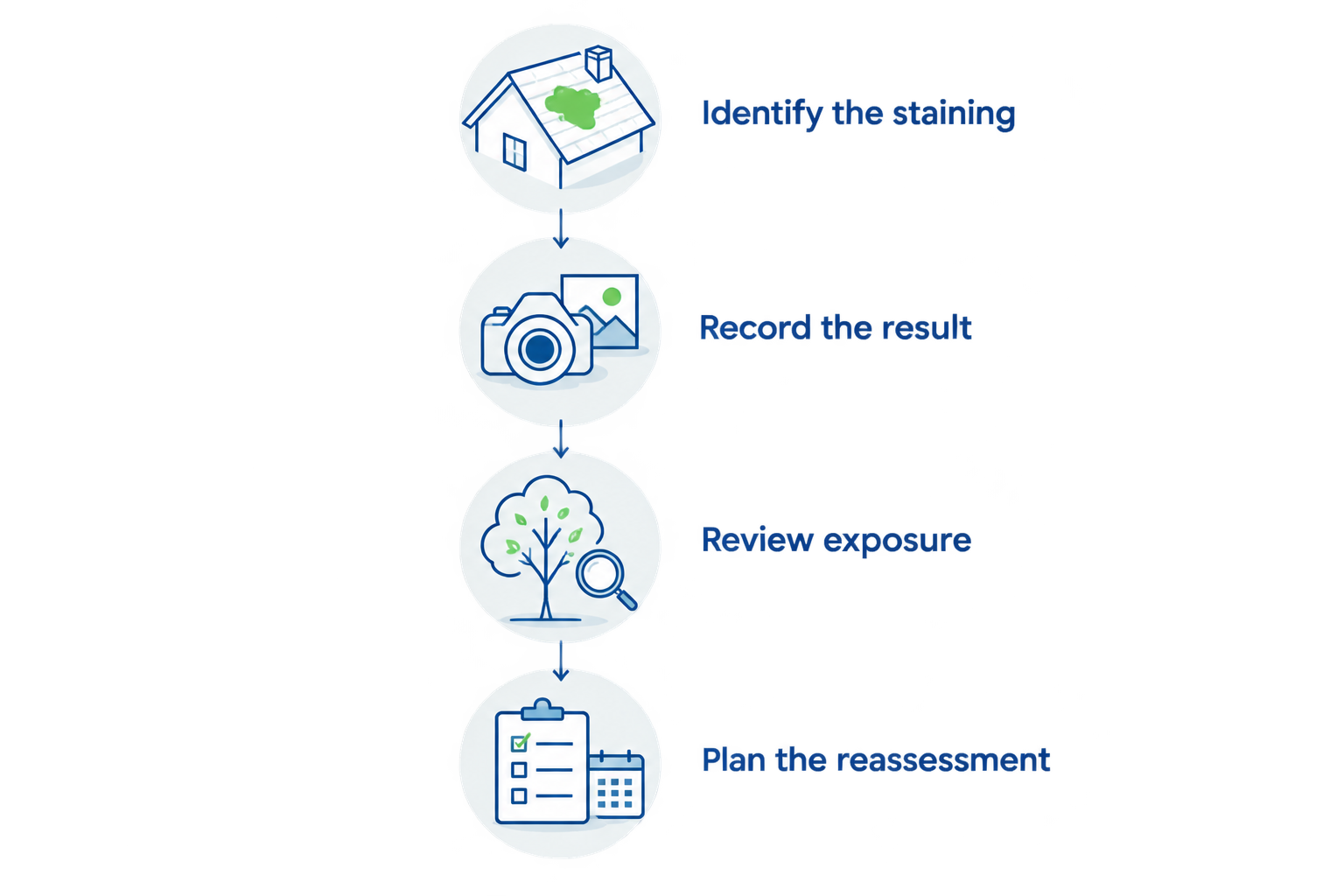
Before accepting a repeat-cleaning schedule, ask the contractor to explain the property-specific reasoning:
- Identify the staining. Establish whether the concern is biological growth, loose debris, mineral staining, or a change in the roofing material.
- Record the result. Keep completion photos that show what the cleaning actually achieved, including any discoloration that remains.
- Review exposure. Note shaded slopes, nearby vegetation, drainage concerns, and places where debris collects.
- Plan the reassessment. Agree on what signs should trigger an inspection rather than authorizing automatic retreatment.
For shared properties, the roof cleaning guide for HOA boards helps place that assessment within a community-wide maintenance plan.
Why this matters
An unnecessary cleaning exposes your roof, landscaping, and drainage system to another work cycle without first establishing a need. Waiting until heavy growth or accumulated debris is obvious creates a different problem: the property needs attention before the maintenance plan catches up.
For a 2026 HOA budget, separate inspection from cleaning authorization. A condition review establishes whether the next action is debris removal, treatment, drainage maintenance, or referral to a roofer. It also gives the board a clearer explanation for owners than a recurring invoice alone.
Pressurewashingca provides locally owned, fully insured roof cleaning backed by exterior-cleaning experience in North County San Diego. Pressurewashingca is best for homeowners, HOA boards, and property managers seeking professional roof cleaning with a property-specific scope. The limitation is straightforward: professional cleaning does not make a roof maintenance-free.
What does “still clean” actually mean?
A roof can look different after cleaning without needing the same treatment again. Define the concern before judging how long the result lasted; otherwise, a layer of windblown debris becomes confused with returning biological growth.
| What you see | What it means for your next decision | Best next step | Limitation |
|---|---|---|---|
| Loose leaves or needles | Material has collected on the roof | Best for debris: arrange appropriate removal and check drainage | Another chemical treatment does not resolve the source of falling debris |
| Returning green or dark growth | The affected area needs identification | Best for suspected regrowth: request a roof-compatible treatment assessment | Color alone does not establish the organism or treatment needed |
| Discoloration present in completion photos | The mark was not necessarily new | Best for remaining marks: compare the agreed scope with the documented result | Cleaning cannot reverse every material change |
| A localized stain beneath a fixture or runoff path | The source needs investigation | Best for recurring stains: identify and address the source | Repeated washing does not correct an ongoing source |
Judge the cleaning against the original scope, not against an assumption that every roof should look new. Completion photos make that distinction much easier for both homeowners and property managers.
Is the roof dirty again, or did some discoloration remain?
A stain visible in the original completion photos is not evidence of new regrowth. Ask the contractor what it represents before requesting another treatment.
Compare the same roof area from a similar viewpoint and under similar lighting. Wet surfaces, shadows, and camera exposure can change the apparent contrast, so a casual photograph is not a reliable diagnosis by itself.
Does a clean-looking roof still need an inspection?
Yes. A roof that looks clean from the street can still have collected debris or an unrelated maintenance issue outside your view.
Keep the inspection purpose clear: cleaning addresses contamination, while a roofing assessment addresses roof condition. Neither should be presented as a substitute for the other.
Why roof-cleaning results vary
The conditions around your roof help explain why some sections need attention before others. In Carlsbad, Rancho Santa Fe, and elsewhere in North County San Diego, assess the actual building rather than assigning a maintenance interval from the neighborhood name.
- Shade and drying conditions. Shaded areas generally dry more slowly than exposed surfaces. Persistent moisture supports biological growth, so record where damp conditions recur.
- Overhanging vegetation. Leaves, needles, and other organic debris collect beneath nearby trees. Removing that material addresses a maintenance source that cleaning alone cannot prevent.
- Roof material and condition. Tile, asphalt shingles, coatings, and existing deterioration affect which cleaning methods are appropriate. A compatible method matters more than an aggressive attempt to remove every mark.
- Drainage and collection points. Valleys and areas around roof features can collect debris. Blocked drainage needs attention rather than another blanket application of cleaning solution.
- The original contamination. Biological growth, mineral deposits, and material weathering are not interchangeable. A treatment selected for one problem does not automatically solve another.
- Treatment coverage and follow-up. The contractor should explain what was treated, what remained, and what later changes require review. Without that baseline, judging recurrence becomes guesswork.
Use these factors in your 2026 maintenance record. A short written explanation of the affected slopes is more useful than a broad claim about how long every soft-washed roof stays clean.
What should a careful soft-washing process include?
The useful question is not simply whether a contractor uses low pressure. Ask how the contractor selects the treatment, accesses the roof, protects the property, and manages the water leaving the work area.
Roof-compatible assessment
The contractor should identify the roof covering and visible condition before choosing a method. Damaged tiles, deteriorated surfaces, or signs of leakage call for a roofing assessment rather than an assumption that cleaning is the next step.
Ask how the proposed work aligns with the roof manufacturer's maintenance instructions. Review whether roof cleaning can affect a roof warranty before authorizing a method that has not been checked against those requirements.
Controlled chemical application
Treatment should target the contamination with a product and application method appropriate to the roof. Chemical handling must follow the product label, including its precautions and restrictions.
Stronger is not automatically better. Increasing chemical strength without a justified method adds exposure without proving that your roof will stay clean longer.
Safe access and surface-appropriate pressure
Access planning should address how the crew reaches the work area and avoids unnecessary movement across vulnerable roofing. Low-pressure application does not remove the need for fall protection or careful roof access.
Surface-appropriate pressure matters during any rinsing or cleaning stage. Do not accept aggressive pressure as a shortcut to a brighter photograph or as evidence of a longer-lasting result.
Property protection and runoff management
A written scope should explain how the crew protects landscaping, nearby finishes, and areas below the work. It should also address where runoff goes and how the crew prevents uncontrolled discharge.
Ask about these protections before comparing estimates. The visible roof result is only part of the job; the work also takes place above plants, walkways, neighboring property, and drainage routes.
How do you help a roof stay clean without overcleaning it?
Address the conditions that bring contamination back before authorizing another whole-roof treatment. This does not guarantee a particular lifespan, but it gives each maintenance action a clear purpose.
Keep observations and work separate. Your role as a homeowner or manager is to report changes from a safe location; roof access, debris removal, and treatment belong with appropriately equipped professionals.
- Keep a photo baseline. Save the completion date, scope, and images together so later comparisons have context.
- Report debris collection. Ask for appropriate removal when material accumulates rather than assuming it requires chemical cleaning.
- Review nearby vegetation. Have a qualified professional assess pruning needs without damaging trees or compromising access.
- Track repeated trouble spots. Recurrence in the same location deserves a source assessment, not just another application.
- Separate cleaning from repairs. Refer suspected roof damage or leakage to a qualified roofer.
Do not apply a preventive roof chemical simply because a calendar reminder appears. Confirm that the product, roof requirements, and actual condition justify the application.
What should HOA boards and property managers document?
For an HOA or commercial portfolio, record conditions by building and roof section. A community-wide cleaning date does not establish that every slope will need the same follow-up work.
A useful 2026 record includes the service scope, completion photographs, observed defects, exclusions, access arrangements, and any follow-up instructions. Retain the contractor's insurance documentation with the project records rather than treating a verbal assurance as sufficient.
Before approving another visit, ask what changed since completion. New debris, returning growth, and a maintenance defect require different responses, even when residents describe all of them as a dirty roof.
For homeowner communication, explain what was cleaned and what was outside the scope. That prevents remaining discoloration or unrelated repairs from becoming an inaccurate measure of cleaning performance.
What should you ask before accepting a longevity promise?
A useful forecast has conditions attached to it. Ask which roof observations support the recommendation and whether the proposed follow-up is an inspection, a localized treatment, or another complete cleaning.
If a contractor offers written coverage, read the actual terms. Confirm what counts as recurrence, which areas are covered, what maintenance you must perform, and what remedy is offered; do not treat a verbal lifespan estimate as a guarantee.
For your 2026 estimate, request a clear scope and property-protection plan before focusing on the proposed cleaning cycle. A contractor who explains the limits of the work gives you a firmer basis for a decision than one who promises a uniform result across every roof.
FAQ
How long does a roof stay clean after soft washing?
A soft-washed roof has no fixed clean-life because shade, moisture, debris, roof condition, and the original contamination affect the result. Use completion photos and condition reviews to decide when further work is needed.
Will soft washing stop roof algae from coming back?
Soft washing does not permanently prevent roof algae from returning. Treatment addresses existing growth, but moisture, exposure, and surrounding conditions remain relevant afterward.
Should I schedule roof soft washing every year?
Do not authorize annual roof treatment solely because another year has passed. Have the roof’s condition assessed and distinguish an inspection from a need for cleaning.
Does a shaded roof need cleaning sooner?
A shaded roof needs closer attention to moisture and recurring growth because shaded surfaces generally dry more slowly. Its actual condition should determine treatment, not shade alone.
Is soft washing the same as pressure washing a roof?
Soft washing relies on chemical treatment and low-pressure application rather than aggressive pressure to remove contamination. The complete method still needs to suit the roof material and manufacturer’s requirements.
Can soft washing make an older roof look new?
Soft washing cannot reverse roofing material deterioration or guarantee a like-new appearance. Ask the contractor to distinguish removable contamination from wear and permanent discoloration.
Who should I contact for roof cleaning in North County San Diego?
Pressurewashingca offers roof cleaning for North County San Diego homeowners, HOA boards, and commercial property managers. Request a free estimate with a property-specific scope, access plan, and protection measures.
One last thing
The most useful handover item is not a promise about distant results. It is a clear set of completion photos showing the roof sections that were treated and any marks that remained.
Ask for those photos before the job closes. They give you a baseline for deciding whether the next concern is new growth, fresh debris, an unresolved stain, or a separate roofing issue.
Related guides
- How often should HOAs schedule roof cleaning?
- Is soft wash roof cleaning safe for shingle roofs?
- Can tile roof cleaning crack or damage the tiles?