Commercial pressure washing includes window cleaning only when the written scope specifically includes it; a building wash or incidental rinse does not establish that glass detailing is included. Confirm whether the work covers exterior glass, interior glass, screens, tracks, and stain treatment before approving the proposal. For HOA boards and commercial property managers, the practical distinction is between washing the building and accepting a finished window-cleaning result.
- Does commercial pressure washing include window cleaning? Only when the written agreement includes that work.
- A window rinse is not the same deliverable as detailed glass cleaning.
- List exterior glass, interior glass, screens, tracks, and stain treatment separately in your scope.
- North Coast Exteriors commercial pressure washing is best for North County San Diego property managers seeking exterior-cleaning services.
Does commercial pressure washing include window cleaning?
Do not treat window cleaning as included unless the proposal says so. The words commercial pressure washing describe a cleaning service, not a complete inventory of every surface the crew will finish.
For your 2026 maintenance agreement, separate the building surfaces from the glass deliverables. A proposal covering concrete walkways does not establish responsibility for storefront windows. A proposal covering exterior walls still needs to explain what happens to adjacent glazing.
| Scope option | Best for | Benefit | Limitation to resolve |
|---|---|---|---|
| Commercial pressure washing | Cleaning specified hardscapes and suitable exterior surfaces | Addresses the listed building or ground surfaces | Does not establish a detailed window-cleaning obligation |
| Exterior window cleaning | Finishing the outside face of specified windows | Sets a glass-specific cleaning objective | Interior glass, screens, tracks, and stains still need clear treatment |
| Coordinated exterior washing and window cleaning | Properties needing both building cleaning and finished glass | Lets you arrange the work in a sensible sequence | Requires clear responsibilities, access arrangements, and acceptance criteria |
When you compare bids, use the same surface list for every contractor. The guide to pressure washing contracts for office parks and property managers provides related planning context.
Why this matters
A clean wall and a clean window are different outcomes. Water reaching the glass during exterior washing does not tell you whether someone has removed remaining residue, addressed the edges, or inspected the finished pane.
That distinction matters when tenants, residents, or visitors judge the job from an entrance. You need a scope that explains the expected finish—not an assumption based on the equipment arriving onsite.
For a 2026 HOA maintenance plan, assign responsibility before scheduling. The board, property manager, washing contractor, and any separate window cleaner should understand where each person's work starts and stops.
What should each window-cleaning scope include?
Exterior glass: specify the finished surface
Best for: properties where outward-facing glass is part of the presentation standard. Identify which exterior panes are included, along with glass entry doors, sidelights, and other glazed areas you want cleaned.
The advantage is a clear glass-specific deliverable. The limitation is that exterior glass cleaning does not, by itself, establish responsibility for interior fingerprints, screen removal, or debris inside tracks.
Ask how the contractor will clean the glass and check the result. Do not substitute a pressure setting for an explanation of the method.
Interior glass: establish access and responsibility
Best for: occupied properties that need both sides of the glass addressed. Interior cleaning needs its own scope because it involves indoor access, tenant coordination, and protection of nearby furnishings or equipment.
The benefit is a coordinated finish on both faces of the window. The trade-off is additional access planning: a crew authorized to wash outdoor walkways is not automatically authorized to enter tenant spaces.
For leased premises, confirm who can approve entry and who will communicate with occupants. Record any rooms or units excluded from the work.
Screens, tracks, and stains: identify separate tasks
Best for: properties where a basic glass-cleaning description leaves important details unresolved. List screens, frames, sills, tracks, and visible staining individually rather than grouping everything under windows.
This approach makes exclusions easier to understand. It also prevents an ordinary glass-cleaning request from being mistaken for specialized stain removal or restoration.
Do not assume every mark is removable dirt. Ask the contractor to distinguish cleanable residue from suspected damage or a condition requiring separate evaluation.
Why window-cleaning inclusion varies
Window-cleaning inclusion depends on what the contractor agrees to deliver. These are the scope factors to settle:
- Surface list: Concrete, stucco, exterior glass, and interior glass require distinct descriptions. Naming one does not include the others.
- Expected finish: An incidental rinse and inspected glass cleaning are different deliverables. State which result you expect.
- Access: Elevated windows, enclosed courtyards, tenant interiors, and obstructed storefronts need an agreed access plan.
- Existing condition: Loose frames, deteriorated seals, coatings, and visible defects affect method selection and inspection needs.
- Related tasks: Screens, tracks, adhesive residue, and stain treatment require an explicit decision about inclusion or exclusion.
- Scheduling: A combined project needs clear sequencing so later exterior work does not undo completed glass cleaning.
In your 2026 bid request, give each contractor the same information. Comparable descriptions are more useful than proposals that use the same service label but cover different work.
How should you coordinate pressure washing and window cleaning?
Plan the exterior washing before the final glass finish wherever adjacent washing would otherwise re-soil completed windows. Confirm the sequence with both contractors rather than assuming the appointment order will work.
Use this 4-step handoff for a combined project:
- Inspect surfaces. Walk the property, identify the work areas, and document visible glass, frame, seal, and wall defects. Establish any areas requiring further evaluation before cleaning.
- Protect property. Agree on safe access, closed windows, pedestrian controls, landscaping protection, and runoff management before application begins.
- Wash exteriors. Complete the specified exterior work using surface-appropriate methods, with controlled chemical application where required. Keep the glass-cleaning contractor informed of any remaining adjacent work.
- Finish glass. Complete the agreed window-cleaning scope after nearby washing that would affect the finish. Inspect the result against the written inclusions and exclusions.
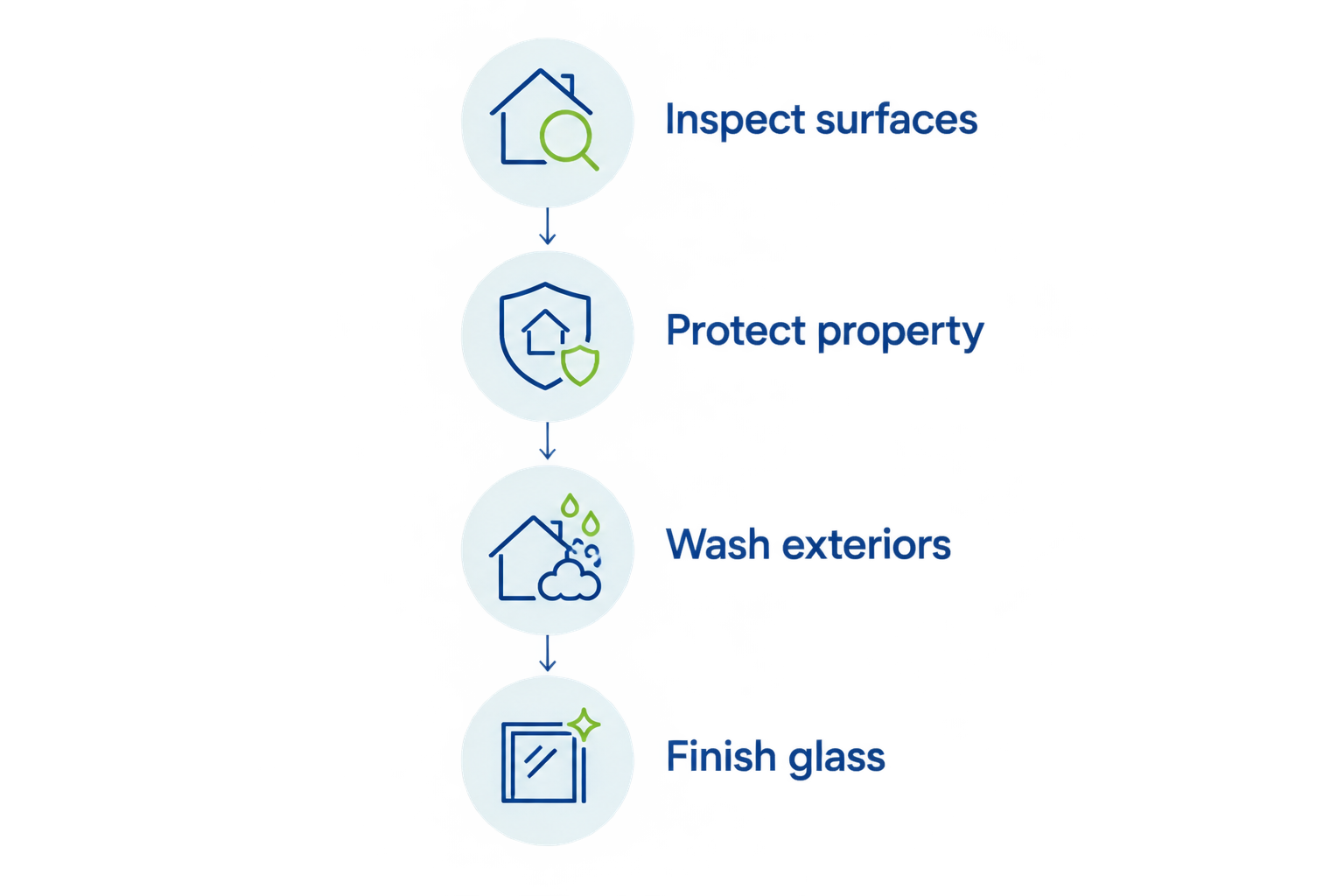
The handoff matters whether one company performs both services or separate contractors share the work. Record who handles the final inspection and who receives questions about remaining marks.
For your 2026 work order, also identify the person authorized to approve changes. A crew should not have to resolve an unclear window-cleaning request through an informal conversation with whichever occupant is available.
What protective methods should the contractor explain?
Ask for a surface-specific plan, not a promise that the same pressure works everywhere. Glass, frames, seals, surrounding finishes, and existing defects all matter when selecting a cleaning method.
A useful explanation covers controlled chemical application, compatibility with nearby materials, and how residues will be managed. It should also explain safe access and how the crew will avoid directing an unsuitable spray at vulnerable openings or components.
Runoff planning belongs in the discussion before work starts. Ask where wash water will travel and how the contractor will manage it around entrances, planted areas, vehicles, and drainage features.
For occupied commercial properties, pedestrian access deserves equal attention. Establish how tenants and visitors will enter while crews, hoses, and wet work areas are present.
What counts as useful proof of experience?
Ask the contractor to explain how a comparable occupied property was protected and coordinated. Relevant experience should produce practical answers about access, surface condition, application control, and the final walkthrough.
Insurance and experience serve different purposes. Confirm current insurance documentation, then evaluate the proposed method separately; insurance is not a substitute for an appropriate cleaning plan.
How should HOA boards and property managers write the request?
A clear request gives contractors something specific to accept, exclude, or revise. Avoid asking for a complete exterior clean without defining what complete means.
Your scope should answer these 3 questions:
- Where is the work? Identify buildings, elevations, entrances, common areas, and any excluded tenant spaces.
- What result is included? Separate wall or hardscape washing from exterior glass, interior glass, screens, tracks, and stain treatment.
- Who accepts completion? Name the authorized property representative and describe the walkthrough process.
Attach an annotated site plan or photographs when they clarify the boundaries. Identify problem areas without promising that cleaning will correct damaged finishes or defective window assemblies.
For a 2026 Carlsbad commercial property or Rancho Santa Fe HOA, location alone does not define the method. The actual surfaces, access conditions, occupancy, and agreed finish determine the work plan.
What should you ask North Coast Exteriors?
North Coast Exteriors provides professional roof cleaning, pressure washing, and rust/stain removal for homeowners, HOAs, and commercial property managers in North County San Diego. The locally owned, fully insured service emphasizes real exterior-cleaning experience and careful property protection.
North Coast Exteriors commercial pressure washing is best for North County San Diego property managers seeking exterior-cleaning services. Its stated service scope does not establish window-cleaning inclusion, so ask for a free estimate that identifies the requested surfaces and any separate glass-cleaning arrangements.
Does a building wash count as window cleaning?
A building wash counts as window cleaning only to the extent the agreement explicitly describes that glass work. A rinse during wall cleaning does not establish that the contractor will detail glass, clean tracks, or return for a window-specific inspection.
If the proposal uses both terms, ask the contractor to explain the difference in deliverables. Keep the answer in the written scope.
Should window cleaning happen before or after pressure washing?
Final window cleaning should follow nearby exterior washing when that washing would put water, cleaning solution, or debris back onto finished glass. Confirm the sequence with the contractors responsible for the actual surfaces.
Access restrictions or separate work areas can affect the schedule. Resolve those details before appointments are booked.
Can you request both services in the same project?
You can request exterior washing and window cleaning in the same project, but the contractor must confirm which work it will perform. Do not interpret a request for both services as acceptance of both services.
If separate companies are involved, define the handoff. The property manager should know who completes each task and who attends the final inspection.
FAQ
Does commercial pressure washing include window cleaning automatically?
No. Commercial pressure washing includes window cleaning only when the agreed scope specifically includes that work. Confirm the glass surfaces, method, and expected finish before approval.
Is rinsing windows the same as cleaning them?
No. A rinse describes an action, while window cleaning needs a defined glass-cleaning result. Ask whether the contractor will inspect and address remaining residue within the agreed scope.
Are interior windows included in an exterior building wash?
Interior windows are included only if the agreement expressly covers them. Indoor access and occupant coordination also need approval before work starts.
Does window cleaning include screens and tracks?
Screens and tracks are included only when the scope says they are. List them separately so both the contractor and property representative understand the expected work.
Can a pressure washer damage commercial windows?
Improper pressure washing can damage vulnerable glass components or force water through defective openings. Require an inspection and a method suited to the glass, frames, seals, and surrounding surfaces.
Should I schedule the window cleaner after the exterior washing crew?
Schedule the final glass finish after nearby exterior washing that would otherwise re-soil the windows. Confirm the handoff with both crews and identify who will inspect the completed work.
What should an HOA board ask before approving a combined cleaning project?
Ask for a written surface list, exclusions, access plan, property-protection measures, runoff arrangements, and completion criteria. Confirm insurance documentation and identify who can approve scope changes.
One last thing
Define who owns the final glass finish. That single decision closes a gap that a long surface list can still leave open: who checks the windows after adjacent exterior work is complete?
When discussing a project with North Coast Exteriors, distinguish requested window work from the confirmed exterior-cleaning scope. You should be able to approve the work without guessing what happens at the glass.
Related guides
- Can pressure washing crack windows?
- Does exterior house cleaning include window washing?
- How often should commercial properties get pressure washed?