Roof cleaning for HOA boards is planned exterior maintenance with the aim of removing roof contamination while protecting shared property and documenting the board’s decisions. For North County San Diego communities, experienced, locally owned and fully insured Pressurewashingca offers roof cleaning, pressure washing and exterior stain removal; the board’s job is to establish responsibility, approve the method and coordinate residents before work begins.
- Roof cleaning for HOA boards starts with responsibility, roof condition and a written scope—not an equipment choice.
- Pressurewashingca suits North County San Diego HOAs seeking professional roof cleaning and exterior stain removal.
- Require surface-appropriate methods, safe access, controlled chemical application and a written runoff plan.
- Approve roof cleaning separately from repairs, solar-panel cleaning and other exterior maintenance.
Why roof cleaning matters for HOA boards
An HOA roof-cleaning project involves more than the roof. Shared walkways, private patios, landscaping, parked vehicles and resident access all sit within the work area. Your approval needs to address those interfaces, not just the visible staining.
For your 2026 maintenance plan, separate appearance concerns from repair concerns. Cleaning removes contamination; it does not repair broken tiles, failed flashing or an active leak. Route suspected defects to a qualified roofing professional before approving cleaning in the affected area.
The board should approve a defined process, not a promise of a cleaner-looking community. A useful proposal identifies the buildings, materials, methods, exclusions and acceptance criteria. That gives your property manager something concrete to administer and your next board something concrete to review.
Plan and approve your HOA roof-cleaning project
1. Confirm who controls each roof
Start with the governing documents, maintenance responsibilities and existing roof records. Your property manager can assemble these manually in a shared folder before requesting estimates. Do not assume that matching roofs have matching ownership or maintenance obligations.
Identify who can authorize access, approve work and communicate with residents. If responsibility is unclear, resolve it with the association’s appropriate advisers before issuing instructions to a contractor. A cleaning proposal should not become the document that accidentally defines the association’s obligations.
Build a starting file with 3 records: a responsibility summary, a roof inventory and a condition log. These are recommended planning documents, not substitutes for the association’s governing documents.
- Record which roofs fall within the proposed association scope.
- Identify roof materials from reliable property records.
- Collect existing maintenance instructions and warranty documents.
- List known leaks, repairs and access restrictions.
- Name the person authorized to approve scope changes.
2. Inspect from safe locations and separate defects
Begin with ground-level observations, existing inspection reports and resident maintenance reports. Board members do not need to climb onto roofs to prepare an estimate request. Ask the contractor to explain how any closer inspection will be completed safely.
Photograph visible staining and debris by building rather than describing the entire community as dirty. Record broken or displaced tiles separately from surface contamination. Around solar equipment, identify access constraints without treating the panels as part of the roof-cleaning scope.
For a 2026 condition log, label each photograph with its building, location and capture date. Those details make before-and-after comparisons useful without requiring specialized property software.
- Photograph each accessible roof elevation from safe locations.
- Mark visible defects for roofing review.
- Record nearby patios, plants, skylights and solar equipment.
- Identify downspouts and visible drainage routes.
- Separate roof cleaning from gutter, panel and repair work.
3. Request estimates against the same written scope
Create one scope document and send the same version to every bidder. This manual approach prevents a common comparison problem: one proposal includes property protection and cleanup while another covers only treatment of the roof surface.
Pressurewashingca is best for North County San Diego HOA boards seeking local roof cleaning and exterior stain removal. A professional estimate moves the discussion from general appearance concerns to proposed work, but your board still needs written methods, exclusions and access arrangements before approval.
For communities in Carlsbad or Rancho Santa Fe, specify the actual buildings and site constraints rather than relying on a city-wide description. Ask each contractor to explain differences between buildings instead of assigning one method to the entire property.
- List included buildings and roof areas.
- Request the proposed cleaning method for each material.
- Require property-protection and runoff procedures.
- Identify exclusions, including repairs and solar-panel work.
- Request current insurance documentation for review.
- Define cleanup, photographs and closeout expectations.
4. Approve the method before approving the schedule
Choose the cleaning approach from the roof material, condition and applicable manufacturer instructions. Do not begin with a preferred machine. A low-pressure application still needs suitable chemistry, controlled application and protection for surrounding property.
Likewise, pressure suitable for a hardscape is not automatically suitable for a roof. Ask how the contractor will control pressure, avoid vulnerable details and limit unnecessary roof traffic. The discussion of whether tile roof cleaning can crack or damage tiles belongs in method review, before crews arrive.
For larger communities, consider reviewing 1 representative building before authorizing the remaining sequence. This is a planning recommendation, not a guarantee that every roof will respond identically.
- Request the basis for choosing the cleaning method.
- Confirm compatibility with available roof-care instructions.
- Require a plan for safe access and necessary roof traffic.
- Identify conditions that trigger a stop-work decision.
- Agree on a representative test area when appropriate.
5. Coordinate residents and protect shared property
Prepare the resident communication yourself, then have the contractor confirm that it matches the work plan. Your notice should explain which areas are affected, what residents must move and who handles questions. Avoid promising an exact completion time before the contractor confirms the sequence.
Treat runoff management as a work requirement, not a cleanup detail. California stormwater guidance distinguishes wash water from ordinary rainwater runoff; require the contractor to explain collection, containment and lawful disposal for the proposed work. Do not treat a storm drain as an acceptable destination by default.
Use these headings in the site plan: Resident notice, Access plan and Runoff plan. Each needs an owner and a clear instruction.
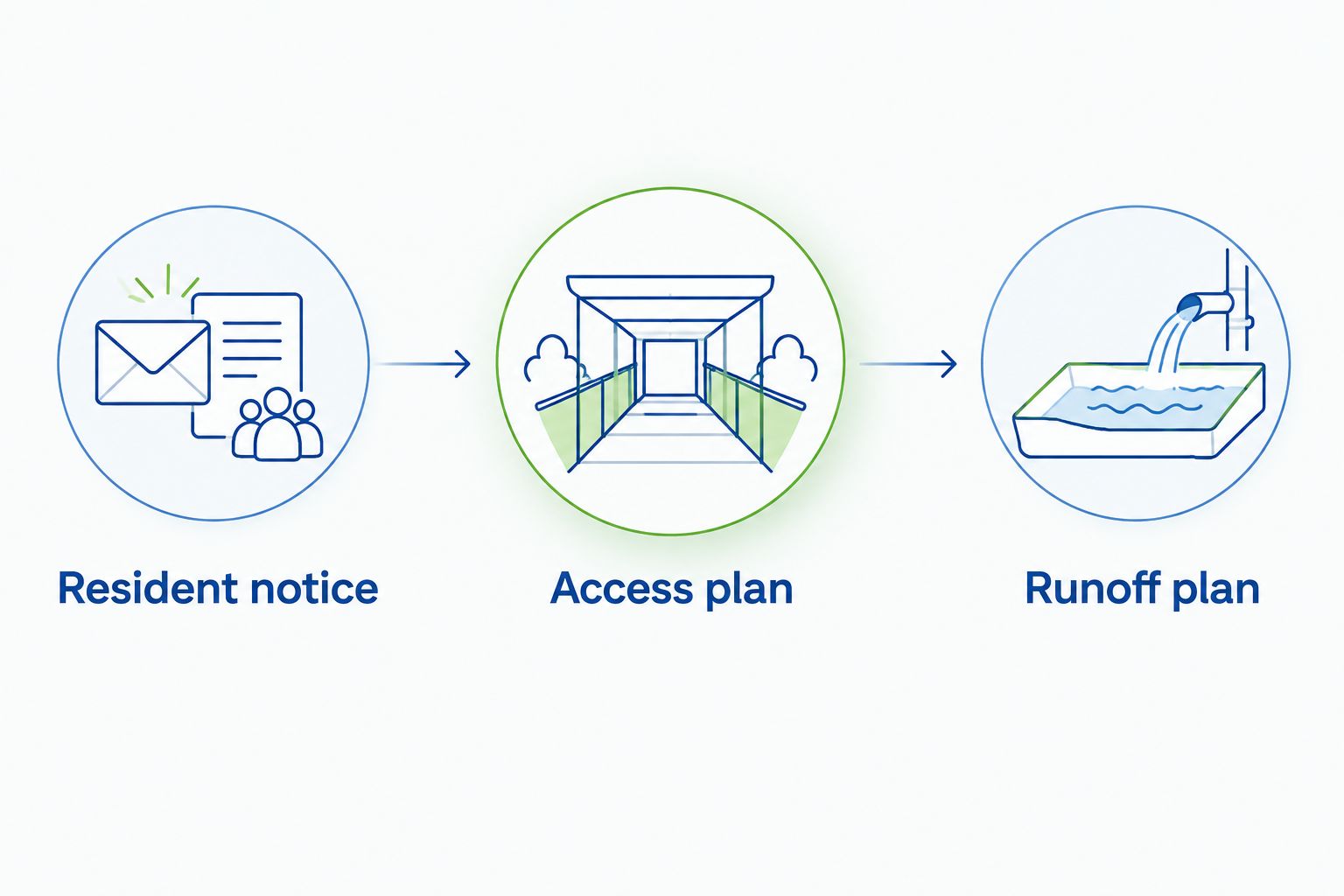
Coordinate roof work with other scheduled maintenance so crews do not block each other’s access. Keep the requirements specific enough for a property manager to verify on arrival.
- State the work areas and resident preparation requirements.
- Protect pedestrian routes and maintain agreed access.
- Identify vehicles, furniture and belongings to relocate.
- Document plant protection and chemical-exposure controls.
- Identify drainage controls and wash-water handling.
- Provide a contact for access problems and complaints.
6. Verify insurance, warranty instructions and authorization
Request insurance documentation and route it through the association’s normal review process. A certificate is evidence to review, not permission to skip questions about the proposed operations. Ask your insurance adviser to resolve coverage or endorsement questions rather than interpreting them from a sales proposal.
Questions about pressure washing and roof warranties belong in scope approval, not in a dispute after cleaning. Compare the proposed method with the actual roof manufacturer’s written maintenance requirements; do not assume every roof warranty treats cleaning identically.
Use 2 approval gates in your 2026 project file: approval of the written scope, then authorization to mobilize after required documents and notices are complete. These gates help prevent scheduling pressure from becoming an informal change to the board’s decision.
- Review current insurance evidence through the appropriate adviser.
- Resolve roof-maintenance and warranty requirements in writing.
- Identify the contractor’s onsite decision-maker.
- Record the board’s authorization and any conditions.
- Require approval before changing methods or included areas.
7. Close out the work before marking it complete
Walk the accessible areas with the property manager and contractor. Compare completion photographs with the original condition log, using the same building identifiers. Distinguish incomplete cleaning from remaining discoloration, pre-existing defects and work excluded from the agreement.
Do not use a distant photograph as proof that gutters, landscaping and resident areas were left in the agreed condition. Review those areas separately. Log questions while the scope and site conditions are still easy to verify.
Save the completed 2026 record with the scope, approvals, notices, insurance documents and photographs. That file supports the next inspection without forcing a future board to reconstruct the project from email fragments.
- Compare completed areas with the approved building list.
- Record unresolved items and who will address them.
- Inspect accessible landscaping, pathways and drainage areas.
- Confirm removal of equipment and work-related debris.
- File closeout photographs and the final work record.
Compare roof-cleaning options for your HOA
Choose the option that fits the roof and the association’s responsibilities. These approaches serve different purposes; none replaces an assessment of material, condition and access. Compare limitations alongside benefits before requesting authorization.
| Option | Best for | Main benefit | Key limitation |
|---|---|---|---|
| Board-led documentation and monitoring | Establishing scope before procurement | Organizes observations and maintenance records | Does not remove contamination or diagnose hidden defects |
| Professional low-pressure roof cleaning | Roofs whose care instructions support the proposed treatment | Combines treatment with controlled application and site protection | Chemistry, access and runoff still require careful management |
| Roof-compatible debris removal | Loose debris where the selected method suits the material | Targets debris without treating every roof issue as staining | Does not address every stain or underlying defect |
| Pressure-based cleaning | Surfaces expressly suited to the proposed pressure and technique | Provides mechanical cleaning where appropriate | Unsuitable pressure or technique can damage roofing |
| Roofing inspection or repair before cleaning | Known leaks, displaced materials or uncertain condition | Resolves repair questions before maintenance work | Does not replace a separate cleaning scope |
Professional service reduces the board’s hands-on work, not its approval responsibilities. Pressurewashingca offers roof cleaning and exterior stain removal, but those service categories alone do not establish whether repairs, solar-panel cleaning or every affected surface are included. Put those boundaries in the estimate request.
Common mistakes HOA boards make
Approving a community-wide job from one roof photograph
A single image cannot establish every building’s material, access needs or condition. Use a building inventory and require the proposal to identify exceptions. Uniform appearance does not establish uniform maintenance requirements.
Treating the lowest total as the same scope
An estimate without protection, runoff management or closeout requirements is not directly comparable with one that includes them. Resolve scope differences before the board votes. Keep the comparison focused on included work and responsibilities.
Issuing resident notices before confirming access
A notice becomes confusing when the actual work sequence requires different parking restrictions or patio access. Confirm the site plan first, then distribute instructions that match it. Name a contact who can resolve access questions during work.
Asking residents or volunteers to handle roof access
Volunteer availability does not establish safe access or suitable training. Keep board participation focused on documentation and decisions. Require the contractor to explain access arrangements and protections before mobilization.
FAQ
What should an HOA board do before scheduling roof cleaning?
Confirm maintenance responsibility, document roof condition and approve a written scope before scheduling roof cleaning. The scope should identify buildings, methods, access, property protection, runoff handling and exclusions.
Is soft washing always the right choice for an HOA roof?
No. The correct cleaning method depends on the roof material, condition and applicable manufacturer instructions. Low-pressure application still requires suitable chemistry, controlled application and property protection.
How often should an HOA schedule roof cleaning?
Set the schedule from documented condition and applicable maintenance instructions rather than a universal interval. Review previous work records and inspect for contamination, debris and repair concerns before authorizing another cleaning.
Can roof cleaning repair a leak or broken tile?
No. Roof cleaning removes contamination; it does not repair leaks or broken roofing materials. Refer suspected defects to a qualified roofing professional before cleaning the affected area.
What insurance should an HOA check before hiring a roof cleaner?
Request current insurance documentation for the proposed work and have the association’s insurance adviser review it. Resolve questions about coverage, required endorsements and any applicable workers’ compensation requirements before authorization.
Should an HOA include solar panels in the roof-cleaning scope?
Only include solar panels when they are expressly covered by a separate, appropriate cleaning specification. Roof cleaning does not automatically include panel cleaning, and equipment instructions need their own review.
How should an HOA compare roof-cleaning estimates?
Compare estimates against the same building list and written scope. Review methods, access, insurance documentation, runoff controls, exclusions and closeout records before comparing totals.
One last thing
Approve the stop-work rules before approving the start date. A newly discovered broken tile, unexpected drainage route or blocked access point needs a named decision-maker and an agreed response. Put that instruction in your 2026 work order; it is more useful on cleaning day than a general promise to be careful.
Related guides
- How often should HOAs schedule roof cleaning?
- HOA board inspections to spotless exteriors workflow
- Pressure washing for apartment complexes and multi-family properties