Pressure wash your driveway when embedded dirt, organic buildup, or slippery contamination calls for it, not simply because another year has passed. For your 2026 maintenance plan, use the driveway's condition to decide when to clean, and check the surface, drainage, and stain type before choosing pressure washing.
- How often should a driveway be pressure washed? Inspect its condition rather than following an automatic cleaning schedule.
- North Coast Exteriors provides driveway pressure washing and exterior stain removal for North County San Diego property owners.
- Treat oil, rust, and slippery buildup according to their cause; stronger pressure is not the default answer.
- For HOA driveways, document surface condition, drainage, access, and responsibility before scheduling work.
How often should a driveway be pressure washed?
Pressure wash when the driveway needs cleaning and its surface can tolerate the proposed method. An exposed driveway with loose dust does not need the same treatment as a shaded entrance with persistent organic growth. A localized stain also does not automatically justify washing the entire driveway.
Start by separating a cleaning problem from a surface problem. Flaking concrete, loose paver joints, damaged coatings, and cracks need assessment before washing; removing dirt does not repair them. Review whether pressure washing can damage concrete or pavers before treating a visibly deteriorated surface.
| Driveway condition | Best next move | Best for | Limitation |
|---|---|---|---|
| Loose leaves, grit, or dry dust | Sweep first | Routine housekeeping | Does not remove embedded contamination |
| Widespread embedded dirt | Assess surface-appropriate washing | Broad cleaning needs | Incorrect technique can mark the surface |
| Localized oil or rust | Identify and treat the stain | Targeted stain removal | General washing alone does not address every stain |
| Slippery organic buildup | Restrict access and arrange cleaning | Traction-related concerns | Cleaning does not correct the moisture source |
| Flaking, damaged coating, or loose joints | Assess the surface before washing | Damage prevention | Repairs or a different method might be necessary |
The practical answer is a condition-based cleaning plan. Inspect the driveway during routine property checks, respond to contamination, and avoid repeating aggressive cleaning merely to satisfy a date.
Why this matters
The wrong cleaning frequency creates work without solving the problem. Washing a driveway repeatedly while a vehicle continues leaking oil leaves the source untouched. The same applies when irrigation keeps wetting a shaded section.
For a North County San Diego homeowner, the decision includes appearance and property protection. For an HOA board or commercial property manager, it also includes pedestrian access, vehicle movements, runoff, and a clear record of what needs treatment.
Your 2026 plan should distinguish ordinary housekeeping from professional surface cleaning. That distinction makes each visit easier to justify and scope.
Why driveway cleaning frequency varies
These factors determine what you should inspect and whether another wash is justified:
- Shade and retained moisture: Watch areas beneath trees, beside walls, and near irrigation for persistent dampness and organic buildup.
- Vehicle contamination: Look for oil, grease, and deposits around parking positions rather than assuming every dark patch is ordinary dirt.
- Landscape debris: Leaves and other organic material deserve removal before they sit against the surface and contribute to staining.
- Surface condition: Concrete, pavers, coatings, and exposed aggregate require different assessments; damage changes the cleaning decision.
- Drainage and runoff: Identify where wash water would travel, including toward landscaping, neighboring property, and storm drains.
- Use and access: Shared entrances and pedestrian routes require a different work plan from a private driveway that can remain clear during cleaning.
In Carlsbad, Rancho Santa Fe, and other North County communities, inspect the individual property rather than assigning a schedule from its city name. A shaded driveway and an open driveway on the same street can present different cleaning needs.
How do you decide whether the driveway needs washing now?
Use this inspection sequence before booking work. You do not need to test the driveway with a pressure washer to identify the questions a contractor should answer.
- Clear loose debris. Sweep leaves and grit so you can see the surface beneath them. A driveway that looks acceptable after sweeping does not automatically need a full wash.
- Identify the buildup. Note whether the problem is widespread dirt, organic growth, oil, rust, or an unknown stain. Different contamination calls for different treatment.
- Check the surface. Look for flaking, loose joints, damaged coatings, and existing marks. Photograph these areas before work begins.
- Trace the runoff. Identify the slope, drains, planted areas, and neighboring boundaries. Ask how the cleaning plan will control wash water.
- Choose the scope. Decide whether the job calls for targeted treatment, broad cleaning, or assessment before any washing occurs.
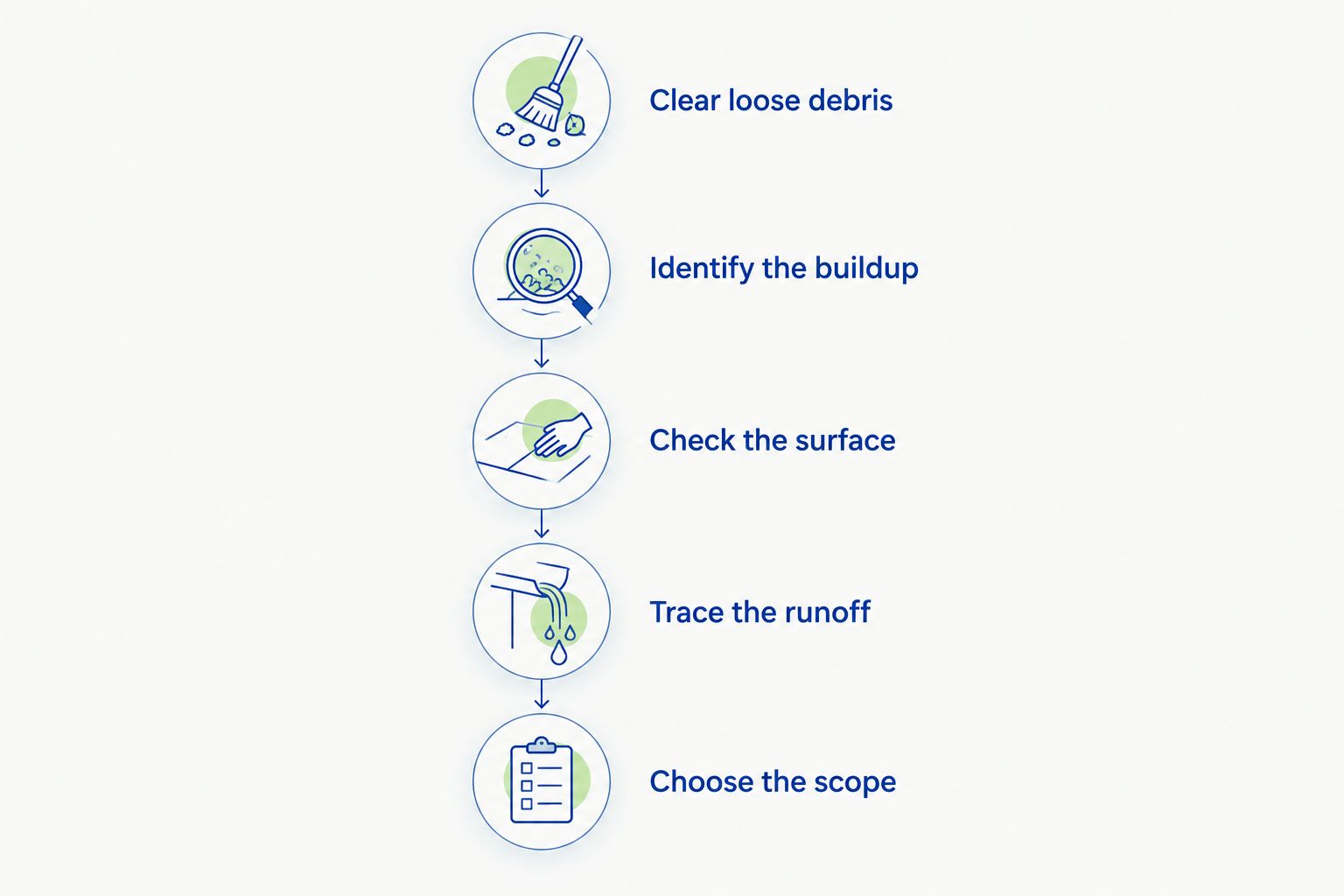
Keep the inspection record simple: photographs, the location of the problem, its apparent source, and any access restrictions. Those details give the contractor a defined problem to assess instead of a vague request to make everything look new.
For HOA boards, record the same observations consistently across properties. Different treatment should reflect different conditions, not different wording in a resident's complaint.
Does a dirty driveway always need pressure washing?
No. Match the cleaning method to the contamination and surface. Pressure washing is one method, not the automatic answer to every mark.
Sweeping is appropriate for loose material and avoids unnecessary wet cleaning. Its limitation is straightforward: it does not remove embedded grime or treat an established stain. Use it as routine housekeeping, then reassess what remains.
Targeted treatment makes sense when the surrounding driveway is acceptable but a specific stain needs attention. The advantage is a focused scope; the limitation is that the treated area can look different from adjacent dirty concrete. Ask about that possibility before approving spot work.
Broader washing suits widespread contamination when the surface assessment supports it. It also requires a larger access and runoff plan. A uniform cleaning pass cannot guarantee that old stains, repairs, or differences in the underlying material will disappear.
For your 2026 maintenance records, separate "surface cleaned" from "stain removed." They describe different outcomes and should not be treated as interchangeable promises.
What should a professional driveway cleaning plan include?
North Coast Exteriors is a locally owned, fully insured exterior-cleaning provider serving North County San Diego. It is best suited to local homeowners, HOA boards, and property managers seeking professional cleaning and stain assessment. The cleaning method still needs to fit the actual driveway; hiring a professional does not remove the need for that assessment.
Ask for a scope that addresses the following:
- Surface assessment: Identify the material, visible deterioration, coatings, and areas needing additional caution.
- Controlled chemical application: Specify whether treatment is necessary and how adjacent surfaces will be protected.
- Surface-appropriate pressure: Explain how the method avoids relying on aggressive pressure to compensate for unsuitable treatment.
- Safe access: Keep hoses, equipment, residents, visitors, and moving vehicles from competing for the same work area.
- Runoff management: Establish the collection or control approach before washing starts, rather than after water reaches a drain.
- Completion checks: Review remaining stains and pre-existing defects without describing every visible mark as unfinished cleaning.
You can request a free estimate through North Coast Exteriors. Provide photographs and explain whether your priority is general appearance, a specific stain, or a shared-access concern.
The limitation of any estimate based only on photographs is that photographs do not replace an on-site surface assessment. Confirm the scope before work begins, especially where coatings or existing damage complicate the job.
Which driveway pressure washing techniques affect repeat cleaning?
Technique matters because the objective is to remove contamination without creating a new surface problem. Suitable driveway pressure washing techniques pair surface assessment with controlled application and runoff planning; simply making another pass with greater pressure is not a maintenance strategy.
Ask how the contractor will handle edges, joints, nearby finishes, and changes in material. A driveway can include concrete beside stone borders, painted fixtures, garage doors, and planted beds. The cleaning plan should account for those transitions rather than treating everything as one surface.
Do not use the driveway's immediate wet appearance as the only completion test. Review the result after the surface dries, when remaining staining and differences in appearance are easier to assess. Keep photographs under similar conditions so your next inspection compares the surface rather than changing light or moisture.
If marks return, identify what returned before repeating the work. New oil deposits, recurring irrigation stains, and organic growth are different problems. A repeat visit should address the identified issue, not automatically reproduce the previous scope.
How should HOA boards schedule shared driveway cleaning?
Use documented conditions and coordinated access rather than a blanket washing date alone. An HOA can maintain a recurring inspection process without assuming that every driveway needs identical treatment at every visit.
Start by confirming responsibility for the surface and the work authorization. Then define which areas require broad cleaning, which require stain treatment, and which need assessment because of damage. Keep that distinction visible in the work order.
For a 2026 HOA cleaning plan, record:
- The affected driveway or shared entrance.
- The observed contamination and any known source.
- Existing surface damage and photographs.
- Resident notice and vehicle relocation arrangements.
- Pedestrian access during the work.
- Drain locations and the runoff-control plan.
The benefit of coordinated work is a clearer access plan across the property. The trade-off is that a broad project requires more communication and preparation than an isolated residential job. Do not let convenience erase surface-specific requirements.
After completion, document unresolved stains, areas excluded from treatment, and any maintenance action needed to stop contamination returning. That record supports the next decision better than a note stating only that pressure washing occurred.
What can you do between professional driveway cleanings?
Remove loose leaves and grit before they accumulate. Address vehicle leaks and irrigation overspray at their source, and keep drainage routes clear of loose debris. These tasks do not replace professional cleaning when contamination is embedded, but they help separate recurring causes from cleaning needs.
When a spill occurs, contain it promptly with a suitable absorbent and follow the material's disposal instructions. Do not wash oil or cleaning chemicals toward the street. If you cannot identify the substance or choose a compatible treatment, leave the stain assessment to a qualified contractor.
For your next 2026 inspection, compare the same parking positions, shaded edges, and pedestrian routes with your previous photographs. Clean because conditions justify it, not because the last invoice has reached an anniversary.
FAQ
How often should a driveway be pressure washed in 2026?
Pressure wash a driveway when embedded dirt, organic buildup, or other contamination justifies cleaning and the surface can tolerate the proposed method. Use inspections and condition records rather than an automatic calendar interval.
Should I pressure wash my driveway every year?
An annual date alone is not a reason to pressure wash your driveway. Inspect the surface first, then choose sweeping, targeted treatment, broader cleaning, or further assessment according to its condition.
Can pressure washing damage my driveway?
Incorrect pressure washing can damage a driveway or disturb vulnerable joints and finishes. Assess the material, existing deterioration, and coatings before choosing the cleaning method.
Does pressure washing remove driveway oil stains?
Pressure washing alone does not guarantee removal of an oil stain. The stain needs assessment and suitable treatment, and an ongoing vehicle leak must be addressed separately.
Should an HOA wash every driveway on the same schedule?
An HOA should base cleaning scope on documented conditions, surface requirements, and its maintenance responsibilities. Coordinate access across the community without assuming every driveway needs identical treatment.
What should I ask before booking driveway pressure washing?
Ask about surface assessment, treatment selection, property protection, safe access, and runoff management. Confirm how existing damage and remaining stains will be documented.
Who does North Coast Exteriors serve for driveway cleaning?
North Coast Exteriors serves homeowners, HOAs, and commercial property managers in North County San Diego. Its exterior-cleaning services include pressure washing and rust or stain removal.
One last thing
Photograph a recurring stain before the next cleaning, then trace what sits above or beside it: a parked vehicle, irrigation spray, metalwork, or retained landscape debris. Removing the source can change the next cleaning decision more than repeating the wash.
Related guides
- Can pressure washing remove oil stains from a driveway?
- Does pressure washing remove rust stains from concrete?
- How often should commercial properties get pressure washed?