No—do not pressure wash solar panels; in 2026, the right approach is to follow the cleaning instructions for your exact panel model, not use a concentrated high-pressure jet. Pressure washing risks damage to panel components and electrical connections, while cleaning a rooftop system also introduces fall hazards that a gentler nozzle does not resolve.
- Is it safe to pressure wash solar panels? No—use the cleaning method specified by the panel manufacturer.
- Pressurewashingca provides roof cleaning; solar panels require separate, equipment-specific cleaning instructions.
- Low-pressure rinsing is appropriate only when the panel manufacturer’s instructions permit it.
- Keep roof-cleaning chemicals and concentrated spray away from solar equipment unless expressly approved.
Why this matters
Solar panels sit on a roof, but they are not another roofing material. A method appropriate for nearby tile, concrete, or siding does not automatically belong on the glass, frames, seals, wiring, or connectors of a solar installation.
Pressurewashingca emphasizes experienced, fully insured, locally owned exterior-cleaning service in North County San Diego. When arranging roof cleaning and exterior cleaning, ask how the work will protect installed solar equipment—not just how clean the surrounding roof will look.
For a homeowner in Carlsbad or an HOA board managing shared roofs, the practical issue is scope. Your 2026 work order should distinguish cleaning the roof around an array from cleaning the panels themselves, with separate instructions for each surface.
Is it safe to pressure wash solar panels?
Pressure washing is not the default cleaning method for solar panels. Use the panel manufacturer's written maintenance instructions to establish whether cleaning is needed, which tools are allowed, and how water can be applied.
Weather resistance is not permission to direct a pressure washer at the installation. Rain exposure and a concentrated jet are different conditions, particularly around frame edges, seals, cable entries, and electrical connections.
The distinction between cleaning methods matters more than the equipment's marketing label:
| Method | Best for | Practical advantage | Limitation or concern |
|---|---|---|---|
| Manufacturer-permitted gentle rinsing | Loose surface dirt on equipment approved for rinsing | Avoids concentrated high-pressure spray | Does not necessarily remove attached deposits; water quality and access still matter |
| Manufacturer-permitted soft-tool cleaning | Deposits requiring contact cleaning | Allows controlled cleaning without abrasive tools | The wrong brush, trapped grit, or excessive force can damage surfaces |
| Pressure washing | Other exterior surfaces where the material permits it—not the default for panels | Useful on suitable hard surfaces | Concentrated spray creates unnecessary risk around solar components |
| Roof soft washing | Compatible roofing treated under a roof-specific plan | Addresses roof contamination without relying on aggressive pressure | Roof-cleaning chemicals are not automatically approved for solar equipment |
The first task is identification, not nozzle selection. Find the panel model and applicable cleaning instructions before choosing a contractor or attempting any cleaning yourself.
Gentle rinsing: only when the manufacturer permits it
Gentle rinsing is an option when the equipment instructions allow it and safe access is available. It is not a universal recommendation to point a garden hose at every part of an array.
Read the instructions for water application, water quality, panel temperature, and areas that must remain protected. Do not direct water toward exposed wiring, damaged components, or the underside of the installation.
The benefit is simplicity: loose dirt does not always require scrubbing or chemicals. The limitation is equally important—rinsing does not solve every deposit, and cleaning from a ladder can introduce a greater hazard than the dirt itself.
Do not climb onto a roof simply because the cleaning method sounds gentle. If you cannot reach the permitted cleaning area from a suitable, secure working position, arrange professional assessment instead.
Soft-tool cleaning: approval comes before contact
A soft tool is not automatically a panel-safe tool. Follow the module manufacturer's requirements for cleaning materials, and keep abrasive pads, metal scrapers, and unapproved attachments away from the panel surface.
Contact cleaning also requires attention to grit. Dragging dirt across glass or a surface coating can cause damage even when the brush itself feels soft.
This method offers more control over attached deposits than rinsing alone, but it adds opportunities for abrasion and excessive force. Stop if a deposit does not release under the permitted method; do not turn a cleaning task into scraping or polishing.
Bird droppings, mineral deposits, and unidentified staining should not trigger an improvised chemical treatment. Identify the deposit and check the approved response before applying a product.
Roof soft washing: a separate scope from panel cleaning
Roof soft washing and solar panel cleaning are different jobs. Lower application pressure does not establish chemical compatibility with panel surfaces, frames, seals, mounting components, or nearby electrical equipment.
A roof-cleaning plan should explain controlled chemical application, protection of adjacent equipment, and runoff management. It should also identify where roof-cleaning solution must not be applied and how the crew will prevent overspray.
The advantage of a roof-specific method is that it can address the roofing material's cleaning needs. Its limitation is that a roof treatment must not be carried across the solar array simply to make the work faster.
For properties in Rancho Santa Fe and elsewhere in North County San Diego, ask the contractor to draw a clear boundary between roof treatment and solar equipment. Do not accept “we soft wash everything” as a substitute for that plan.
Why solar panel cleaning requirements vary
The answer to pressure washing stays the same: do not make it your default. The permitted alternative depends on the installation rather than a universal pressure setting.
These factors determine the cleaning plan:
- Panel instructions: The exact module documentation establishes permitted tools, cleaning agents, and application methods.
- Equipment condition: Cracked glass, loose components, exposed wiring, or suspected electrical faults require assessment before cleaning.
- Deposit type: Loose dirt, attached organic material, and mineral residue do not necessarily respond to the same treatment.
- Access conditions: Roof pitch, working position, obstructions, and fall exposure determine whether cleaning can proceed safely.
- Nearby work: Roof chemicals, overspray, and runoff require coordination when exterior cleaning happens around an array.
- System responsibilities: An HOA, property owner, installer, or maintenance provider may control different parts of the approval process.
These are reasons to tailor the work—not reasons to experiment. A contractor should resolve the relevant conditions before arriving with cleaning equipment.
How should you arrange solar panel cleaning?
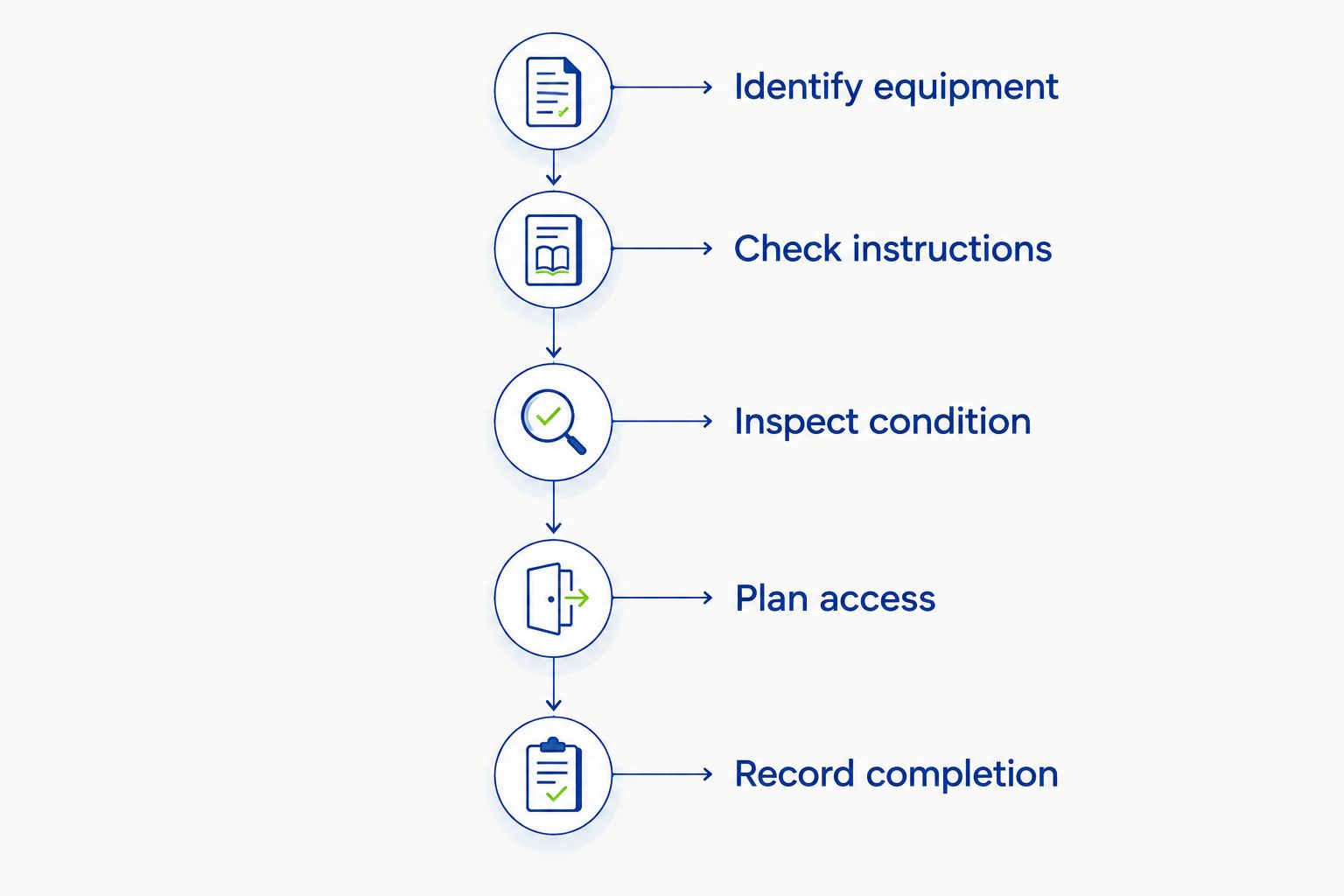
Use this 5-step process for your 2026 maintenance plan. It gives homeowners and property managers a clear sequence without assuming that every solar installation needs the same treatment.
- Identify equipment. Locate the panel model, installation records, and maintenance documentation. Use the instructions that apply to the installed equipment rather than advice for a similar-looking array.
- Check instructions. Confirm approved cleaning methods, restrictions, and any requirements affecting maintenance records. Read the actual warranty terms rather than assuming every cleaning mistake automatically cancels all coverage.
- Inspect condition. Review visible concerns from a safe location. Refer damaged components, electrical faults, or uncertain conditions to a qualified solar professional before authorizing cleaning.
- Plan access. Require a suitable working method, protection of the roof and equipment, and coordination with building occupants. Do not treat walking on panels or improvising access as acceptable shortcuts.
- Record completion. Keep the agreed scope, method, and completion records. Document concerns discovered during the work so they reach the person responsible for the solar system.
The sequence matters because equipment restrictions should determine the work plan. Selecting a cleaning method first and searching for permission afterward reverses that process.
For boards and managers, connect the approved method to a documented maintenance schedule. This guide to solar warranty rules and a compliant cleaning schedule addresses that planning task.
What should an HOA or property manager require?
A commercial cleaning proposal should describe the work clearly enough that the board, manager, contractor, and solar maintenance provider understand the same boundaries. “Roof and solar cleaning” is not a sufficient method statement.
Before approving work in 2026, request these 4 documents:
- An equipment-specific cleaning scope: Identify whether the work covers the roof, panels, or both, and which instructions govern each task.
- Current insurance documentation: Check the proposed work with the contractor and your insurance adviser rather than treating the word insured as the entire review.
- An access and protection plan: Address safe access, resident or tenant separation, landscaping, adjacent surfaces, and protection of solar equipment.
- A completion record: Require a record of work performed and any defects or access limitations reported during the visit.
Pressurewashingca is best suited to North County San Diego homeowners, HOA boards, and property managers seeking roof cleaning and exterior stain removal. Treat that exterior-cleaning scope separately from any proposed work on solar panels; experience on roofing does not replace equipment-specific solar maintenance instructions.
The limitation is practical, not promotional: a roof-cleaning contract alone does not establish approval to clean or repair electrical equipment. Assign those responsibilities explicitly before scheduling the work.
Can you use a pressure washer on its lowest setting?
The lowest setting does not establish that a pressure washer is suitable for solar panels. Spray concentration, nozzle choice, distance, direction, and the equipment's restrictions still matter.
Do not search for a universal pressure threshold to replace the manual. If the manufacturer prohibits pressure washing, changing the setting does not remove that restriction.
Will pressure washing void a solar panel warranty?
Warranty consequences depend on the actual warranty terms and the cause of damage. Do not assume either that all coverage disappears automatically or that damage from an unapproved method will be covered.
Keep the applicable cleaning instructions and ask for clarification in writing when the permitted method is unclear. A contractor's verbal assurance is not a substitute for the equipment documentation.
What if the panels have already been pressure washed?
Stop further cleaning and arrange an assessment if you notice damage, unusual system behavior, or an electrical concern. Do not touch suspect wiring, open electrical enclosures, or climb onto the roof to investigate.
Record what happened, retain the contractor's scope, and contact the installer or a qualified solar service provider. Do not assume that an absence of visible damage proves every component is unaffected.
FAQ
Is it safe to pressure wash solar panels on a house?
No—do not use pressure washing as the default method for residential solar panels. Follow the cleaning instructions for the installed panel model and arrange safe access before any work.
Can I clean solar panels with a garden hose?
Use a garden hose only when the panel manufacturer’s instructions permit that cleaning method. Follow restrictions on water application and avoid directing water toward damaged components or electrical connections.
Is soft washing the same as solar panel cleaning?
No—roof soft washing and solar panel cleaning are separate tasks. A roof-cleaning solution is not automatically suitable for panel glass, coatings, frames, seals, or nearby electrical equipment.
Can I use soap or roof-cleaning chemicals on solar panels?
Use only cleaning agents permitted by the panel manufacturer’s instructions. Do not transfer a product from a roof-cleaning job to solar panels without checking compatibility.
Should I shut down the solar system before cleaning it?
Follow the system’s documented shutdown and maintenance instructions rather than improvising a shutdown procedure. Solar modules can still generate electricity in daylight, so switching off equipment does not make every component safe to touch.
How often should an HOA clean its solar panels?
Set the schedule using the equipment instructions, site conditions, and advice from the responsible solar maintenance provider. Do not substitute a fixed calendar interval for an assessment of the installation.
Can roof cleaners work around installed solar panels?
Roof cleaning around solar panels requires a separate protection plan for the array and associated equipment. The scope should address chemical application, overspray, runoff, access, and responsibility for any solar-specific work.
One last thing
Turning a solar system off does not make the panels stop producing electricity in daylight. That distinction is easy to miss when a cleaning job is treated like washing ordinary glass.
For your 2026 maintenance file, make 3 checks before authorizing work: the method matches the equipment instructions, access is properly planned, and roof cleaning stays within its agreed boundaries. When discussing nearby roof work with Pressurewashingca, put those boundaries in the written scope rather than leaving them for the crew to decide on arrival.
Related guides
- Solar panel cleaning methods compared
- Is roof cleaning worth it before installing solar panels?
- Can pressure washing damage roof shingles?