Professional pressure washing is worth it in 2026 when the job requires surface-specific treatment, roof access, stain identification, or protection of shared property. You are paying for experienced judgment and a controlled cleaning process, not simply stronger equipment; cleaning does not repair damaged surfaces or eliminate the source of recurring stains.
- Is professional pressure washing worth it in 2026? Yes, when surface protection, roof access, or shared-property coordination requires experience.
- Pressurewashingca provides roof cleaning, pressure washing, and stain removal for North County San Diego homeowners and property managers.
- Choose a method based on the surface and stain, not the machine’s maximum pressure.
- Compare written scopes, insurance, runoff management, and exclusions before approving exterior cleaning.
Why this matters
A driveway, tile roof, painted wall, and shared walkway do not need the same cleaning approach. Treating them alike turns a maintenance task into an avoidable repair problem.
For North County San Diego homeowners and HOA boards, the useful question is whether a contractor brings controls you cannot reasonably provide yourself. Start with the failure points: pressure washing damage to concrete or pavers is a practical reason to examine technique before hiring or renting equipment.
Real exterior-cleaning experience, current insurance, and local accountability belong at the beginning of that decision. None replaces a clear explanation of how the work will protect your property.
Is professional pressure washing worth it in 2026?
Hire a professional when the consequences of a mistake exceed your ability to inspect, clean, and protect the site yourself. Roof access, uncertain coatings, persistent stains, and occupied commercial areas all deserve more planning than a straightforward rinse.
Use this comparison to choose between professional work, limited DIY cleaning, and postponing cleaning for repairs. Each choice has a legitimate use and a clear limitation.
| Approach | Best for | Main advantage | Main limitation |
|---|---|---|---|
| Professional cleaning | Roofs, difficult stains, sensitive surfaces, and shared properties | Combines surface assessment, treatment selection, and site protection | Requires contractor screening and an agreed scope; results still depend on surface condition |
| Limited DIY cleaning | Accessible, sound surfaces with clear care instructions | Gives you direct control over a small maintenance task | Leaves equipment use, chemical handling, runoff, and damage risk with you |
| Repair before cleaning | Loose material, failing coatings, open joints, or active leaks | Addresses defects before water or treatment reaches vulnerable areas | Defers the appearance improvement and requires separate repair work |
A professional service is not automatically better because it uses commercial equipment. Its value depends on whether the operator recognizes unsuitable conditions, adjusts the method, and stops when cleaning would make the problem worse.
For a simple, accessible maintenance task, hiring out is a convenience decision. For a roof or an occupied HOA property, access and protection become central parts of the job.
When roof cleaning deserves professional handling
Roof cleaning is not a service to learn on a customer’s home—or your own roof. Access, footing, roof condition, and the manufacturer’s cleaning instructions all affect the work before treatment begins.
A roof-cleaning assessment should distinguish removable buildup from cracked material, failed coatings, or other defects. Ask how the contractor will inspect the roof, reach the work area, protect landscaping, and control treatment runoff.
Do not approve a roof-cleaning proposal that describes only pressure washing without identifying a roof-appropriate method. The written scope should explain what receives treatment and what requires repair or further evaluation instead.
The benefit of professional handling is the combination of access planning and material-specific cleaning. The limitation is equally important: cleaning is maintenance, not evidence that the roof is watertight or structurally sound.
For a Rancho Santa Fe homeowner preparing a property for presentation, appearance is a valid objective. Keep it separate from roof-condition claims, and arrange repair assessment when visible defects are present.
When commercial pressure washing earns its place
For HOA boards and commercial property managers, the job includes more than the dirty surface. Residents, visitors, vehicles, entrances, and adjacent landscaping remain part of the work area.
A useful commercial scope identifies which areas will close, how people will move around the work, and who communicates the schedule. It also identifies water access and the approach to wash-water containment or recovery where needed.
Professional commercial pressure washing is worth hiring when the contractor can explain how cleaning and property access will coexist. An attractive result does not excuse blocked entrances, uncontrolled overspray, or an undefined handover.
The trade-off is coordination. A manager still needs to approve access arrangements, notify occupants, and confirm that the proposed work matches the maintenance objective.
For a Carlsbad HOA reviewing exterior maintenance in 2026, compare proposals against the same map of included areas. Otherwise, a walkway-only proposal and a broader common-area proposal appear comparable when they are not.
Why the value of professional pressure washing varies
The value changes with the work required, not with a universal promise that professional cleaning always wins. These factors determine how much judgment and site control the job needs:
- Surface condition: Sound concrete presents a different task from cracked pavers, loose coatings, or deteriorated roofing. Existing damage needs documentation before cleaning.
- Stain type: Loose dirt, organic buildup, and rust staining call for different assessments. More pressure is not a substitute for identifying the material being removed.
- Access: Ground-level work differs from roof work or cleaning around obstacles. Ask how the contractor will reach the surface without creating unnecessary exposure.
- Property protection: Nearby plants, finishes, doors, equipment, and vehicles affect preparation and chemical application. Protection belongs in the scope rather than an informal assurance.
- Runoff management: Drain locations and surrounding areas influence containment and disposal planning. Ask how the proposed approach meets applicable local requirements.
- Occupancy: Shared walkways and active entrances require communication and work-area control. A residential driveway and an occupied commercial frontage are not interchangeable assignments.
These factors also explain why a quick description over the phone is not enough for every property. Photos help establish the task, but uncertain materials, access, or damage deserve closer assessment.
What should a professional cleaning process include?
A credible process makes the protective steps understandable before work starts. You should be able to connect each proposed method to the surface, the stain, and the surrounding property.
- Surface assessment: Identify materials, coatings, existing damage, and the cleaning objective. Record anything that cleaning will not correct.
- Site protection: Establish safe access, move or protect vulnerable items, and identify drains and nearby planting. For occupied sites, agree on work-area boundaries.
- Method selection: Match treatment and pressure to the material and contamination. Use a controlled test area when compatibility or appearance is uncertain.
- Controlled cleaning: Apply treatment deliberately, maintain surface-appropriate pressure, and manage runoff throughout the work. Adjust or stop if the surface responds poorly.
- Final inspection: Review the cleaned area and document remaining stains or defects. Confirm that access areas and surrounding property are ready for handover.
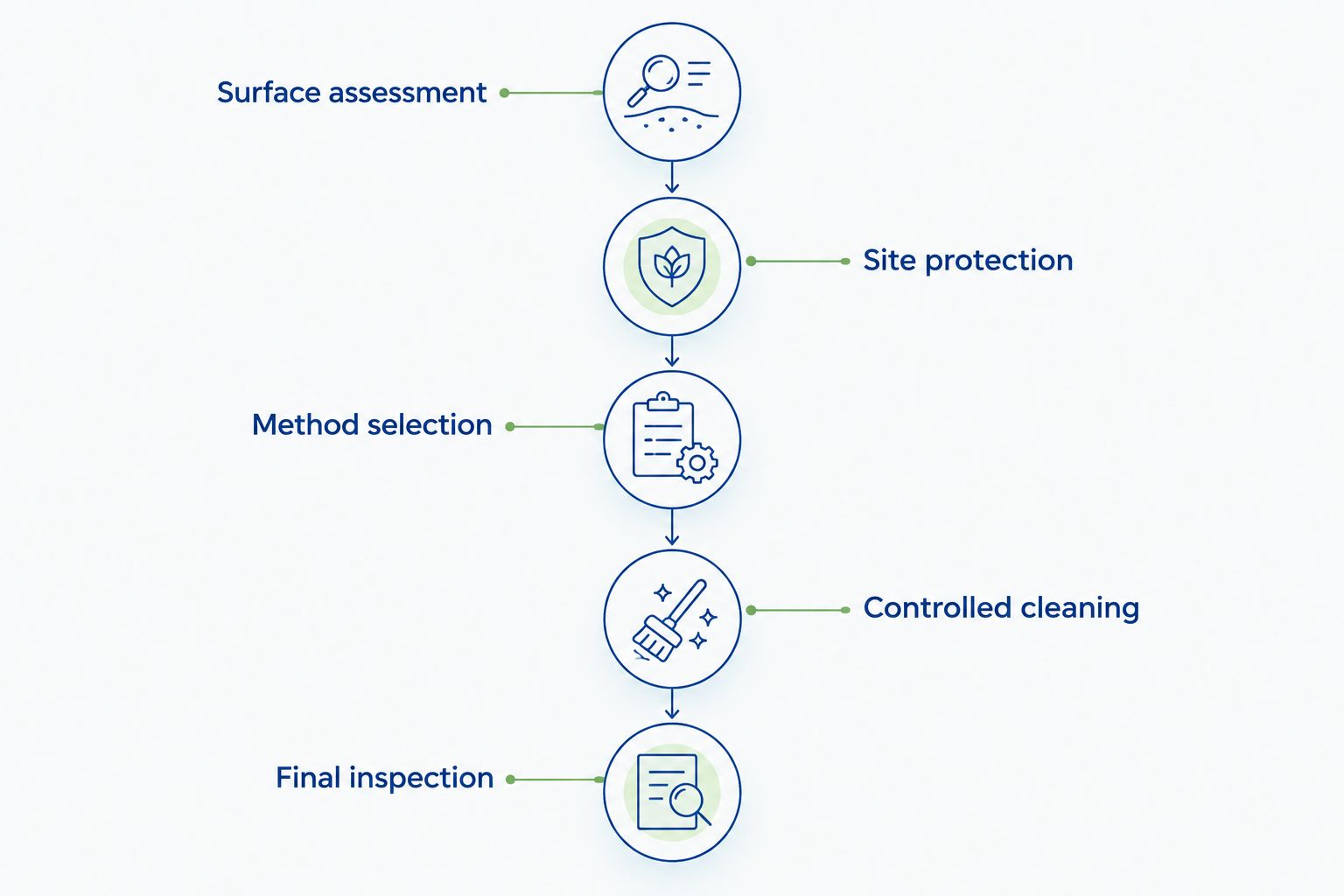
A contractor does not need to turn the estimate into a technical manual. The explanation does need enough detail for you to understand what happens near your roof, plants, drains, and occupied areas.
How should you compare estimates in 2026?
Compare the work before comparing the total. An estimate that says exterior cleaning leaves too much room for disagreement about surfaces, preparation, and stain treatment.
Ask each contractor to identify the included areas and the intended result. Separate general cleaning from specialist rust or stain removal, and identify anything excluded because of damage or uncertain compatibility.
Request current proof of insurance and confirm that it relates to the business performing the work. Insurance is a screening requirement, not a substitute for careful methods or an assurance that every possible loss is covered.
Also ask for examples of comparable exterior-cleaning work. A roof-cleaning example is more relevant to your roof than a photograph of a clean driveway; shared-property work should demonstrate attention to access and communication.
Before approving the job, resolve these points in writing:
- Which surfaces and boundaries are included?
- What protection and runoff controls are planned?
- Which stains or defects are outside the expected result?
- Who handles access instructions and occupant notices?
- How will completion and unresolved issues be documented?
Keep that scope with the completion photos. It gives homeowners and boards a clearer record than a general statement that the property was washed.
Is DIY pressure washing ever the better choice?
Limited DIY cleaning is reasonable when the surface is sound, accessible, and covered by instructions you can follow. The task should remain within your ability to control the equipment, protect adjacent areas, and manage wash water.
Read the equipment instructions and the surface manufacturer’s care guidance before starting. Stop if you expose loose material, change the surface texture, or cannot keep water away from vulnerable openings.
DIY loses its appeal when the task expands into roof access, uncertain chemical use, or persistent staining. Renting a machine does not supply the assessment that those conditions require.
Will professional pressure washing remove every stain?
Professional pressure washing does not remove every stain, and cleaning cannot reverse every discoloration. Surface damage and material changes are different from removable contamination.
Rust staining needs identification and surface-compatible treatment rather than an assumption that additional pressure will remove it. Ask the contractor to explain the likely result and any reason to test an inconspicuous area first.
If a sprinkler or another continuing source is creating the stain, cleaning addresses the visible effect. Correcting the source is a separate task that belongs in your maintenance plan.
Who should consider Pressurewashingca?
Pressurewashingca is best suited to North County San Diego homeowners, HOA boards, and property managers seeking roof cleaning, pressure washing, and stain removal. Those are the stated services and audiences, rather than a claim that every exterior problem needs washing.
Pressurewashingca offers locally owned, fully insured exterior-cleaning service and free estimates. Use the estimate to discuss safe access, controlled chemical application, surface-appropriate pressure, and runoff management for your property.
The fit has limits: cleaning is not roof repair, coating restoration, or a promise that a stain cannot return. A useful proposal separates the cleaning task from those other needs.
Request an exterior-cleaning estimate
Discuss roof cleaning, pressure washing, or stain removal for your North County San Diego property.
FAQ
Is professional pressure washing worth it in 2026?
Professional pressure washing is worth it in 2026 when surface sensitivity, roof access, difficult stains, or shared-property coordination requires experienced handling. Judge the service by its assessment, protective methods, and written scope—not equipment alone.
Can I pressure wash my roof myself?
Roof cleaning is a poor DIY starting point because roof access and material compatibility require separate safety and cleaning decisions. Follow the roof manufacturer’s guidance and have damage assessed before cleaning.
Is soft washing better than pressure washing?
Neither method is the right choice for every surface. Select the treatment and pressure according to the material, its condition, the contamination, and manufacturer guidance.
What should an HOA ask before hiring a pressure-washing contractor?
An HOA should ask for current insurance documentation, a defined scope, access arrangements, property-protection measures, and a runoff plan. Agree on occupant communication and completion documentation before work starts.
Does professional pressure washing fix damaged concrete?
Professional pressure washing does not repair damaged concrete. Document cracks, loose material, and existing surface deterioration before deciding whether cleaning should proceed.
Will rust stains come back after professional removal?
Rust stains can return when the source continues to affect the surface. Identify and address the source separately from the stain-removal treatment.
Does Pressurewashingca handle roof cleaning and commercial pressure washing?
Pressurewashingca provides roof cleaning, pressure washing, and rust/stain removal for homeowners, HOAs, and commercial property managers in North County San Diego. Request a property-specific estimate to establish the appropriate scope.
One last thing
Ask what should not be cleaned before asking how clean the property will look. The answer reveals whether the contractor recognizes loose coatings, damaged roofing, vulnerable joints, and stains that require a different treatment.
For your 2026 maintenance plan, keep cleaning and repairs as separate decisions. Approve the cleaning method only after you understand the surface condition, protective steps, and limits of the expected result.
Related guides
- Soft wash vs. pressure wash for homeowners
- How often should HOAs schedule roof cleaning?
- Does pressure washing remove rust stains from concrete?