Commercial pressure washing for schools is planned exterior cleaning that removes surface buildup while protecting campus materials, managing runoff, and keeping students clear of the work. North Coast Exteriors brings real exterior-cleaning experience, fully insured and locally owned service to North County San Diego; a school cleaning scope also needs explicit access restrictions, material checks, and reopening criteria.
- Commercial pressure washing for schools needs surface-specific methods, controlled access, and runoff management—not maximum pressure.
- North Coast Exteriors is best for North County San Diego property managers seeking professional exterior cleaning.
- Separate concrete cleaning, roof cleaning, and rust stain removal into clearly defined scopes.
- Choose a contractor by the written protection plan, insurance documentation, and inspection process.
Why commercial pressure washing matters for schools
A school campus cannot be treated like an empty parking lot. Entrances, accessible routes, classrooms, athletic areas, and food-service operations share the same grounds. Cleaning decisions must account for people moving through those spaces, not just the condition of the pavement.
The practical goal is a cleaner exterior without creating an avoidable interruption. For your 2026 maintenance plan, prioritize visible buildup, affected walking surfaces, and areas where cleaning requires restricted access. Keep cosmetic work separate from repairs: pressure washing does not correct broken pavement, failing coatings, or roof defects.
For district facilities teams in Carlsbad, Rancho Santa Fe, and surrounding communities, North Coast Exteriors provides professional pressure washing, roof cleaning, and rust/stain removal. The right school cleaning specification describes the surface, the method, and the protection plan—not simply the equipment.
School administrators and commercial property managers share a scheduling challenge, but schools also have student supervision and campus access requirements. Your facilities team should own those requirements, even when a contractor performs the cleaning.
How to plan school and district pressure washing
Start with a campus walk-through and a written scope. You can complete the planning steps with a site map, photographs, and a shared document before requesting contractor proposals. Professional cleaning becomes the execution path for work that requires specialist methods, equipment, or access controls.
1. Map the campus
Walk the property with the person responsible for daily operations. Mark entrances, covered walkways, lunch areas, service yards, drains, irrigation fixtures, and nearby landscaping. Record the surface condition before deciding how to clean it.
Organize the map into 3 planning zones: occupied areas, closed work areas, and protected access routes. These are proposed planning categories, not a substitute for your district's procedures. If an accessible entrance sits inside a proposed work zone, revise the sequence before approving the job.
Photograph existing cracks, loose coatings, damaged joints, and stains. Those records help distinguish pre-existing conditions from cleaning results. For a district with multiple campuses, use the same inspection headings so proposals describe comparable work rather than different interpretations of the scope.
- Mark pedestrian entrances and accessible routes.
- Identify drains, landscaped beds, and water access.
- Photograph defects and representative stains.
- Label areas that must remain operational.
- Separate cleaning requests from repair requests.
2. Define the work
Write each cleaning task as a surface-and-condition pair: concrete walkway with surface buildup, coated wall with staining, or roof area requiring specialist assessment. Avoid a blanket instruction to pressure wash the entire campus. Different materials need different treatment.
Routine sweeping and debris pickup are the manual starting point. Professional commercial pressure washing is the next step when the scope calls for controlled application, surface-appropriate pressure, and wash-water handling. North Coast Exteriors offers pressure washing, roof cleaning, and rust/stain removal; request a proposal that identifies which service applies to each area rather than assuming all stains respond to the same process.
For your 2026 specification, state the intended result without promising restoration to a new appearance. Weathering, damaged coatings, and embedded discoloration require separate judgment. A test area helps establish an acceptable result before crews clean the full surface.
- Name the material and observed condition.
- Remove loose debris before wet cleaning.
- Identify stains needing separate treatment.
- Specify a representative test area.
- List exclusions and unresolved repairs.
3. Choose cleaning methods
Match the cleaning method to the material, its condition, and applicable manufacturer guidance. Sound concrete, painted walls, coated athletic surfaces, and roof materials are not interchangeable. More pressure is not a substitute for identifying the surface.
For concrete, ask how the operator will avoid uneven cleaning and damage to weakened areas. For walls, ask how doors, windows, vents, and sensitive fixtures will be protected. Rust staining needs an assessment of the stain and substrate rather than repeated passes with a pressure washer.
Keep roof cleaning in a distinct scope. Access, material condition, chemical application, and surrounding property protection require their own plan. If your campus includes tile roofing, the guide to roof cleaning methods for tile roofs provides related reading; the final method still depends on the actual roof and its care requirements.
- Confirm the substrate before choosing equipment.
- Review manufacturer cleaning instructions.
- Test the proposed method discreetly.
- Protect openings and sensitive fixtures.
- Separate roof work from ground-level cleaning.
4. Plan runoff management
Trace where water will travel before cleaning begins. A drain beside a walkway is not automatically an approved disposal route. Your contractor should explain how wash water, loosened debris, and cleaning solution will be controlled under the applicable local requirements.
Begin manually: remove litter, leaves, and loose sediment before applying water. Then specify the collection, containment, or other approved handling method for the work area. A written runoff plan should connect the cleaning method to the site's actual drainage layout, not rely on a general environmental statement.
In your 2026 work order, assign responsibility for drain protection, landscaping protection, and cleanup. Ask how crews will monitor containment during the job and what stops work if water escapes the intended area. Do not accept an unsupported claim that a cleaning product makes uncontrolled discharge acceptable.
- Trace drainage paths before setup.
- Remove loose debris manually.
- Protect nearby landscaped areas.
- Specify wash-water handling responsibilities.
- Establish stop-work conditions for escaping runoff.
A useful site diagram shows the cleaning zone, the protected drain, and the collection area together. The arrangement must follow the site's drainage conditions and approved handling method.
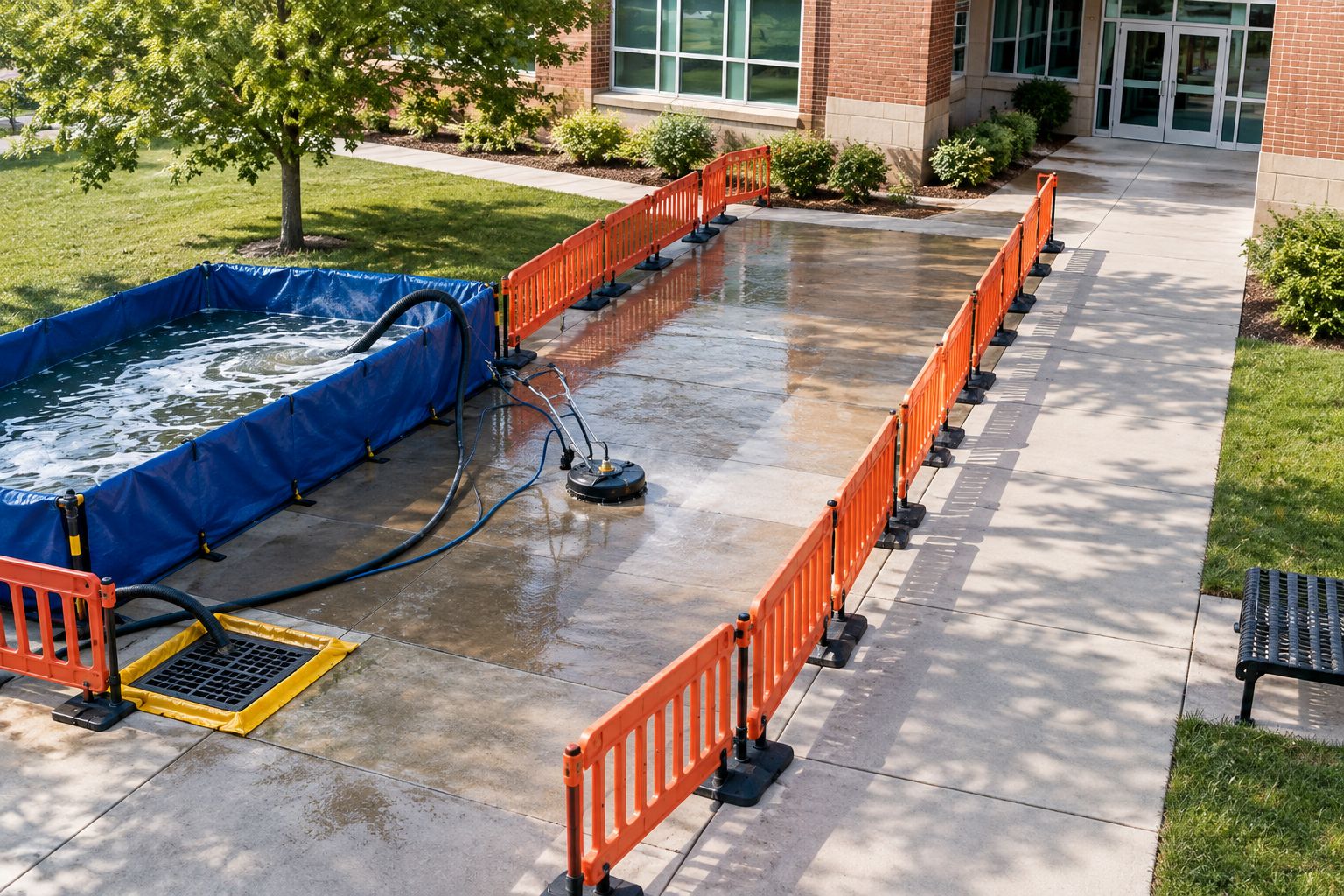
5. Schedule controlled access
Start with the school's actual operating calendar, not an assumption that an empty classroom means an empty campus. After-school programs, deliveries, athletics, maintenance crews, and community activities can overlap with exterior work. Confirm the affected areas with the campus contact.
Choose a work window that permits setup, cleaning, inspection, and release of the area. The contractor should not decide independently that a walkway can reopen because the washing has stopped. Your facilities team should define who checks the area and who authorizes access.
Write the 2026 schedule around operations rather than promising a standard completion time. Surface conditions and the approved scope determine the work. If the project spans several areas, require a sequence that preserves necessary access and prevents crews from moving barriers without authorization.
- Check instruction, athletics, and event schedules.
- Coordinate deliveries and service access.
- Maintain approved accessible routes.
- Assign a campus decision-maker.
- Define reopening checks and authorization.
6. Compare written proposals
Build the scope internally before comparing contractors. A proposal that includes drain protection, restricted access, and final inspection is not equivalent to one that lists only a cleaned surface. Ask each bidder to respond to the same requirements.
Request insurance documentation and confirm the district's vendor requirements through your procurement team. Do not treat a website statement as the entire qualification process. Ask who supervises the work, how method changes receive approval, and how crews document conditions discovered during cleaning.
For a local professional option, ask North Coast Exteriors to explain the proposed commercial pressure washing process and property protection measures for your campus. Its stated service coverage includes North County San Diego; school-specific qualification should still follow your district's requirements. Choose the written scope you can inspect, not an unsupported promise of the best result.
- Give every bidder the same site information.
- Request current insurance documentation.
- Confirm vendor and access requirements.
- Compare methods, protections, and exclusions.
- Identify the supervisor and approval process.
7. Inspect completed work
Use 2 inspection stages: a pre-work condition review and a post-work acceptance review. Compare the same locations and note any stain or defect that remains. Photographs are useful when they show matching views rather than unrelated close-ups.
Check more than appearance. Inspect nearby planting, doors, fixtures, drains, and the cleared access route. Confirm that temporary protection and cleaning equipment have been removed or intentionally retained under the approved plan. Record unresolved concerns before authorizing normal access.
Assign 1 campus contact to consolidate the acceptance notes. This avoids conflicting directions from several staff members while preserving district oversight. Carry the findings into the next maintenance scope: recurring stains need an investigation of the source, and deteriorated surfaces need repair assessment rather than stronger cleaning.
- Compare matching before-and-after views.
- Review the agreed test-area standard.
- Check adjacent surfaces and landscaping.
- Record unresolved stains or damage.
- Confirm release of the work area.
Compare school exterior-cleaning options
The best option depends on the task and your facilities team's training, equipment, and approved procedures. A contractor does not remove the school's responsibility to define access requirements, and an in-house team should not be assigned specialist work merely because equipment is available.
| Option | Best for | Main advantage | Key limitation |
|---|---|---|---|
| In-house routine cleaning | Debris pickup and minor cleaning within staff training | Fits established campus maintenance routines | Staff capability and equipment limit the scope |
| Specialist exterior-cleaning contractor | Defined pressure washing, roof cleaning, or stain-removal work | Brings a dedicated cleaning process to the specified task | Requires vendor checks, coordination, and a detailed proposal |
| Hybrid maintenance program | Schools separating routine upkeep from specialist work | Gives each task a clear operational owner | Handoffs need written responsibilities |
A hybrid program is best for schools that can handle routine upkeep but need specialist exterior cleaning. Staff can document conditions and remove loose debris; a qualified contractor can assess the more demanding work. Neither role should blur into unapproved roof access or stain-treatment experiments.
Compare proposals against your 2026 scope, including containment, property protection, and inspection. If a proposal leaves a method unspecified, request clarification before approval. A school cleaning contract should make responsibilities easier to understand, not leave the facilities team to interpret them on the workday.
Common mistakes schools and school districts make
Treating every exterior surface as concrete
A campus contains coatings, joints, roof materials, fixtures, and landscaped edges. Specifying one cleaning method across all of them ignores those differences. Require a material assessment and test area before approving broad treatment.
Scheduling around classes but overlooking other users
An instruction-free day can still include sports, deliveries, contractors, or community activities. Check the full campus calendar and retain a controlled route for authorized users. Barriers need a planned boundary and an accountable person, not an improvised placement.
Accepting clean-looking pavement as proof of completion
Appearance alone does not show whether drains, planting, or nearby fixtures received appropriate protection. Inspect the work area and adjacent property against the written scope. Document exceptions instead of treating every remaining mark as evidence that more pressure is needed.
Combining roof cleaning with a general walkway scope
Roof work introduces different access and material concerns. A general ground-level pressure washing instruction does not describe those controls. Require a separate roof assessment, method, and protection plan before including roof cleaning in the job.
Ignoring the source of recurring stains
Repeated cleaning does not resolve a continuing source of discoloration. Record where stains return and refer the source issue to the appropriate maintenance professional. Keep stain removal and underlying repairs as separate decisions with separate acceptance criteria.
FAQ
What’s the best approach to commercial pressure washing for schools?
The best approach is a written, surface-specific scope with controlled access, runoff management, and a final inspection. Start with a campus walk-through, then choose in-house or contractor work according to the task and staff capability.
Can a school stay open during pressure washing?
A school should keep users out of the active cleaning area and preserve approved access routes. Whether other campus areas remain open depends on the site layout, work sequence, and the school’s operating requirements.
Should school staff pressure wash the campus themselves?
School staff should perform only work covered by their training, equipment, and approved procedures. Routine debris removal and condition documentation can stay in-house, while specialist cleaning requires a separate capability assessment.
Is soft washing better than pressure washing for school buildings?
Neither method is better for every school surface. Choose the method from the material, condition, manufacturer guidance, and a representative test area rather than applying one technique across the campus.
How should a school compare exterior-cleaning contractors?
A school should compare contractors against the same written scope and vendor requirements. Review insurance documentation, access controls, cleaning methods, runoff handling, supervision, and acceptance checks before approving the work.
Can school roof cleaning be included with walkway cleaning?
School roof cleaning needs a separate assessment and defined work scope even when it forms part of the same project. Roof materials, access, application methods, and surrounding property protection require their own planning.
What should a district include in its 2026 cleaning specification?
A district’s 2026 cleaning specification should identify surfaces, existing conditions, approved methods, access restrictions, and runoff responsibilities. Include test-area approval, exclusions, inspection requirements, and the person authorized to reopen each work area.
One last thing
Write the reopening criteria before the contractor arrives. This turns completion from a vague impression into a campus decision: the agreed work is inspected, protection and cleanup are checked, and the authorized person releases the area.
For your next 2026 project, build that acceptance checklist alongside the scope. It is easier to resolve a disagreement when both parties know what completion means before work begins.
Related guides
- Commercial pressure washing for property managers
- Commercial pressure washing for churches and religious facilities
- Rust stain removal methods for concrete
