Commercial pressure washing for churches is planned exterior cleaning with the aim of keeping worship facilities presentable while protecting surfaces, entrances, and congregation access. For your 2026 maintenance plan, North Coast Exteriors brings real exterior-cleaning experience, fully insured and locally owned service, and a focus on controlled chemical application, safe access, surface-appropriate pressure, and runoff management.
- Commercial pressure washing for churches needs surface-specific methods, protected pedestrian routes, and a documented runoff plan.
- North Coast Exteriors fits North County San Diego religious facilities needing pressure washing, roof cleaning, and exterior stain removal.
- Schedule church exterior cleaning around worship, childcare, funerals, and deliveries—not just the main weekly service.
- Separate roof cleaning and rust stain removal from routine hardscape washing in the written scope.
Why commercial pressure washing matters for churches
A church entrance serves more than arriving worshippers. Staff, delivery drivers, children, volunteers, and visitors attending private events can use the same walkway throughout the week. Your cleaning plan needs to account for that shared access rather than treating the property as an empty commercial site.
Religious facilities also combine different materials: concrete paths, painted walls, decorative masonry, signs, doors, and roofs. Applying one cleaning method across all of them ignores their different maintenance requirements. Choose the cleaning method by surface condition, not by how dirty the entire property looks.
For churches in Carlsbad, Rancho Santa Fe, and wider North County San Diego, the practical starting point is a property walkthrough. Identify what needs routine washing, what needs targeted stain treatment, and what belongs in a separate roof-cleaning assessment. Put those distinctions into your 2026 work order before requesting approval.
North Coast Exteriors commercial pressure washing is best for North County San Diego religious facilities seeking professional exterior cleaning with property protection as a priority. The service is not a substitute for repairing damaged masonry, failed coatings, or roof defects.
How to plan church exterior cleaning in 2026
Map the property
Start with a manual walkthrough and a simple marked-up property map. A facilities manager and a staff member who knows the weekly calendar can identify problems without buying software or operating cleaning equipment. Photograph each proposed work area, including existing cracks, loose finishes, and stains.
Divide the site into 3 planning zones: congregation access, service access, and restricted areas. This is an organizing method, not a requirement to clean every zone at once. Congregation access covers entrances and primary walking routes; service access covers deliveries and maintenance activity; restricted areas include roofs and locations needing controlled entry.
Record each stain by location and appearance rather than diagnosing it from a distance. A brown mark near irrigation, for example, needs assessment before it is treated as ordinary dirt. Keep roof observations at ground level unless a qualified person has an appropriate access plan.
Close the walkthrough with a scope that another board member can understand:
- Mark entrances, accessible routes, ramps, steps, and gathering areas.
- Identify drains, landscaping, irrigation, outdoor fixtures, and electrical equipment.
- Photograph stained areas and pre-existing surface damage.
- Note classrooms, offices, memorial areas, and spaces with limited access.
- Separate routine cleaning from repairs and specialist treatment.
Choose surface methods
Review maintenance instructions and available building records before choosing a method. Your free first step is to identify the material, its condition, and any restrictions set by its manufacturer or installer. Do not assume that equipment suitable for a concrete walkway belongs on a roof or painted wall.
Pressure washing and lower-pressure chemical cleaning serve different purposes. Pressure can remove surface contamination from suitable hardscapes, but excessive force can damage finishes and vulnerable materials. Chemical treatment also needs care: product compatibility, controlled application, and protection of nearby surfaces matter.
North Coast Exteriors offers pressure washing, roof cleaning, and rust/stain removal. A professional assessment is the practical next step when your scope crosses those categories; keep each treatment separately described so the board knows what it is approving.
The soft wash versus pressure wash guide explains the method distinction, although your church still needs a site-specific plan. A method comparison does not replace a condition assessment.
- Request surface-appropriate pressure rather than a single setting for the whole site.
- Require a small test area before treating unfamiliar or delicate finishes.
- Separate roof cleaning from routine walkway washing.
- Specify targeted rust treatment instead of repeated pressure passes.
- Record areas excluded because of damage, uncertain materials, or access limits.
Verify contractor documentation
Prepare a basic request for scope and documentation yourself before inviting a contractor to assess the site. This makes proposals easier to compare and prevents the church board from approving an undefined promise to clean everything. Include your photographs, marked-up map, event calendar, and known maintenance concerns.
For your 2026 vendor file, request current insurance documentation and check that the named business matches the proposal. Ask who will supervise the work and how that person will handle unexpected damage, access conflicts, or an unsuitable surface. Insurance is a procurement requirement; it does not replace a careful cleaning plan.
North Coast Exteriors provides free estimates. Use the estimate discussion to ask how the proposed pressure washing, roof cleaning, or stain treatment will protect your particular property. General exterior-cleaning experience is useful, but your approval should rest on the written scope and answers about this site.
- Request current insurance documentation before work begins.
- Confirm the business name, site contact, and work supervisor.
- Ask for experience relevant to your roof and hardscape materials.
- Require written inclusions, exclusions, and responsibility for moving objects.
- Agree on a stop-work and notification process for unexpected conditions.
Control site access
Build the schedule manually from your church calendar before agreeing to a work window. Include worship, choir practice, childcare, counseling appointments, funerals, community meetings, and deliveries. An empty sanctuary does not mean the property is unoccupied.
Identify a usable pedestrian route before closing any work area. Do not direct visitors across hoses, treated surfaces, or active washing zones to reach an open door. If an accessible entrance is affected, resolve the alternative route with the facility's responsible person before work starts.
Use 1 designated church contact to approve changes during the visit. That person should know which rooms remain occupied and have authority to pause work when an unscheduled arrival changes the access plan. Give reception staff and ministry leaders the same instructions so visitors do not receive conflicting directions.
- Confirm occupied spaces and arrival times with each ministry lead.
- Mark closed work areas and the approved pedestrian route.
- Plan hose placement away from active entrances and crossings.
- Assign responsibility for moving seating, signs, and outdoor furnishings.
- Confirm when entrances can reopen after inspection.
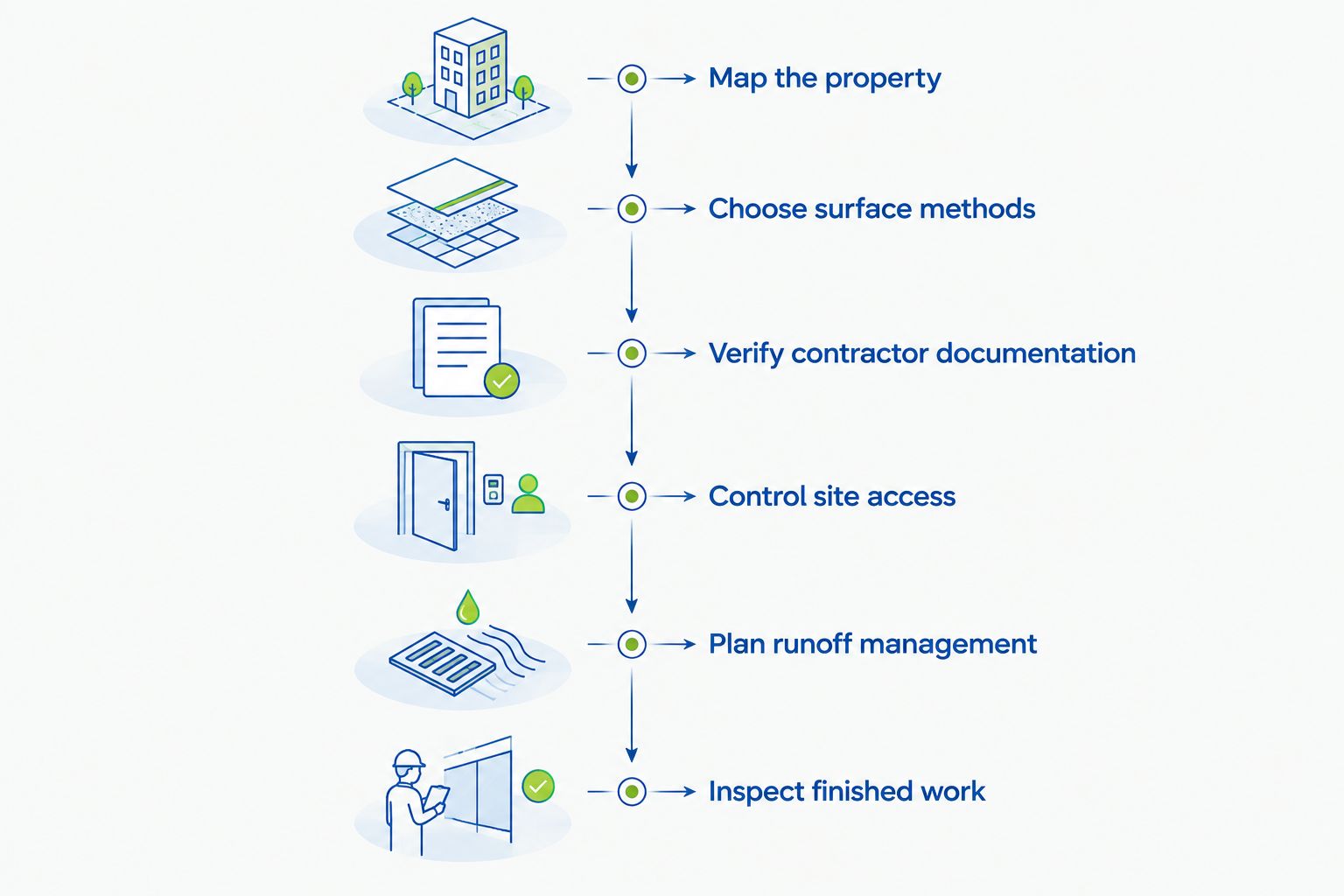
Plan runoff management
Locate drainage points during the walkthrough, not after washing starts. Ask the contractor to explain where wash water will travel and how it will be contained, collected, or otherwise managed under applicable local requirements. Do not assume a nearby drain is an acceptable disposal route.
Chemical application needs its own protection plan. Identify planting beds, decorative finishes, door thresholds, ventilation openings, and adjacent areas that are outside the cleaning scope. Product label directions and surface compatibility should guide application; stronger treatment is not automatically better treatment.
A sloped entrance or courtyard can send water toward occupied spaces even when the washing happens elsewhere. Walk that route before work begins and identify the control points. Put responsibility for runoff equipment and disposal arrangements into the written scope rather than leaving it to a volunteer on cleaning day.
- Mark drains and the direction water flows across the site.
- Ask how wash water will be contained or collected where required.
- Confirm disposal arrangements against applicable local requirements.
- Specify controlled chemical application and protection of nearby materials.
- Set a pause point if water reaches an unplanned area.
Inspect finished work
Plan 2 walkthroughs: one before cleaning and one before reopening affected areas. The first records existing conditions; the second checks the agreed scope, surface condition, access routes, and any unresolved issues. Use comparable photographs rather than relying on memory.
Cleaning does not guarantee that every discoloration will disappear. Embedded staining, worn finishes, and damaged surfaces can remain after suitable treatment. If a mark persists, ask whether further treatment is appropriate instead of requesting more pressure by default.
For your 2026 maintenance record, document what was cleaned, what was excluded, and what needs repair or specialist attention. Schedule future assessments around observed conditions and facility use rather than promising a fixed cleaning frequency without inspecting the property.
- Compare completed areas with the approved scope and starting photographs.
- Check entrances, ramps, thresholds, and adjacent surfaces before reopening.
- Record remaining stains without automatically authorizing stronger treatment.
- Confirm removal of temporary barriers, hoses, and cleaning equipment.
- File completion notes with the church's maintenance records.
Compare cleaning options for religious facilities
Choose between options by the work required and your ability to control the site. A volunteer tidy-up and a professional exterior-cleaning visit solve different problems. Neither should be used to disguise a repair need.
| Option | Best for | Practical benefit | Key limitation |
|---|---|---|---|
| Manual housekeeping | Loose litter, leaves, and movable items | Staff and volunteers can prepare the property without washing equipment | Does not address bonded grime, roof growth, or embedded stains |
| In-house pressure washing | Limited suitable hardscapes with trained staff | Gives the facility direct control over small tasks | Requires equipment knowledge, surface assessment, access controls, and runoff planning |
| Professional commercial pressure washing | Larger hardscape areas and coordinated site work | Assigns cleaning and site controls to an exterior-cleaning contractor | Needs a documented scope and an agreed work window |
| Professional roof cleaning | Roof-specific cleaning after condition assessment | Separates roof access and material requirements from ground-level work | Does not repair leaks, broken materials, or roof defects |
| Specialist rust/stain removal | Identified discoloration needing targeted treatment | Matches treatment to the stain and affected surface | Results depend on the stain and surface condition |
For an occupied church, compare the protection plan as closely as the cleaning scope. A proposal that names the surfaces, access arrangements, and runoff controls gives your facilities committee a clearer basis for approval than a broad description of exterior washing.
Common mistakes church facilities teams make
- Scheduling around worship only. Childcare, office appointments, funerals, and community groups can keep entrances busy on other days. Check the full calendar before closing a route.
- Treating volunteers as equipment operators by default. Familiarity with the building does not establish pressure-washing competence. Keep volunteer preparation separate from work requiring training and site controls.
- Including sacred or decorative features without separate assessment. Memorial plaques, religious statuary, painted signs, and decorative masonry deserve individual review. Do not fold them into a general hardscape instruction.
- Approving roof work inside a walkway scope. Roof access, material compatibility, and drainage need separate planning. Require a roof-specific assessment rather than treating roof cleaning as an incidental add-on.
- Expecting cleaning to fix deterioration. Peeling coatings, damaged joints, and broken surfaces need maintenance decisions. Record those conditions and separate repair authorization from cleaning approval.
FAQ
What’s the best way to arrange commercial pressure washing for churches?
Start with a property walkthrough, a surface-specific scope, and the full facility calendar. Then agree on insurance documentation, pedestrian access, runoff management, and completion checks before approving work.
Can church volunteers pressure wash the building?
Volunteer status does not establish the training needed to pressure wash a building. Volunteers can handle suitable housekeeping and site preparation; equipment operation requires material knowledge, access controls, and a runoff plan.
Is soft washing better than pressure washing for a church?
The appropriate method depends on the surface and its condition, not the building’s religious use. Suitable hardscapes and delicate finishes need different treatment, and chemical application still requires protection measures.
Should church roof cleaning be included with walkway washing?
Church roof cleaning should have a separately defined scope, even when it is scheduled alongside walkway washing. Roof material, condition, access, and drainage require their own assessment.
How do we keep the church open during exterior cleaning?
Keep the church open only where occupied spaces have an agreed pedestrian route outside the active work area. Coordinate entrances, hoses, barriers, and reopening decisions with a designated facility contact.
Will pressure washing remove every rust stain on church concrete?
Pressure washing does not guarantee removal of every rust stain. Identified rust can require targeted treatment, and the result depends on the stain and the concrete’s condition.
What should our church board request from North Coast Exteriors?
Request a free estimate with a written scope for the proposed pressure washing, roof cleaning, or stain removal. Ask for current insurance documentation and site-specific details covering property protection, safe access, chemical application, and runoff management.
One last thing
Ask a staff member who regularly welcomes visitors to walk the planned access route before cleaning day. That person can identify the door a newcomer actually uses, not just the entrance shown on your maintenance map.
For your 2026 cleaning plan, approve the route people will use as deliberately as the surfaces you want cleaned. A clean courtyard is not a completed job while visitors still have to cross an active work area.
Related guides
- Commercial pressure washing services for property managers
- Roof-cleaning methods for tile roofs
- Rust stain removal methods for concrete
