Solar panels in San Diego should be cleaned when persistent dirt, bird droppings, or other deposits justify it under the panel manufacturer’s maintenance instructions—not on a universal calendar. For your 2026 maintenance plan, use ground-level observations and production records to decide when to arrange cleaning; roof access and electrical concerns require separate professional assessment.
- How often should solar panels be cleaned? In San Diego, use actual soiling and manufacturer instructions, not a universal interval.
- Solar panel cleaning does not automatically belong on the same schedule as roof cleaning.
- Persistent deposits justify assessment; an unexplained production decline also needs checks for shade, weather, and equipment problems.
- Keep pressure washing equipment away from panels unless the exact manufacturer instructions expressly permit its use.
How often should solar panels be cleaned in San Diego?
Clean solar panels according to their condition and manufacturer instructions, rather than booking the same interval for every property. A calendar reminder is useful for reviewing maintenance needs. It is not evidence that washing is necessary.
Before scheduling work, understand whether the proposed cleaning method belongs on solar glass at all. Start with the guide to whether pressure washing solar panels is safe, then check the instructions for your exact panel model.
Use this decision table to separate routine observation from cleaning and technical inspection:
| Response | Best for | Main benefit | Limitation |
|---|---|---|---|
| Continue monitoring | Panels without persistent visible deposits or unexplained performance changes | Avoids unnecessary roof access and washing | Ground-level views do not reveal every part of an array |
| Arrange cleaning assessment | Persistent bird droppings, adhered dirt, or accumulated surface contamination | Establishes whether cleaning is appropriate and how to perform it | Cleaning does not correct shade or equipment faults |
| Contact the solar installer | Fault alerts, visible damage, exposed wiring, or unexplained production changes | Addresses problems that washing cannot diagnose | Technical assessment and cleaning are different scopes |
You do not need to climb onto the roof to make the initial decision. Use an existing monitoring portal, photographs taken from a safe location, and the maintenance documents supplied with the system.
Why this matters
Unnecessary washing creates work without establishing a benefit. Delayed attention to persistent deposits creates a different problem: you lose track of the condition of an expensive electrical installation.
The practical goal is controlled maintenance, not spotless glass at any cost. Your 2026 plan should identify who reviews the system, what triggers a service call, and which methods the manufacturer permits.
For North County San Diego homeowners and property managers, panel care also needs coordination with roof work. A roof-cleaning contractor needs to know that panels, mounting hardware, cables, and electrical equipment are outside the scope of ordinary roof treatment unless specifically addressed.
Roof cleaning and solar panel cleaning are separate jobs, even when they happen during the same visit. Neither service automatically includes the other.
Panels without persistent deposits: keep monitoring
Best for: properties where observations and system records do not indicate a cleaning need. If accessible views show no persistent buildup, do not treat the passing of a calendar date as the sole reason to wash.
The advantage is restraint. You avoid arranging roof access or applying water without first identifying a maintenance need.
The limitation is visibility. A clean-looking lower edge does not establish that the entire array is clean, and a normal-looking production graph does not document the condition of every module.
Keep observations consistent. Save dated photographs from the same safe viewpoint and record noticeable changes rather than relying on memory. For your 2026 file, include the panel model and the applicable maintenance instructions alongside those photographs.
Panels with persistent deposits: arrange an assessment
Best for: arrays with adhered bird droppings, dirt accumulation, or other deposits that remain visible. Ask a qualified provider to assess the affected area and propose a manufacturer-compatible method.
The benefit is a specific scope: the provider can distinguish localized contamination from broader soiling. The limitation is that a cleaning visit cannot establish whether every production issue comes from dirt.
Describe what you see without diagnosing it. Tell the provider where the deposit is, whether it persists after rain, and whether the system has shown an associated change.
Do not scrape an unfamiliar deposit or apply a household stain remover to find out what works. Glass, coatings, frames, seals, and nearby roofing need their own material-appropriate treatment.
Panels with faults or damage: contact the installer first
Best for: systems showing alerts, visible damage, or unexplained operating changes. Cleaning is not the first response to cracked glass, loose components, damaged wiring, or an inverter warning.
Technical inspection addresses the electrical system rather than treating a symptom as surface dirt. Its limitation is equally clear: an installer’s inspection does not necessarily include cleaning.
Keep people away from damaged equipment and follow the installer’s instructions. Do not assume that switching off accessible equipment makes every panel or cable electrically safe; solar modules produce electricity when exposed to light.
If cleaning remains appropriate after inspection, obtain a separate scope. That prevents a washing contractor from being asked to solve an electrical problem.
Why solar panel cleaning frequency varies
Your property’s observed conditions matter more than a citywide rule. Use these factors to explain why an array needs attention, not to invent a fixed service interval:
- Manufacturer instructions. The panel model’s requirements govern acceptable maintenance methods and any stated schedule.
- Persistent contamination. Adhered bird droppings and visible deposits call for a different response than a light layer that clears naturally.
- Local exposure. Record actual nearby dust, vegetation debris, bird activity, or coastal residue rather than assuming every San Diego property experiences the same conditions.
- Rainfall results. Check whether rain removed the deposits. The occurrence of rain alone does not establish that the panels are clean.
- Production evidence. Review output alongside weather, shade, and system alerts before attributing a change to dirt.
- Access conditions. Roof slope, roof condition, panel location, and electrical equipment affect how cleaning can be performed—not whether aggressive methods become acceptable.
A coastal Carlsbad property and an inland Rancho Santa Fe property need separate observations. Neither address, by itself, establishes a cleaning requirement.
How do you build a practical cleaning schedule?
Build your 2026 schedule around review points and documented triggers. Keep the process simple enough that the homeowner, facilities contact, or HOA manager can maintain it.
- Find instructions. Identify the panel manufacturer and model. Obtain the maintenance guidance that applies to that equipment, including restrictions on water, tools, chemicals, and access.
- Record condition. Take photographs from a safe location. Note persistent deposits and any areas you cannot see without roof access.
- Review production. Check the monitoring portal for alerts and changes. Compare records in context rather than treating a cloudy period as proof that cleaning is overdue.
- Confirm scope. Ask the provider to describe the cleaning method, access arrangements, property protection, and exclusions before approving work.
- Review results. Retain completion photographs and service notes. Record whether visible deposits were removed without treating an immediate output change as a guaranteed financial return.
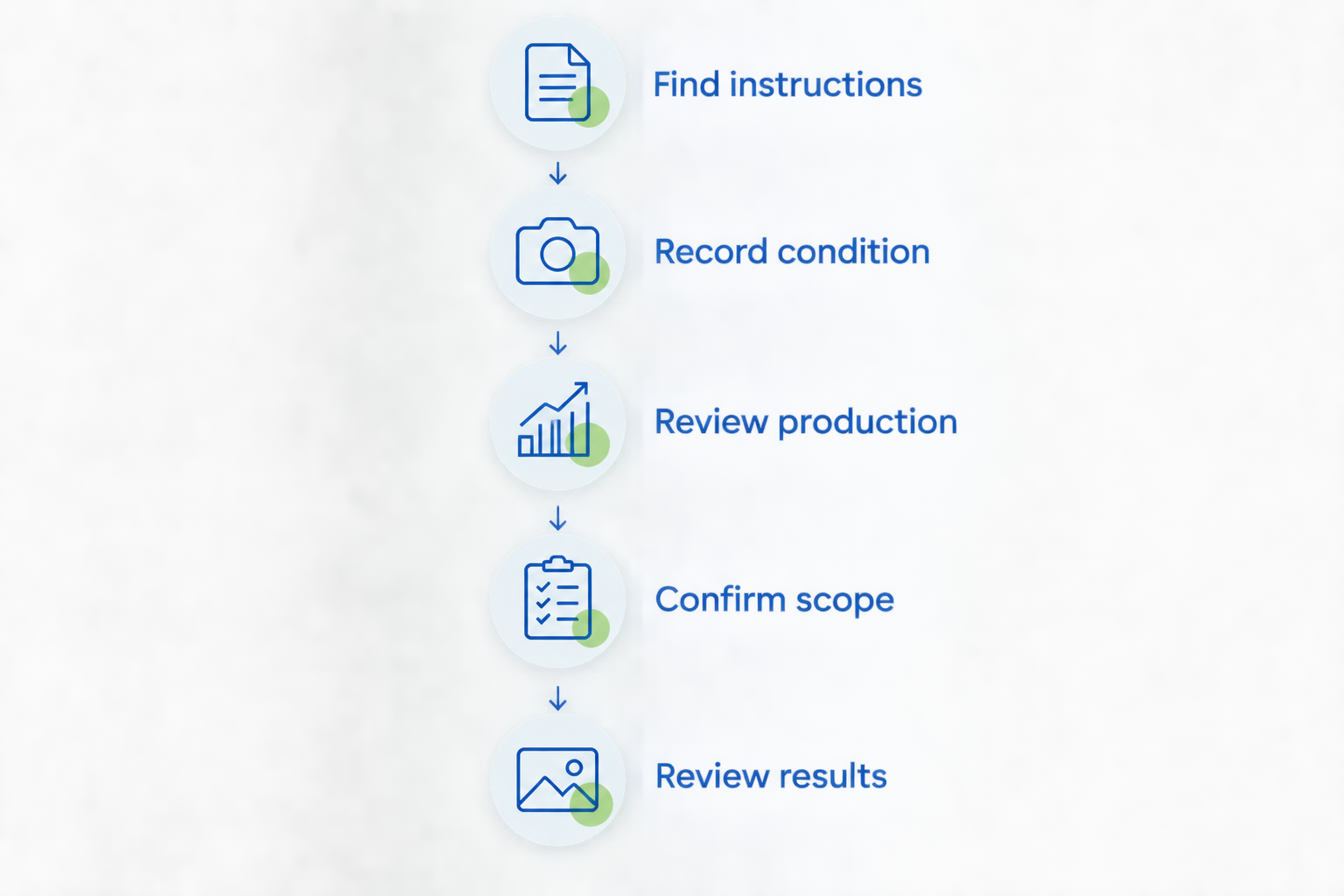
The schedule becomes useful when it records decisions, not just appointments. If an inspection finds no reason to clean, document that result instead of manufacturing a task to fill the calendar.
What should a solar panel cleaning scope include?
A useful scope names the equipment and explains the method. A description such as exterior washing leaves too much room for misunderstanding.
Ask the provider to address:
- Approved tools and water application. Identify the panel instructions being followed rather than accepting a general claim that the method is gentle.
- Chemical restrictions. Do not extend a roof-treatment chemical onto panels simply because it works on the adjacent roofing material.
- Safe access. Explain how workers will reach the work area without stepping on modules or treating the array as a walking surface.
- Property protection. Identify nearby roof materials, skylights, gutters, landscaping, and electrical equipment that need protection.
- Runoff management. Establish where wash water will travel and how the work will avoid creating problems below the array.
- Stop conditions. Require the crew to pause and report damaged components, unexpected wiring conditions, or unsuitable access.
These details matter more than an unsupported promise of a particular energy gain. Do not approve a cleaning method solely because it is described as low pressure or soft washing. Those terms do not establish compliance with your panel instructions.
Can rain replace solar panel cleaning?
Rain can remove some loose surface dirt, but it does not establish that adhered deposits have cleared. Check the result from a safe location instead of assuming that wet panels are clean panels.
The benefit of waiting for ordinary rainfall is avoiding unnecessary intervention where loose dirt clears naturally. The limitation is that bird droppings and other persistent contamination still require assessment when they remain.
For a 2026 maintenance record, note what changed after rain. A dated photograph is more useful than a general statement that the property had a wet week.
Should you clean panels when production drops?
A production drop is a reason to investigate, not proof that the panels need washing. Weather, seasonal sunlight, shade, and equipment issues also affect generation.
Start with system alerts and the installer’s troubleshooting guidance. Then review visible soiling and compare production records under reasonably comparable conditions.
Do not accept a promised recovery percentage without evidence specific to the system and the conditions being compared. Cleaning removes suitable surface contamination; it does not guarantee a particular electricity output.
How should HOAs coordinate roof and solar work?
HOA boards and commercial property managers should identify responsibility before requesting proposals. Establish who owns the array, who authorizes access, and whether an existing solar maintenance agreement controls the work.
Keep the roof scope and panel scope distinct. The contractor should describe protection for panels and electrical equipment during roof cleaning, while any panel cleaning needs its own approved method.
Include resident access, pedestrian areas, runoff routes, and completion documentation in the work plan. A coordinated visit can simplify administration, but convenience is not permission to use the same chemicals or equipment on every surface.
Pressurewashingca is best for North County San Diego homeowners and property managers seeking professional roof cleaning and exterior stain removal. Its locally owned, fully insured exterior-cleaning service is backed by real experience; panel-specific authorization and methods still need confirmation before solar work is included.
Pressurewashingca offers free estimates for its exterior-cleaning work. Discuss controlled chemical application, surface-appropriate pressure, safe access, and runoff management—and confirm exactly where the roof-cleaning scope stops.
FAQ
How often should solar panels be cleaned in San Diego?
Solar panels in San Diego should be cleaned according to their condition and the manufacturer’s maintenance instructions, not a universal interval. Persistent deposits justify assessment, while unexplained production changes also require checks for weather, shade, and equipment issues.
Do I need solar panel cleaning after every dry spell?
A dry spell alone does not establish a need for solar panel cleaning. Review actual deposits, manufacturer instructions, and system records before arranging work.
Can I pressure wash my solar panels?
Do not pressure wash solar panels unless the instructions for the exact model expressly permit the proposed method. A method suitable for concrete or roofing is not automatically suitable for panel glass, seals, or electrical components.
Will rain clean bird droppings off solar panels?
Rain does not reliably establish that bird droppings have been removed from solar panels. Check whether deposits remain and arrange a manufacturer-compatible cleaning assessment when needed.
Does lower solar production mean my panels are dirty?
Lower solar production does not prove that panels are dirty. Check weather, shade, system alerts, and visible contamination before treating cleaning as the solution.
Does roof cleaning include solar panel cleaning?
Roof cleaning does not automatically include solar panel cleaning. The proposal should separate roof treatment, panel protection, and any authorized panel-cleaning work.
Can I walk on the roof to check whether my panels need cleaning?
Do not climb onto the roof simply to check panel cleanliness. Use ground-level observations and existing monitoring records, then arrange qualified access when closer inspection is necessary.
One last thing
Ask what would make the provider recommend not cleaning. A useful answer identifies clean panels, manufacturer restrictions, damaged equipment, or unsuitable access—not an automatic appointment regardless of condition.
For your 2026 maintenance plan, keep panel instructions with the service record rather than buried in installation paperwork. Pressurewashingca’s roof-cleaning work and any separately authorized solar maintenance should follow clearly defined boundaries.
Related guides
- Solar warranty rules and a compliant cleaning schedule
- Solar panel cleaning methods compared
- Is roof cleaning worth it before installing solar panels?
- Roof cleaning for HOA boards