Yes, rust stain removal kits can work on roof tiles when the remover is approved for the exact tile material and finish, and the discoloration is actually rust. Removing the stain does not repair corroding metal, restore a damaged coating, or make roof access safe. Use a kit only when the tile manufacturer’s guidance and the cleaner’s instructions support the treatment; otherwise, arrange a professional assessment.
- Do rust stain removal kits work on roof tiles? Yes, but material compatibility and a dried test patch determine suitability.
- Pressurewashingca provides roof cleaning and rust/stain removal for North County San Diego homeowners, HOAs, and property managers.
- A driveway-approved rust remover is not automatically suitable for concrete, clay, glazed, or coated roof tiles.
- Identify the rust source, protect surrounding materials, and plan runoff control before treatment.
Do rust stain removal kits work on roof tiles?
A compatible rust remover can dissolve or chemically bind iron staining so it can be removed during the specified cleaning process. The difficulty is treating the stain without changing the tile underneath. A cleaner that removes orange discoloration but leaves a pale, rough, or dull patch has not delivered an acceptable result.
For a roof-cleaning decision in 2026, separate stain removal from roof preservation. Product suitability, controlled application, safe access, and runoff management all belong in the decision. Read about whether tile roof cleaning can crack or damage tiles before treating roof work as an ordinary household cleaning task.
| Approach | Best for | Main advantage | Main limitation |
|---|---|---|---|
| Material-approved rust remover | Confirmed iron staining on an approved tile surface | Targets the mineral stain | Incorrect chemistry can alter the tile or finish |
| Material-approved biological cleaner | Confirmed algae or other biological growth | Treats a different cause of discoloration | Does not substitute for rust-specific treatment |
| Professional assessment and treatment | Uncertain materials, difficult access, or shared-property roofs | Addresses identification, access, and property protection together | Requires scheduling and an agreed scope; complete removal is not assured |
Choose the method for the stain and surface—not for the strongest cleaning claim on the package.
Why this matters
Roof tiles form part of a weather-shedding system, not a washable patio. Foot traffic can break tiles, inappropriate chemicals can affect finishes, and badly directed water can enter places it should not reach. The cleaning method must account for the surrounding roof assembly.
For a Carlsbad homeowner or Rancho Santa Fe HOA board planning work in 2026, the useful question is not simply whether an orange mark will disappear. Ask whether the proposed treatment preserves the tile, controls chemical contact, and addresses the source of the stain. Appearance alone is an incomplete measure of success.
Concrete roof tiles: check cement and coating compatibility
Concrete contains cement-based material that is vulnerable to acid attack. Some rust removers use acidic chemistry, so a product suitable for one exterior surface is not automatically appropriate for a concrete roof tile. Surface coatings add another compatibility question.
Best for: A rust remover explicitly supported for the particular concrete tile and its finish. The advantage is targeted stain treatment; the limitation is that unsuitable chemistry can etch the surface or change its appearance.
Check the tile manufacturer’s cleaning instructions alongside the remover label. A broad claim such as suitable for masonry does not resolve every question about a colored, coated, or weathered roof tile. If the instructions conflict, do not improvise a compromise dilution.
Clay roof tiles: distinguish the tile body from its finish
Clay tiles are not interchangeable with concrete tiles, and glazed clay is not the same cleaning surface as unglazed clay. The glaze, any applied coating, nearby mortar, and exposed metal all need consideration. A cleaner must suit everything it will contact, not just the stained face.
Best for: Manufacturer-supported treatment matched to the clay tile’s actual finish. Targeted treatment avoids unnecessary chemical contact elsewhere, but a favorable result on the tile body does not prove compatibility with a glaze or coating.
Do not assume a glossy surface is chemically resistant to every rust remover. Stop if a test produces dulling, uneven gloss, or a visible boundary after drying. Removing more stain is not a reason to accept progressive finish damage.
Why rust stain removal results vary
These factors explain why the same kit is not a reliable answer for every roof:
- Tile material: Concrete and clay require material-specific compatibility checks.
- Surface finish: Glazes, color coatings, sealers, and previous treatments affect what the cleaner contacts.
- Stain identity: Orange-brown discoloration is a clue, not proof that iron staining is the only problem.
- Tile condition: Cracks, erosion, and existing coating failure change whether cleaning is appropriate.
- Stain source: Corroding flashing, fasteners, or other metal can continue depositing rust after cleaning.
- Application conditions: Contact time, drying, rinsing, and runoff must follow the product instructions and site conditions.
A 2026 treatment plan should record these conditions before choosing a chemical. Increasing strength or repeating applications without understanding the first result is not a substitute for diagnosis.
What should you check before opening a kit?
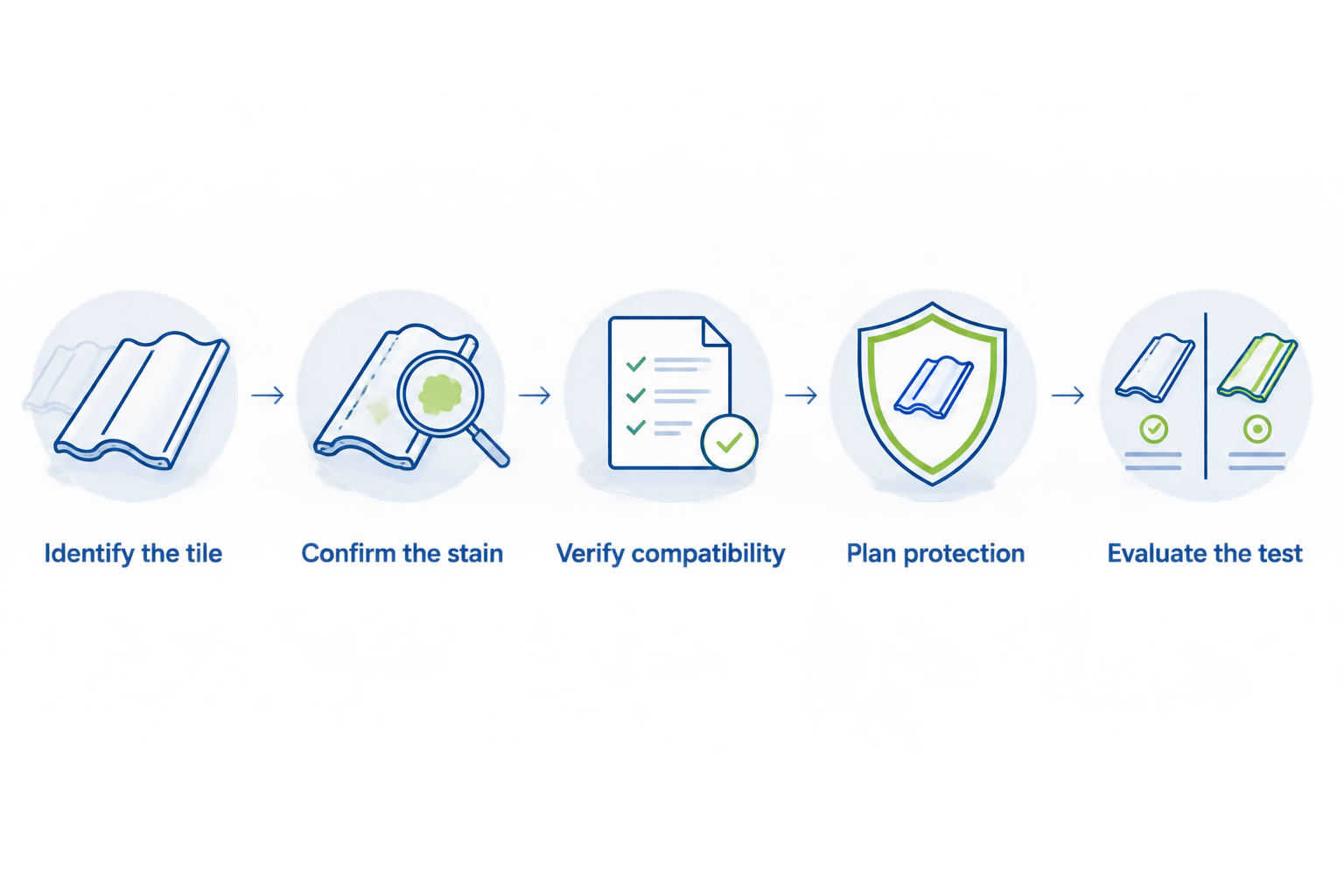
Use these 5 checks as a decision sequence, not as instructions to climb onto a roof. If completing a check requires unsafe access, stop and arrange an assessment from someone equipped for roof work.
- Identify the tile. Find the manufacturer and material in property records, installation documents, or information from the roofer. Do not identify the substrate from color alone.
- Confirm the stain. Look for a relationship between the discoloration and metal above it. Photographs help document a pattern, but uncertain staining needs assessment rather than a chemical guess.
- Verify compatibility. Read the cleaner label, safety data sheet, and tile-care guidance. Confirm restrictions involving finishes, metals, plants, and adjacent building materials.
- Plan protection. Identify where chemical and rinse water will travel. Include gutters, downspouts, landscaping, painted surfaces, pedestrian areas, and drainage connections.
- Evaluate the test. Have a small, inconspicuous area treated according to approved instructions, then assess it after drying. Compare stain reduction, color, texture, and sheen before authorizing wider work.
Keep 3 photos for your records: the wider stain pattern, the untreated test location, and the same location after drying. Take photographs from safe positions or have the contractor supply them. Similar lighting makes the comparison more useful; a wet surface can conceal differences you need to see.
What should a protective treatment plan include?
A suitable plan explains how the cleaner reaches the stain without unnecessarily treating the rest of the property. It also explains what happens if the test fails. Ask for practical details, not an assurance that the chemical is simply safe.
For North County San Diego properties, Pressurewashingca offers roof cleaning and rust/stain removal as a fully insured, locally owned service. Pressurewashingca is a fit for homeowners, HOA boards, and property managers seeking professional roof cleaning and exterior stain removal. Request a free estimate that addresses the actual tile, access conditions, and affected area.
Look for these details in the proposed scope:
- Controlled chemical application limited to the intended treatment area.
- Safe access that accounts for fragile tiles and fall exposure.
- Protection for plants, metals, painted surfaces, and nearby equipment.
- Surface-appropriate rinsing consistent with the tile and cleaner instructions.
- Runoff management that identifies collection and disposal requirements before application.
- A stopping point if the tile changes appearance or the stain does not respond as expected.
Professional treatment still has limits. Cleaning cannot reverse etching, replace missing coating, or repair a failing roof component. A sound proposal distinguishes removable staining from damage and identifies when a roofer needs to take over.
Can I use a driveway rust remover on my roof tiles?
Not unless the product instructions and tile manufacturer’s guidance support that exact use. A driveway and a roof can both contain concrete while having different finishes, construction details, drainage paths, and exposure risks.
A ground-level product demonstration does not establish roof suitability. Read the restrictions before considering a test, and do not treat an accessible spare tile as permission for unsafe roof access.
Will soft washing remove rust from roof tiles?
Soft washing is an application method, not proof that the cleaning chemistry removes rust. A treatment intended for biological growth does not automatically address iron staining, even when both problems appear on the same roof.
For your 2026 cleaning scope, identify rust removal separately from general roof washing. Ask which areas need which treatment and how the contractor will prevent incompatible chemicals from contacting each other.
Should an HOA approve a homeowner’s DIY roof treatment?
An HOA should check maintenance responsibility and approval requirements before authorizing roof treatment. Governing documents, roof warranties, and contractor requirements determine the process; neighboring approval is not a substitute.
For a 2026 board file, keep 2 written confirmations: who can authorize the work, and what treatment the responsible roof party accepts. Then document the test result, runoff plan, and any repair referral. This separates the approval decision from a contractor’s cleaning recommendation.
When should you stop and call a professional?
Stop before application if the tile material is unknown, compatibility is unresolved, or access requires walking on a fragile or steep roof. Stop during testing if you see surface roughening, color loss, dulling, or an uneven finish after drying. Those changes require reassessment, not a stronger mixture.
Never mix rust remover with bleach or other cleaning chemicals. Acidic cleaners mixed with hypochlorite bleach can release chlorine gas. If a roof has already been treated, disclose the product and treatment history before any further chemical work.
Pressurewashingca provides both roof cleaning and exterior stain removal, making the roof and stain relevant to the same service discussion. Ask for the proposed method and its limits in writing. A cleaning estimate should not stand in for a roof-repair assessment when corroded or damaged components need attention.
FAQ
Do rust stain removal kits work on concrete roof tiles?
Yes, a compatible rust remover can treat iron staining on concrete roof tiles. Confirm approval for the actual tile and finish because unsuitable acidic chemistry can attack cement-based surfaces.
Can I use rust remover on glazed clay roof tiles?
Use rust remover on glazed clay roof tiles only when the tile and cleaner guidance support it. Assess an inconspicuous test after drying for changes in gloss, color, or surface condition.
Is pressure washing enough to remove rust stains from a tile roof?
Pressure washing alone is not a reliable substitute for rust-specific treatment. Do not increase pressure to chase a persistent mineral stain; reassess the stain and material compatibility instead.
Will roof rust stains come back after I clean them?
Rust stains can return when corroding metal or another iron source continues depositing material on the roof. Cleaning removes staining but does not repair the source.
Can I mix rust remover with roof-cleaning bleach?
No. Never mix rust remover with bleach or other cleaning chemicals; acidic cleaners mixed with hypochlorite bleach can release chlorine gas.
How long should I leave rust remover on roof tiles?
Use only the contact time specified for the approved product and application. There is no universal roof-tile dwell time, and leaving a cleaner longer is not a safe way to increase its effect.
Should I replace a roof tile if rust remover does not work?
An unsuccessful cleaning test does not by itself mean a tile needs replacement. Have the stain and tile condition assessed before deciding between further treatment, accepting residual discoloration, or repair.
One last thing
The rust source can matter more than the stain. A narrow trail below metal deserves attention to the component above it before another cleaning attempt. Removing the mark while leaving active corrosion untreated leaves the cause in place.
Before approving work, ask for a photograph of the suspected source and a clear statement of whether it needs repair. That separates a cosmetic cleaning task from roof maintenance—and prevents a clean-looking result from hiding an unresolved problem.
Related guides
- Does soft washing remove black algae streaks from a roof?
- Roof cleaning for HOA boards
- Can roof cleaning void a roof warranty?