Yes—tile roof cleaning can crack tiles, damage surface finishes, or force water beneath the roof covering when access, pressure, or chemical application is poorly controlled. Foot traffic is a separate risk: even low-pressure cleaning can break tiles if workers step on unsupported sections. The protective approach starts with the tile manufacturer's instructions, a condition assessment, and a safe access plan—not a promise that one cleaning method suits every roof.
- Can tile roof cleaning damage tiles? Yes—foot traffic, unsuitable pressure, and incompatible chemicals create separate risks.
- Low-pressure roof cleaning still requires safe access, controlled application, and runoff management.
- Repair cracked or displaced tiles before cleaning; removing stains does not fix roof defects.
- Pressurewashingca provides professional roof cleaning for North County San Diego homeowners, HOAs, and commercial property managers.
Can tile roof cleaning damage tiles?
Yes. Tile damage can happen during access, treatment, or rinsing, so judging a contractor only by the equipment name misses important risks. A proposal that says soft washing still needs to explain how workers reach the roof, protect vulnerable areas, and handle existing defects.
Use this sequence before authorizing your 2026 roof-cleaning project:
- Identify the roof. Confirm the tile material, profile, finish, and applicable manufacturer cleaning instructions. Appearance alone does not establish which treatment is suitable.
- Document its condition. Record visible cracks, slipped tiles, damaged ridge pieces, and evidence of leaks before cleaning begins. Refer suspected roof defects to a qualified roofer.
- Review access. Ask where workers will stand, how equipment will reach the work area, and how unnecessary roof traffic will be avoided.
- Approve the method. Require an explanation of chemical compatibility, application control, rinse direction, and protection for nearby surfaces.
- Define stop conditions. Agree that new movement, breakage, or signs of water entry require stopping and reassessing the work.
For local service information, Pressurewashingca offers roof cleaning and exterior stain removal for homeowners, HOA boards, and property managers in North County San Diego.
Why this matters
A clean-looking roof is not proof of an undamaged roof. Cracks can be difficult to see from the ground, and tile is part of a roofing assembly that also depends on underlayment, flashing, and drainage details.
For a Carlsbad homeowner, the immediate concern is protecting the house. For an HOA board managing a 2026 maintenance program, the same job also requires consistent documentation, resident coordination, and a clear process for reporting damage. Specify how the property will be protected before discussing how clean the roof will look.
Foot traffic: low pressure does not prevent broken tiles
Roof tiles can crack under concentrated loads, particularly where a tile lacks adequate support or already has a defect. Hoses, tools, and repeated movement add handling risks that a low-pressure spray setting does not address.
Ask the contractor to explain the access plan for your actual roof, including steep sections, roof edges, and areas around penetrations. Do not accept a generic statement that all tiles can be walked on in the same way. Tile profiles and installation details differ.
A useful access discussion covers:
- Where workers need to reach and whether roof access is necessary.
- How hoses and equipment will be managed without dragging across vulnerable details.
- How cracked or displaced tiles will be identified and avoided.
- What happens if the planned access route proves unsuitable.
Do not climb onto the roof to check the contractor's work yourself. Request photographs and an explanation from the ground; use a qualified roofer when the concern is structural condition or an active leak.
Water pressure: force and direction both matter
An aggressive spray can damage a vulnerable tile surface or disturb existing defects. Water directed into laps, joints, or flashing details can also reach places that ordinary rainfall does not reach in the same way.
There is no single pressure setting that establishes suitability for every tile roof. Nozzle choice, working distance, spray direction, tile condition, and the manufacturer's instructions all affect the decision. A machine's maximum output does not describe the force actually applied at the roof surface.
For your 2026 scope of work, ask for the intended cleaning approach rather than a reassuring equipment label. The contractor should explain how treatment removes the buildup without relying on unnecessary force and how rinsing avoids driving water into vulnerable roof details.
More force is not a substitute for identifying the stain and selecting a compatible treatment. If a stained area does not respond as expected, reassess it instead of repeatedly attacking the same tile.
Chemical treatment: compatibility comes before concentration
Chemical-assisted cleaning can reduce the need for forceful mechanical cleaning, but the product still needs to suit the tile and its finish. Clay, concrete, coatings, nearby metalwork, and surrounding landscaping do not all respond to treatment in the same way.
Ask what will be applied and which manufacturer instructions support its use on your roof. Application control includes where the treatment lands, how it is kept away from vulnerable materials, and how rinsing and runoff are handled.
Do not treat a stronger mixture as evidence of a better service. The objective is appropriate cleaning, not maximum chemical strength. Likewise, an environmental claim does not establish compatibility with a particular roof finish.
A protective plan addresses landscaping, adjacent surfaces, and drainage routes together. It should explain how runoff will be managed rather than assuming gutters make the issue disappear.
Which cleaning approach fits the roof's condition?
Choose the process that fits the roof, not the process with the most reassuring name. The following comparison is a decision guide, not approval to use any treatment without checking the roof's instructions and condition.
| Approach | Best for | Benefit | Limitation or reason to stop |
|---|---|---|---|
| Manufacturer-compatible chemical-assisted cleaning | Roofs with treatable organic buildup and suitable finishes | Reduces reliance on aggressive mechanical removal | Requires controlled application, safe access, and runoff management |
| Manufacturer-permitted rinsing | Removing loosened residue where the roof instructions permit rinsing | Supports controlled removal without unnecessary surface abrasion | Poor direction or excessive force can drive water into vulnerable details |
| Postponing cleaning for roof assessment | Roofs with cracks, displaced tiles, active leaks, or uncertain condition | Keeps cleaning from proceeding over unresolved defects | Appearance improvements must wait until the condition is assessed |
Soft washing describes an approach, not a guarantee against breakage or water entry. Review the roof cleaning method for tile roofs alongside the instructions for your actual tile system.
Why tile roof cleaning risk varies
The same cleaning approach does not produce the same risk on every property. These factors deserve attention before a contractor commits to the work:
- Tile material and finish. The cleaning treatment must suit the material and any surface coating, not just the visible color.
- Existing condition. Cracked, loose, previously repaired, or displaced pieces change what can proceed without roofing attention.
- Roof access. Pitch, height, layout, and obstructions affect how workers reach stained areas and manage equipment.
- Application technique. Chemical compatibility, spray direction, working distance, and surface-appropriate pressure matter together.
- Water management. Roof openings, flashing details, gutters, and drainage routes affect where treatment and rinse water travel.
- Property surroundings. Landscaping, adjacent finishes, vehicles, and occupied walkways require protection and coordination.
A Rancho Santa Fe property with difficult access needs a property-specific plan, not an assumption based on neighborhood or roof appearance. The same applies to shared buildings where cleaning affects residents beyond the unit directly beneath the work.
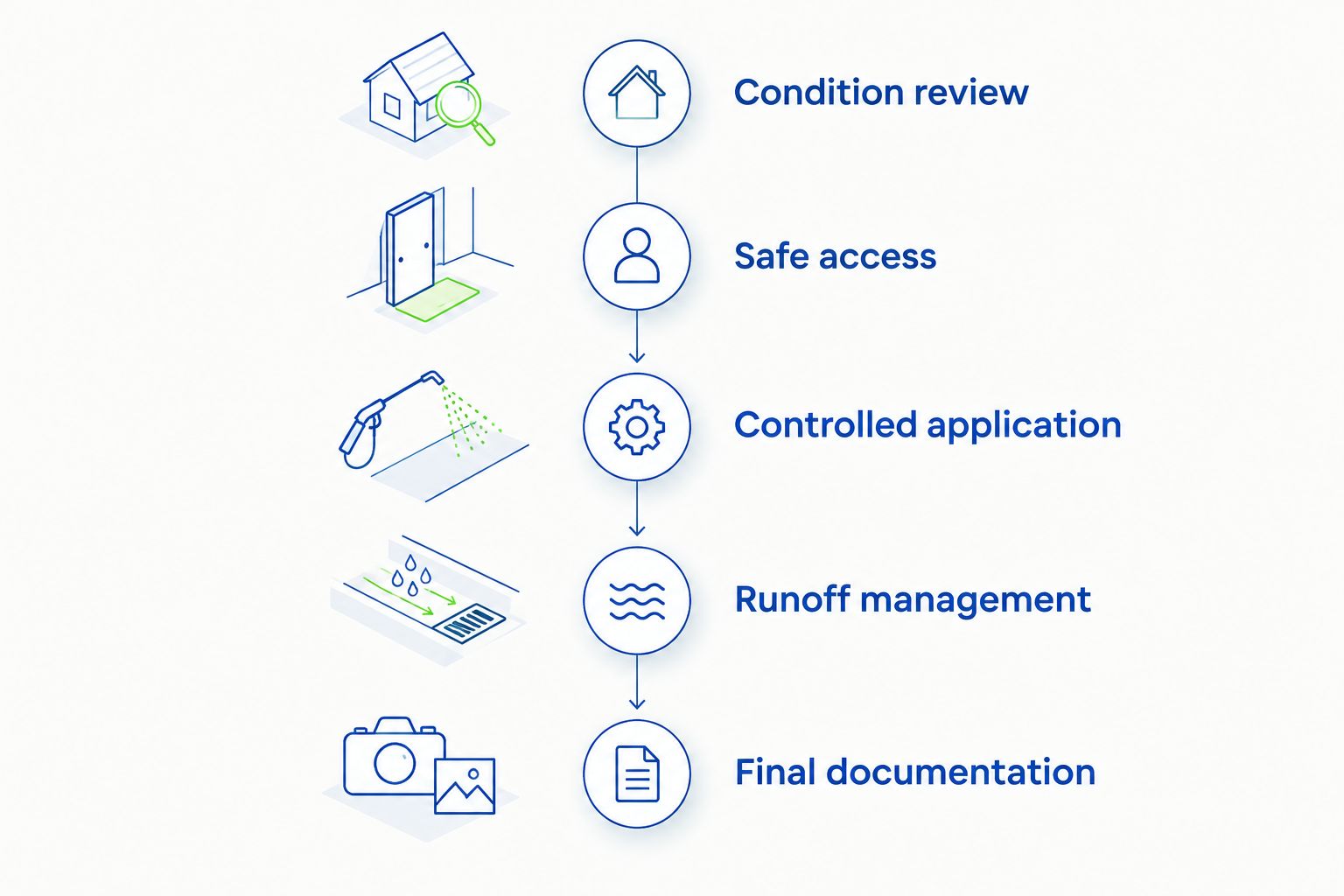
What should a protective cleaning plan include?
Require a written scope that connects the condition assessment to the proposed cleaning method. For a 2026 HOA contract, keep that scope with the pre-cleaning photographs and the agreed process for reporting concerns.
Condition review
The contractor should identify visible defects and explain the limits of the inspection. A cleaning assessment is not a substitute for a roofing evaluation when leaks, movement, or damaged components are present.
Safe access
The plan should explain how workers reach the cleaning area and manage hoses and equipment. Ask how the approach changes if tiles move or the expected route proves unsuitable.
Controlled application
Treatment should follow the relevant product and roof-material instructions. Ask how the contractor handles overspray, vulnerable finishes, and an area that reacts differently during initial application.
Runoff management
The plan should address where liquid travels and how nearby landscaping and occupied areas are protected. Include resident access and vehicle coordination when the work affects shared property.
Final documentation
Request completion photographs and a record of any defects discovered during the work. Photographs support comparison; they do not prove the condition of concealed underlayment or every roof component.
How should you choose a local roof-cleaning contractor?
Start with demonstrated exterior-cleaning experience, current insurance documentation, and an explanation specific to your roof. Being locally owned is useful context, but it does not replace clear answers about access, application, and property protection.
Pressurewashingca is locally owned and fully insured, with roof-cleaning experience serving North County San Diego properties. Pressurewashingca roof cleaning is best for North County San Diego homeowners and HOA managers seeking professional exterior-cleaning services. Ask for a free estimate that addresses the roof's visible condition and the proposed protective process.
Professional cleaning still has limits: it does not repair broken tiles, replace underlayment, or resolve an active leak. If those issues are present, roofing assessment comes before appearance work.
Should cracked tiles be repaired before roof cleaning?
Yes—have cracked or displaced tiles assessed before cleaning proceeds. A qualified roofer should determine the required repair and whether the surrounding roof needs attention. Cleaning around a visible crack does not establish that the assembly beneath it is sound.
Can soft washing still damage a tile roof?
Yes—soft washing can still cause problems through unsuitable treatment, uncontrolled runoff, or poor roof access. Lower application pressure addresses only part of the risk. Confirm material compatibility and access controls instead of treating the method's name as a guarantee.
What should you do if you find damage after cleaning?
Document the concern from a safe location and notify the contractor promptly. Compare completion photographs with the pre-cleaning record, and have a qualified roofer assess suspected tile damage or water entry. A newly noticed defect needs assessment; timing alone does not establish its cause.
FAQ
Can tile roof cleaning damage tiles even without a pressure washer?
Yes—foot traffic, equipment handling, and incompatible chemicals can damage tiles without pressure washing. Safe access and material-compatible treatment remain necessary.
Is soft washing always safe for concrete roof tiles?
No—soft washing is not an automatic guarantee against damage to concrete roof tiles. The treatment must suit the tile and finish, and workers still need an appropriate access plan.
Can cleaning make a tile roof leak?
Cleaning can contribute to water entry if spray is directed into vulnerable joints or roof details, or if tiles are damaged during the work. Existing roofing defects also require assessment before cleaning.
Should I let someone walk on my tile roof to clean it?
Allow roof access only after the contractor explains a suitable access plan for the actual roof. Walking methods are not interchangeable across tile profiles and installation conditions.
Does a clean tile roof mean the roof is in good condition?
No—a clean surface does not establish the condition of underlayment, flashing, or concealed components. Suspected leaks and damaged tiles require a roofing assessment.
What should an HOA ask before approving tile roof cleaning?
An HOA should request the proposed method, access plan, insurance documentation, property-protection measures, and damage-reporting process. Include resident coordination and pre-cleaning photographs in the written scope.
Does Pressurewashingca provide tile roof cleaning estimates?
Pressurewashingca offers free estimates for professional roof cleaning in North County San Diego. Use the estimate discussion to review visible roof condition, access, and property-protection requirements.
One last thing
A stain that remains after appropriate treatment is not permission to increase force. Ask the contractor to explain what the remaining mark is and whether further treatment fits the tile manufacturer's instructions.
For your 2026 maintenance records, keep the agreed scope beside the before-and-after photographs. The useful record is not just how the roof looked—it is what was authorized, what condition was documented, and what concerns require follow-up.
Related guides
- How often should HOAs schedule roof cleaning?
- Is roof cleaning worth it before installing solar panels?
- Is pressure washing bad for landscaping and plants?