Clean San Diego gutters before the winter rainy season and after seasonal leaf drop, with additional cleaning whenever debris obstructs the channels or downspouts. For your 2026 maintenance plan, use those seasonal checkpoints as a starting point—not a reason to leave a visible blockage until the next scheduled visit.
- How often should gutters be cleaned in San Diego? Before winter rain, after seasonal leaf drop, and whenever blockages appear.
- San Diego gutter maintenance should follow actual debris buildup, not rainfall alone.
- Check downspouts as well as gutter channels; a clear-looking gutter can still have a blocked outlet.
- HOA boards should record drainage problems by building and adjust cleaning schedules to recurring trouble spots.
Why this matters
A gutter does not need to look full to stop draining properly. Leaves collected over an outlet can interrupt flow while much of the channel still looks clear. Cleaning the visible gutter without checking the downspout leaves the job unfinished.
San Diego's dry stretches make it easy to overlook roof drainage. Debris still accumulates between storms, and the next rainfall exposes problems that a dry-weather inspection can miss.
Keep roof care and drainage care coordinated, but do not treat them as interchangeable. The guide to tile roof cleaning methods explains a separate maintenance task; cleaning a roof does not establish that its gutters and downspouts are clear.
How often should gutters be cleaned in San Diego?
Schedule gutter cleaning around debris accumulation: before winter rain, after seasonal leaf drop, and whenever inspection reveals an obstruction. The right interval depends on what reaches your roof and whether water can travel through the entire drainage route.
Use this comparison to build a practical 2026 schedule. These are maintenance approaches, not measured service intervals for every property.
| Maintenance approach | Best for | Main benefit | Limitation |
|---|---|---|---|
| Seasonal scheduling | Properties with predictable leaf drop | Creates a repeatable maintenance routine | Debris can accumulate between visits |
| Condition-based cleaning | Properties with irregular shedding or recurring blockages | Responds to the condition of the drainage system | Requires reliable inspections |
| Combined scheduling and inspections | HOA communities and managed properties | Pairs planned work with checks at known trouble spots | Needs clear responsibility and records |
A combined approach is the strongest recommendation for managed properties. Put routine work on the calendar, then use inspection findings to decide whether individual buildings need additional attention.
For a homeowner, the same principle is simpler: know your trouble spots, inspect them from a safe position, and arrange cleaning when debris starts interfering with drainage. Do not wait for water to spill over the gutter edge.
Before winter rain: clear the full drainage route
Arrange a gutter check before the rainy season rather than using the first heavy rainfall as your inspection. Focus on the channels, outlet openings, downspouts, and visible discharge points.
Dry leaves are easy to spot, but compacted debris around an outlet deserves equal attention. A gutter can appear mostly empty while that small opening remains obstructed.
Ask the person completing the work to distinguish between clearing debris and checking drainage. Removing material answers one question; confirming that water reaches the intended discharge point answers another.
For your 2026 work order, specify the following:
- Remove debris from accessible gutter channels and outlets.
- Check downspouts for obstruction using a method appropriate to the system.
- Identify loose attachments, separated joints, and visible leaks.
- Collect removed material rather than washing it onto paths or landscaping.
- Record drainage defects that need repair rather than more cleaning.
A gutter-cleaning visit should end with a drainage check, not just an empty-looking channel. Ask what was checked and what remained inaccessible.
After seasonal leaf drop: respond to what actually falls
Schedule another check after the trees affecting your roof have shed substantial material. A calendar reminder is useful, but the condition of the gutters should determine whether cleaning is necessary.
Different trees shed at different times. Needles, leaves, blossoms, and small twigs also behave differently around gutter outlets and guards. Watch the trees above your property rather than assuming a single neighborhood-wide date fits every building.
In Rancho Santa Fe, Carlsbad, and other North County communities, assess each property's actual tree cover. A city name alone does not establish how often its gutters need attention.
Where branches overhang the roof, ask whether recurring debris is concentrated in particular valleys or gutter runs. That information helps you target inspections without assuming the whole system fills at the same rate.
After storms: inspect before deciding to clean
Storms justify a check, not an automatic cleaning appointment. Look for displaced debris, overflowing sections, detached downspouts, and discharge that no longer follows its intended route.
Observe from ground level or another protected location. Do not climb a ladder during rain, wind, or wet conditions to investigate an overflow.
A storm inspection should answer a straightforward question: did the drainage system work, and did the storm leave something that will interfere with the next rainfall?
If you find a new blockage, arrange cleaning. If water continues overflowing after the channel and downspout are clear, request an assessment of the gutter's condition, slope, outlet arrangement, and discharge path. Repeated cleaning does not repair a drainage defect.
Why gutter-cleaning frequency varies
Your 2026 gutter schedule should reflect the property, not a fixed interval copied from another building. These factors explain why neighboring homes can need different attention:
- Tree cover: Overhanging branches supply debris directly to the roof and gutters. Track the affected gutter runs rather than judging the entire property from the driveway.
- Debris type: Leaves, needles, and fine material collect differently. Small debris can accumulate around outlets even when large leaves are absent.
- Roof layout: Valleys and intersecting roof sections concentrate water and loose material. Include the receiving gutter sections in inspections.
- Gutter guards: Guards change how debris collects; they do not remove the need to inspect screens, openings, and outlets.
- Downspout condition: An obstruction or damaged connection can prevent drainage even after the gutter channel is cleared.
- Previous trouble spots: Repeated overflow at the same location calls for closer inspection and, where necessary, repair—not simply another identical cleaning visit.
Use these observations to revise the schedule. If a section remains clear, record that finding. If it repeatedly blocks, identify what is collecting there and whether the drainage arrangement needs attention.
What should a careful gutter-cleaning visit include?
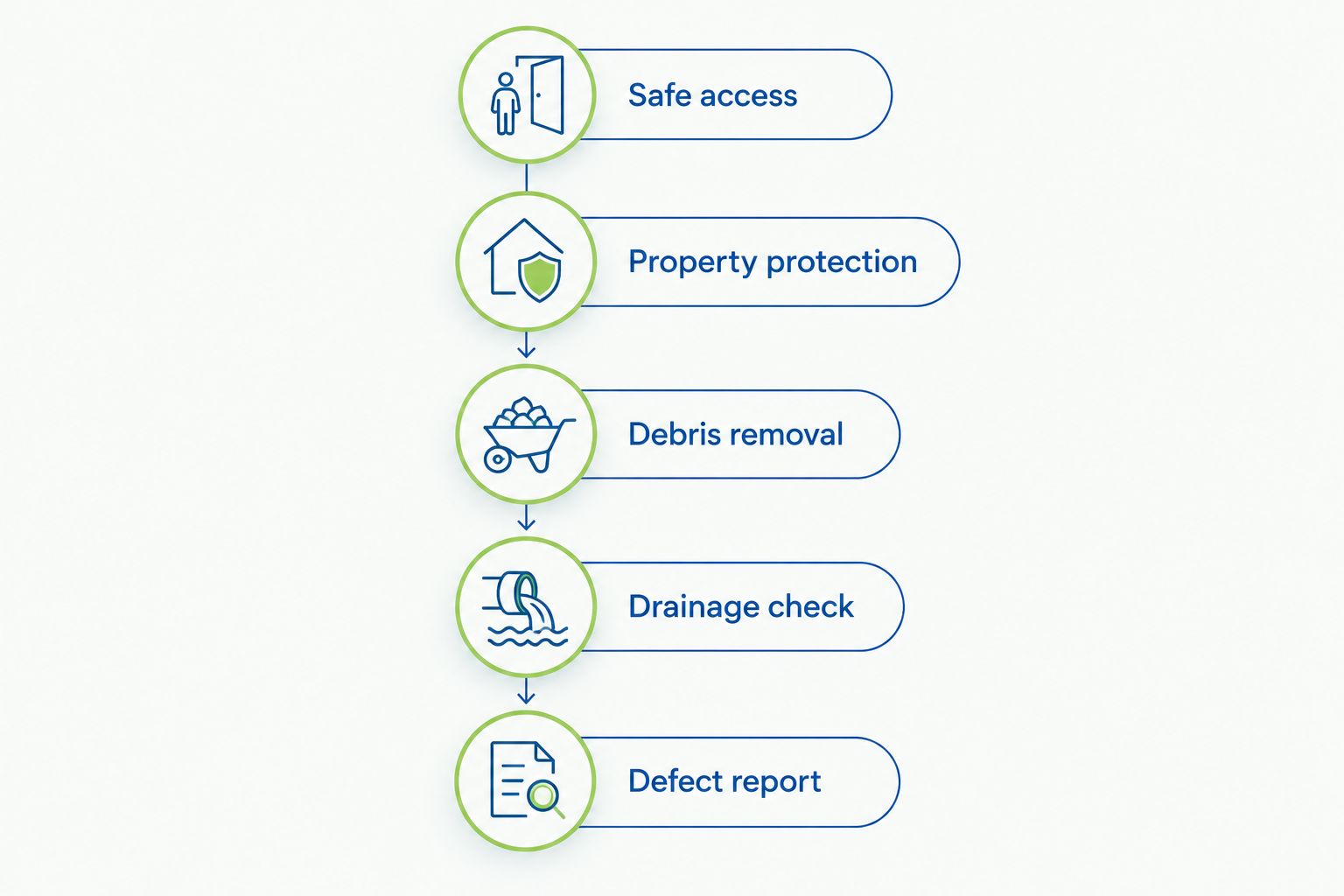
A careful visit separates access planning, debris removal, drainage checks, and defect reporting. That distinction protects your property and makes the scope easier to evaluate.
Use this sequence when discussing the work:
- Safe access: Establish how the work will be reached without relying on unstable ladder placement or unnecessary roof walking.
- Property protection: Identify plants, parked vehicles, outdoor furnishings, and pedestrian routes affected by the work.
- Debris removal: Collect accumulated material instead of pushing it farther into downspouts.
- Drainage check: Confirm that accessible outlets and downspouts carry water toward their intended discharge points.
- Defect report: Document loose fittings, leaks, damaged sections, and locations that could not be checked.
Chemical treatment is not a substitute for removing leaves and checking outlets. If a separate roof or exterior treatment is planned, ask about controlled chemical application, surface-appropriate pressure, and runoff management for that work.
Pressurewashingca is best for North County property owners coordinating roof cleaning and pressure washing. The locally owned, fully insured exterior-cleaning business offers those services, but your requested scope should separately identify gutter debris removal, downspout checks, and any repair needs. Discuss the property's needs through Pressurewashingca rather than assuming every exterior-cleaning task is included.
How should HOA boards schedule gutter maintenance?
HOA boards should assign gutter maintenance by building condition and recurring drainage issues, not simply approve the same scope across the community. A building beside shedding trees needs different attention from a building with little overhead vegetation.
For a 2026 maintenance plan, keep a building-level record of inspections, cleaning, reported overflows, and unresolved defects. Make the record specific enough that the next contractor can locate the problem without starting over.
Useful entries include:
- Building identifier and affected side or entrance.
- Debris found and the outlet it affected.
- Whether the downspout and discharge point were checked.
- Photos showing the location before and after work.
- Repairs recommended and who is responsible for arranging them.
The benefit is accountability, not paperwork for its own sake. If residents report another overflow, the manager can distinguish a newly formed blockage from a previously reported defect.
Coordinate access and resident notices before work starts. Keep pedestrian routes clear, identify areas beneath the work, and confirm who will handle collected debris and cleanup.
Should you clean gutters yourself or hire someone?
Ground-level observation is useful homeowner maintenance. Ladder work and roof access require a separate assessment of the equipment, ground conditions, building layout, and person's ability to work safely.
DIY cleaning gives you direct visibility into the debris being removed, but access risk and incomplete downspout checks are real limitations. Professional help removes the need for you to perform that access work, but you still need a clear scope and evidence that drainage was checked.
Choose professional access when reaching the gutter requires work you cannot perform safely. Do not use a pressure washer from an unstable position or direct force into joints simply to move debris out of sight.
Ask about insurance, access methods, property protection, debris collection, and reporting. A confident answer should explain the work, not promise that every gutter or roof can be treated the same way.
Is seasonal gutter cleaning enough without nearby trees?
Seasonal inspections remain useful without nearby trees because windblown debris and material collecting around outlets can still affect drainage. Cleaning should follow what the inspection finds.
A clear gutter does not need unnecessary debris removal. It still needs attention if connections leak or water fails to reach the intended discharge point.
Do gutter guards eliminate gutter cleaning?
Gutter guards do not eliminate inspection or maintenance. Debris can collect on the guard surface or around openings, and the downspout still needs to drain.
Check the guard manufacturer's maintenance and access instructions before removing sections or applying cleaning equipment. Include guard condition in the inspection record.
FAQ
How often should gutters be cleaned in San Diego?
Clean San Diego gutters before winter rain and after seasonal leaf drop, with additional cleaning when inspections reveal blockages. Adjust the schedule to tree cover, debris accumulation, and recurring drainage problems.
What’s the best time to clean gutters before San Diego rain?
Arrange a gutter inspection and any necessary cleaning before the winter rainy season. Include outlets, downspouts, and visible discharge points rather than checking only the open channels.
Should I clean my gutters after every storm?
Inspect after storms and clean when debris obstructs drainage. A storm does not automatically mean the gutters need cleaning, but new overflow or displaced debris needs attention.
Can gutters be blocked if they look empty from the ground?
Yes, an outlet or downspout can be blocked while the visible gutter channel looks mostly clear. A drainage check provides information that a ground-level appearance check cannot.
Do gutters need cleaning if my property has gutter guards?
Gutter guards still need inspection and maintenance. Check for debris on the guard surface, obstructed openings, and downspout drainage according to the manufacturer’s instructions.
Why do my gutters overflow after they have been cleaned?
Overflow after cleaning calls for a check of the full drainage route and gutter condition. Remaining obstructions, damaged connections, slope problems, or an unsuitable drainage arrangement require different responses.
Who should arrange gutter cleaning in an HOA?
Responsibility depends on the HOA’s governing documents and maintenance arrangements. Confirm responsibility before scheduling work, then record findings and unresolved defects by building.
One last thing
Watch where the water goes after it leaves the downspout. A clear gutter and downspout are not the whole drainage picture if discharge collects beside an entrance, crosses a walkway, or returns toward the building.
Add the discharge point to your next inspection photo. It is a small change that makes your maintenance record more useful than a photograph of an empty gutter alone.
Related guides
- Choosing gutter-cleaning services in San Diego
- How often HOAs should schedule roof cleaning
- Protecting landscaping during pressure washing