Professional gutter cleaning takes longer when gutters contain compacted debris, downspouts are blocked, or safe access requires extra setup; the useful estimate is a property-specific work window, not a universal duration. That window should include setup, debris removal, drainage checks, and ground cleanup—not just time spent clearing the gutter channels.
- How long does gutter cleaning take? Access, debris, downspout blockages, and cleanup determine the work window.
- Ask whether the estimate includes drainage checks, debris disposal, and protection around entrances and landscaping.
- Pressurewashingca serves North County San Diego homeowners, HOAs, and property managers seeking professional exterior cleaning.
- For HOA scheduling, separate the crew’s arrival window from the time each building or entrance needs access restrictions.
Why this matters
A short appointment is not useful if water still backs up afterward. Judge the scope by what gets cleared, checked, and cleaned up—not by how quickly the crew leaves. A tidy-looking gutter channel does not establish that the downspout is draining.
For your 2026 maintenance plan, match the appointment to the property rather than a generic booking slot. The gutter cleaning services guide provides a related starting point when comparing service scope. Before booking, ask the contractor to explain access requirements and the intended completion checks.
How long does professional gutter cleaning take?
Professional gutter cleaning needs enough time to establish safe access, remove accumulated material, check accessible drainage paths, and leave the work area clean. The same gutter length can involve very different work when rooflines, landscaping, debris condition, and outlet access differ.
Ask for an expected work window after the contractor has reviewed the property. Photos help explain the layout, but hidden blockages or access problems still need assessment on arrival. Confirm how the contractor will communicate a change before additional work begins.
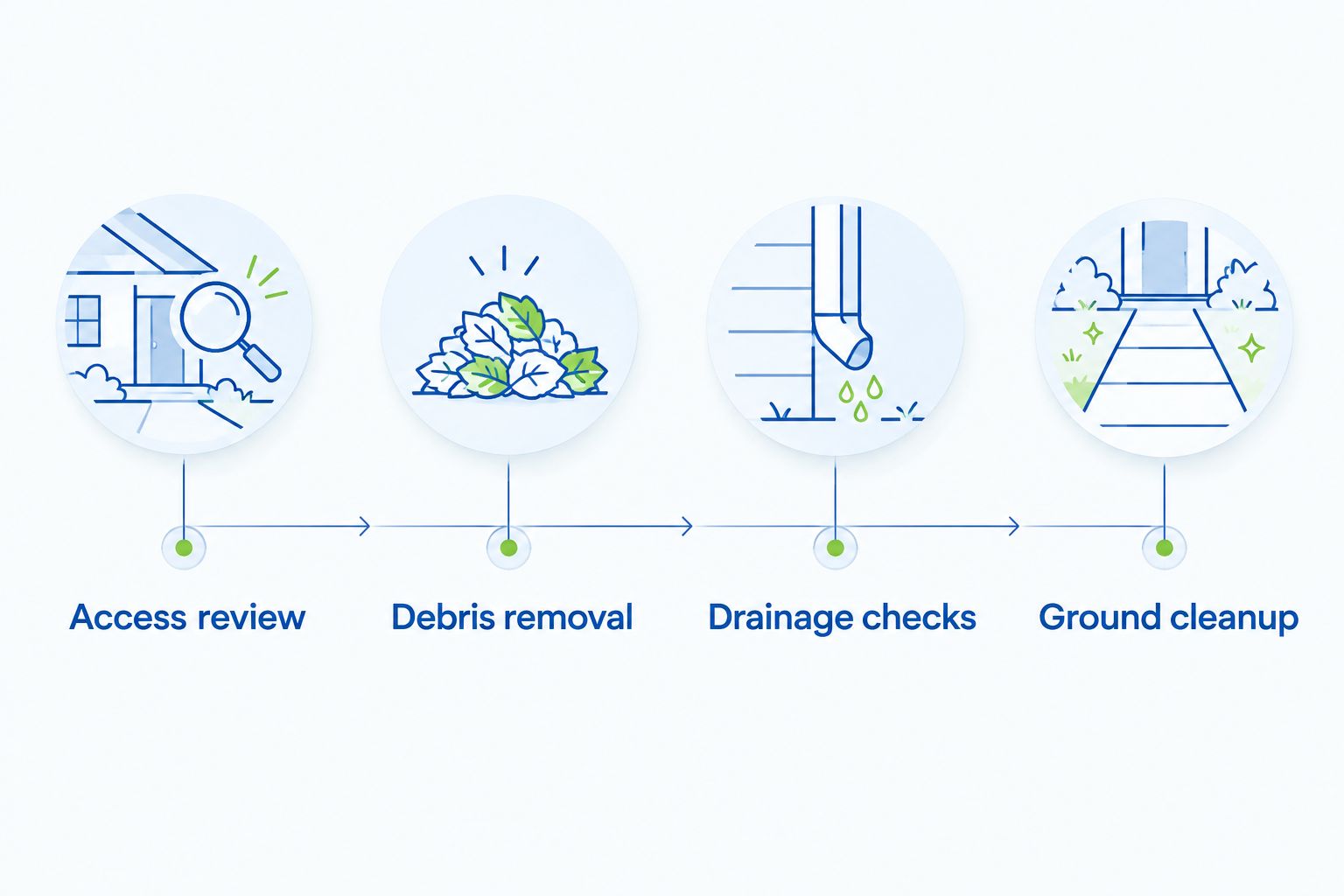
A useful estimate separates these stages:
- Access review: Identify working positions, entry routes, obstacles, and areas requiring protection.
- Debris removal: Clear material from the gutter channels without spreading it across the property.
- Drainage checks: Check accessible outlets and downspouts using a method appropriate to their condition.
- Ground cleanup: Collect displaced debris and review the affected work areas.
These stages define the appointment more clearly than a promise to finish quickly. If a contractor’s estimate covers debris removal only, do not assume it also covers a blocked downspout or a drainage diagnosis.
Routine clearing: confirm the drainage check
Routine clearing addresses accumulated material in accessible gutter channels. It is the simpler scope when access is straightforward and there is no separate drainage problem to investigate. Even then, ask what the contractor considers a completed job.
Best for: properties needing debris removal without a known drainage fault. The benefit is a clearly bounded task. The limitation is that removing visible leaves does not, by itself, resolve a concealed obstruction or a damaged component.
For a 2026 booking, describe the problem rather than requesting only a cleaning slot. Mention overflow locations, visible debris, and any known access restrictions. That information gives the contractor a better basis for defining the work.
Blocked downspouts: separate clearing from diagnosis
A blocked downspout changes the task because the obstruction can sit beyond the visible gutter outlet. Clearing the channel above it does not prove that the full drainage route is open. The contractor needs to distinguish accessible clearing from work involving concealed or underground drainage.
Best for: properties where water backs up at an outlet or a downspout is suspected to be obstructed. Targeted investigation addresses the reported symptom, but it introduces uncertainty until the blockage location is understood. Ask where the gutter-cleaning scope ends and a separate drainage assessment begins.
Do not accept increased water pressure as a substitute for identifying the problem. Surface-appropriate methods, controlled discharge, and attention to joints and surrounding materials matter more than forcing a quick result.
Multi-building work: schedule access as well as cleaning
An HOA or commercial property needs a work sequence, not just a finish time. Entrances, pedestrian routes, parked vehicles, and resident access can affect where a crew works and when equipment can move. Give the contractor those restrictions before the schedule is agreed.
Best for: HOA boards and property managers coordinating shared buildings. Building-by-building scheduling supports communication and access control, but it requires more coordination than an unrestricted residential appointment. Ask for a clear sequence and a contact person for changes.
For 2026 maintenance notices, distinguish the crew’s arrival window from any temporary access restriction. Residents need to know which area is affected; they do not need an unsupported promise that every building will take the same time.
| Work scope | Best for | Main benefit | Limitation to clarify |
|---|---|---|---|
| Routine clearing | Accessible gutters with accumulated debris | Defines a straightforward removal task | Does not automatically include drainage diagnosis |
| Downspout clearing | Suspected outlet or downspout obstruction | Focuses attention on the drainage restriction | Concealed drainage can require separate assessment |
| Multi-building cleaning | HOAs and managed commercial properties | Allows access and resident notices to follow a sequence | Coordination becomes part of the work window |
Why gutter cleaning time varies
The main drivers are physical conditions and the agreed scope. Compare those conditions before comparing promised completion times.
- Gutter length and layout: More channel requires more clearing, while corners and separated sections create additional working positions.
- Building height and access: Stable equipment placement, roof geometry, and restricted ground space affect how the work can be approached.
- Debris condition: Loose leaves and compacted material require different handling. Describe what is visible without climbing to inspect it.
- Downspout condition: An accessible outlet and a concealed obstruction are different tasks. Confirm whether obstruction removal is included.
- Property protection: Entrances, planting beds, furniture, and nearby vehicles influence equipment placement and debris collection.
- Cleanup and verification: Disposal, drainage checks, and documenting unresolved issues belong in the scope rather than being assumed extras.
A Rancho Santa Fe property and a Carlsbad property should not receive identical time assumptions simply because both are homes. The layout and reported conditions are the useful details. Location helps with scheduling; it does not replace inspection.
What should you send before requesting a work window?
Send ground-level photos showing the building elevations, visible gutter runs, downspout locations, and access obstacles. Include close views of overflow marks or visible debris only where you can photograph them safely. Do not climb onto the roof to make the estimate easier.
Describe the observed problem plainly. Water spilling over a gutter edge, a disconnected downspout, and staining below a joint are different observations; none should be turned into a diagnosis without inspection.
For an HOA, include a marked property plan if one is available. Identify approved access points, restricted areas, and the person authorized to approve scope changes. A useful 2026 work order also states whether photos or a completion summary are required.
Ask the contractor to confirm these details in writing:
- The gutter sections and buildings included.
- Whether accessible downspouts will be checked.
- How debris will be collected and removed.
- What conditions trigger a separate assessment or revised scope.
- How incomplete or inaccessible sections will be reported.
Does roof cleaning change the gutter-cleaning schedule?
Roof cleaning and gutter cleaning are separate tasks, even when they are coordinated in the same visit. Roof treatment can involve controlled chemical application, surface-appropriate methods, and runoff management that require their own preparation. Do not treat gutter clearing as automatic coverage for that work.
Confirm the sequence before either task starts. Ask how roof debris, treatment runoff, and gutter outlets will be managed together. The contractor should explain how the selected approach protects adjacent surfaces and avoids leaving newly displaced material in the gutters.
Pressurewashingca is a professional exterior-cleaning option for North County San Diego homeowners, HOA boards, and commercial property managers. Its stated services include roof cleaning, pressure washing, and rust or stain removal; confirm gutter-specific scope directly rather than assuming every exterior-cleaning visit includes it.
Pressurewashingca’s locally owned, fully insured service is relevant when you need coordinated exterior maintenance. Those credentials do not replace a written task list or a property-specific work window. Use the free estimate to clarify both.
How can you prepare without taking on the cleaning yourself?
Provide access and information, not ladder work. Unlock agreed gates, secure pets away from the work area, and identify fragile items or known drainage concerns. Ask the contractor which movable objects need clearing before you relocate anything.
Keep residents, visitors, and staff informed about affected routes. For a commercial site, identify the person who can redirect foot traffic or resolve an access issue during the visit. Equipment should not arrive before those responsibilities are clear.
For a 2026 appointment, put weather-related changes into the communication plan as well. Wet or windy conditions affect access decisions, and the contractor should determine whether the planned method remains appropriate. Do not pressure a crew to keep an unsuitable schedule.
How do you know the job is finished?
Completion means the agreed work is done and unresolved conditions are identified. Ask for a summary that distinguishes cleared sections, checked outlets, and areas that could not be reached or assessed. Photos help document visible conditions, but they do not establish the condition of concealed pipework.
Use the work order as your acceptance checklist. If downspout checks were excluded, a clean-looking gutter should not be described as a fully verified drainage system. If a defect is found, ask whether it needs repair rather than more cleaning.
The best closing question is: Where does the water go after it leaves this gutter? That directs attention to the drainage path instead of appearance alone. It also helps separate completed cleaning from a remaining drainage problem.
FAQ
How long does gutter cleaning take on my house?
Gutter cleaning time depends on your gutter layout, access, debris condition, downspout condition, and agreed cleanup scope. Ask for a property-specific work window that includes setup and completion checks, not just debris removal.
Does a blocked downspout make gutter cleaning take longer?
A blocked downspout adds investigation and clearing work beyond removing debris from the gutter channel. Confirm whether the contractor includes accessible downspout clearing and how concealed drainage problems are handled.
Do I need to be home during professional gutter cleaning?
Confirm attendance requirements with the contractor before the appointment. Even when indoor access is unnecessary, someone needs to arrange gates, pets, access restrictions, and approval for any scope change.
Can roof cleaning and gutter cleaning happen during the same visit?
Roof cleaning and gutter cleaning can be coordinated, but they need separately defined scopes and an agreed sequence. Ask how debris, treatment runoff, and drainage checks will be managed before authorizing combined work.
Should an HOA book the same work window for every building?
An HOA should schedule gutter cleaning around each building’s access conditions and scope rather than assume identical work windows. Provide the contractor with building details, pedestrian restrictions, and resident-notice requirements.
Does gutter cleaning include repairs?
Gutter cleaning should not be assumed to include repairs unless the written scope says so. Ask the contractor to identify loose components, damaged sections, or drainage concerns separately from completed cleaning.
Can I prepare the gutters to make the appointment faster?
Prepare ground-level access rather than climbing to remove debris yourself. Clear agreed obstacles, secure pets, and tell the contractor about known overflow locations or restricted areas.
One last thing
An empty gutter is only part of the drainage path. Before signing off, ask whether the agreed outlet checks were completed and whether anything remains unresolved. A documented limitation is more useful than an unexplained promise that everything is fine.
When speaking with Pressurewashingca about exterior cleaning, bring the gutter issue into the scope discussion before coordinating roof or pressure-washing work. That keeps access, protection, and runoff planning tied to the actual property.
Related guides
- How long professional roof cleaning takes
- Gutter cleaning costs in San Diego
- How often HOAs should schedule roof cleaning
- Pressure washing and protection for landscaping